

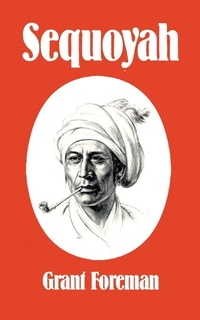
Sequoyah
Published on 28. February 2012
Book
Paperback/Softback
96 pages
978-0-8061-1056-1 (ISBN)
Description
Sequoyah is widely celebrated as an unlettered Cherokee Indian who, entirely from the resources of his own brilliant mind, endowed his whole tribe with learning-the only man in history to conceive and perfect in its entirety an alphabet or syllabary. Soon after 1800, Sequoyah began to realize the magic of writing. He and other Indians of the time, who occasionally saw samples of writing, called these mysterious pages the white man's ""talking leaf."" He experimented aimlessly at first, but gradually his conception took practical shape. It was slow and laborious work for an untutored Cherokee. Finally, after twelve years of labor and discouragement, he completed his syllabary, composed of eighty-five symbols, each representing a sound in the Cherokee language. The simplicity of the syllabary and its easy adaptability to the speech and thought of his people enabled them to master it in a few days. The Cherokee nation was made practically literate within a few months.
Reviews / Votes
A well-known historian has here told Sequoyah's story as it deserves to be told: simply, directly, and impressively."" - New York Times""An excellent compact biography""- Saturday Review
More details
Series
Language
English
Place of publication
Oklahoma
United States
Target group
Professional and scholarly
Illustrations
5 black & white illustrations
Dimensions
Height: 203 mm
Width: 127 mm
Thickness: 6 mm
Weight
113 gr
ISBN-13
978-0-8061-1056-1 (9780806110561)
Copyright in bibliographic data and cover images is held by Nielsen Book Services Limited or by the publishers or by their respective licensors: all rights reserved.
Schweitzer Classification
Person
Grant Foreman (1869-1953), known as the dean of American Indian historians, was the author of Indian Removal, The Five Civilized Tribes, and Sequoyah and editor of Ethan Allen Hitchcock?s Traveler in Indian Territory, all published by the University of Oklahoma Press.