

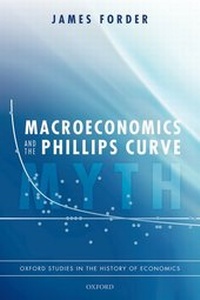
Macroeconomics and the Phillips Curve Myth
Published on 22. February 2018
Book
Paperback/Softback
320 pages
978-0-19-881987-5 (ISBN)
Description
This book reconsiders the role of the Phillips curve in macroeconomic analysis in the first twenty years following the famous work by A. W. H. Phillips, after whom it is named. It argues that the story conventionally told is entirely misleading. In that story, Phillips made a great breakthrough but his work led to a view that inflationary policy could be used systematically to maintain low unemployment, and that it was only after the work of Milton Friedman and Edmund Phelps about a decade after Phillips' that this view was rejected. On the contrary, a detailed analysis of the literature of the times shows that the idea of a negative relation between wage change and unemployment - supposedly Phillips' discovery - was commonplace in the 1950s, as were the arguments attributed to Friedman and Phelps by the conventional story. And, perhaps most importantly, there is scarcely any sign of the idea of the inflation-unemployment tradeoff promoting inflationary policy, either in the theoretical literature or in actual policymaking. The book demonstrates and identifies a number of main strands of the actual thinking of the 1950s, 1960s, and 1970s on the question of the determination of inflation and its relation to other variables.
The result is not only a rejection of the Phillips curve story as it has been told, and a reassessment of the understanding of the economists of those years of macroeconomics, but also the construction of an alternative, and historically more authentic account, of the economic theory of those times. A notable outcome is that the economic theory of the time was not nearly so naive as it has been portrayed.
The result is not only a rejection of the Phillips curve story as it has been told, and a reassessment of the understanding of the economists of those years of macroeconomics, but also the construction of an alternative, and historically more authentic account, of the economic theory of those times. A notable outcome is that the economic theory of the time was not nearly so naive as it has been portrayed.
Reviews / Votes
This highly original book overturns decades of wrong thinking about the history of one of the central concepts in modern macroeconomics and provides an excellent starting point for rethinking the history of macroeconomics since the Second World War. * Professor Roger Backhouse, FBA, University of Birmingham and Erasmus University Rotterdam * Over the last few years, James Forder has made a name for himself among historians of economics by writing a string of papers re-examining the Phillips curve literature...a brilliant and beautifully written essay, and a stimulating read. Its authors cleverness shines through on every page. Its scholarship is impeccable. * Professor Michel de Vroey, Universite catholique de Louvain * ...the book is also a call to arms. A bogus story about Keynesian fools and Friedmanite heroes has long lent rhetorical support to the counter-revolution in macroeconomics. * Dr Michael Beggs, The University of Sydney * After Forder's book no fair-minded observer will be able again to assert that the common story of the Phillips curve is what really happened. It is rare that a historical question is so decisively settled. * Professor Kevin Hoover, Duke University * James Forder successfully convinces the reader of many points, which indeed should force the current state of the inflation-unemployment literature to treat the formation of the story more carefully ... Forder does an excellent job of highlighting Phillips' key contributions. * Sandeep Mazumder, EH.Net *More details
Series
Language
English
Place of publication
Oxford
United Kingdom
Target group
College/higher education
Dimensions
Height: 234 mm
Width: 157 mm
Thickness: 18 mm
Weight
488 gr
ISBN-13
978-0-19-881987-5 (9780198819875)
Copyright in bibliographic data and cover images is held by Nielsen Book Services Limited or by the publishers or by their respective licensors: all rights reserved.
Schweitzer Classification
Other editions
Additional editions
James Forder
Macroeconomics and the Phillips Curve Myth
Book
10/2014
Oxford University Press
€165.50
Shipment within 15-20 days
Person
James Forder has been a senior teaching member of Oxford University since 1993 and is Andrew Graham Fellow and Tutor in Political Economy at Balliol College Oxford, where he is also Vice Master (Executive). He has taught at La Sorbonne and for Stanford University, and is Managing Editor of Oxford Economic Papers. He has previously researched on European integration and the economics of central bank independence. He was Senior Tutor of the Oxford University Business Economic Programme, and a member of the Council of Business for Sterling, in the days of the debate over British membership of the euro.
Content
Introduction
1: The Curve of Phillips
2: The Role of Samuelson and Solow, American Economic Review 1960
3: The Phillips Curve Literature before Friedman's Presidential Address
4: The Post-1968 Literature
5: Attitudes to Inflation
6: Policymaking and Histories of Policymaking
7: Explaining the Emergence of the Myth
8: Conclusions
Notes
References
Index
1: The Curve of Phillips
2: The Role of Samuelson and Solow, American Economic Review 1960
3: The Phillips Curve Literature before Friedman's Presidential Address
4: The Post-1968 Literature
5: Attitudes to Inflation
6: Policymaking and Histories of Policymaking
7: Explaining the Emergence of the Myth
8: Conclusions
Notes
References
Index