

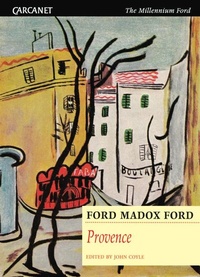
Provence
Published on 28. June 2009
Book
Paperback/Softback
380 pages
978-1-85754-989-8 (ISBN)
Description
Try then to figure for yourself blood-red cliffs in to which a blue, shining mirror should have introduced itself for miles - the multicoloured boats grouped at the landing, the incredible blue of the sky, the incredible whiteness of the light - And a salad in a dish as large as a cart-wheel. And sweet cream cheese, with a sauce made of marc and other sweet herbs. And a pile, large enough to bury a man in, of apples, peaches, figs, grapes - Ford Madox Ford spent his last years in the south of France, near Toulon. In "Provence" (1935), written four years before his death, he explores both the place and the idea of it: 'not a country nor the home of a race, but a frame of mind'. Suffused with a northern European's love for 'the Roman province that lies beneath the sun', "Provence" evokes scents of rosemary and thyme in the dry air, games of boules amid shadows of ancient ruins, the food and flinty local wines. Part memoir, part travel narrative, part history of the region, "Provence" displays Ford's wise, beguiling curiosity.
Humorous, informed digressions take in the Albigensian heresy, bull-fighting, a favourite recipe for bouillabaisse, Henry James and Ellen Terry, the Troubadours and much else. Over the gaiety looms the coming barbarism, the 'fixed bayonets, machine guns, uniforms and arresting fists', against which Ford's "Provence" is a fragile, precious hope for civilised values. This edition is based on the authoritative 1935 Lippincott edition and includes the original illustrations by Ford's companion, the outstanding American artist Biala.
Humorous, informed digressions take in the Albigensian heresy, bull-fighting, a favourite recipe for bouillabaisse, Henry James and Ellen Terry, the Troubadours and much else. Over the gaiety looms the coming barbarism, the 'fixed bayonets, machine guns, uniforms and arresting fists', against which Ford's "Provence" is a fragile, precious hope for civilised values. This edition is based on the authoritative 1935 Lippincott edition and includes the original illustrations by Ford's companion, the outstanding American artist Biala.
Reviews / Votes
"'...we grow our own vegetables, we have six (not very magnificent) rooms, and a garden with the finest view in the world (we are on a hill overlooking the Mediterranean) and a private path down to the sea; for exactly $10 a month...So you see, for a poor painter, this is the place to be.' -Ford's lover Biala on the couple's life in Provence '[Ford] was the only Englishman who stood alongside the great "moderns" - Joyce, Eliot and Pound.' - Peter Ackroyd"More details
Language
English
Place of publication
Manchester
United Kingdom
Publishing group
Carcanet Press Ltd
Product notice
Paperback (trade)
Unsewn / adhesive bound
Dimensions
Height: 216 mm
Width: 136 mm
Thickness: 29 mm
Weight
482 gr
ISBN-13
978-1-85754-989-8 (9781857549898)
Copyright in bibliographic data and cover images is held by Nielsen Book Services Limited or by the publishers or by their respective licensors: all rights reserved.
Schweitzer Classification
Other editions
Additional editions
E-Book
10/2012
Lives and Letters
€14.35
Available for download
Person
FORD MADOX FORD was a great editor, essayist, critic, advocate, and above all a great novelist. The Good Soldier and the Tietjens trilogy (which make up Parade's End) are acknowledged masterpieces. Born in Surrey in 1873, his father was an author and musicologist and his mother was the daughter of the Pre-Raphaelite painter Ford Madox Brown. The Good Soldier was published in 1915, the same year he took a commission in the army. His experience furnished him with material for Parade's End. He continued to publish novels regularly, as well as other works, notably an extended Collected Poems in 1936. He died in Deauville, France in 1939. John Coyle is an expert in 20th century fiction and has written on Joyce, Proust, Ford and Nabokov. He teaches at Glasgow University.