

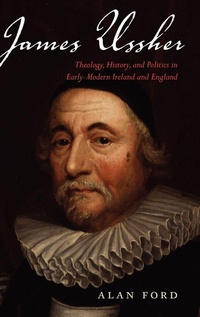
James Ussher
Theology, History, and Politics in Early-Modern Ireland and England
Published on 21. June 2007
Book
Hardback
336 pages
978-0-19-927444-4 (ISBN)
Description
Though known today largely for dating the creation of the world to 4004BC, James Ussher (1581-1656) was an important scholar and ecclesiastical leader in the seventeenth century. As Professor of Theology at Trinity College Dublin, and Archbishop of Armagh from 1625, he shaped the newly protestant Church of Ireland. Tracing its roots back to St Patrick, he gave it a sense of Irish identity and provided a theology which was strongly Calvinist and fiercely anti-Catholic. In exile in England in the 1640s he advised both king and parliament, trying to heal the ever-widening rift by devising a compromise over church government. Forced finally to choose sides by the outbreak of civil war in 1642, Ussher opted for the royalists, but found it difficult to combine his loyalty to Charles with his detestation of Catholicism.
A meticulous scholar and an extensive researcher, Ussher had a breathtaking command of languages and disciplines - 'learned to a miracle' according to one of his friends. He worked on a series of problems: the early history of bishops, the origins of Christianity in Ireland and Britain, and the implications of double predestination, making advances which were to prove of lasting significance. Tracing the interconnections between this scholarship and his wider ecclesiastical and political interests, Alan Ford throws new light on the character and attitudes of a seminal figure in the history of Irish Protestantism.
A meticulous scholar and an extensive researcher, Ussher had a breathtaking command of languages and disciplines - 'learned to a miracle' according to one of his friends. He worked on a series of problems: the early history of bishops, the origins of Christianity in Ireland and Britain, and the implications of double predestination, making advances which were to prove of lasting significance. Tracing the interconnections between this scholarship and his wider ecclesiastical and political interests, Alan Ford throws new light on the character and attitudes of a seminal figure in the history of Irish Protestantism.
Reviews / Votes
a full, coherent, and compelling account of this most fascinatingly ambigious of scholars and churchmen. * Anthony Milton. The Journal of Theological Studies * a valuable contribution to ongoing debates about the role of religion in early modern society. * Nicholas Keene, Ecclesiastic History * [an] excellent study. I can warmly recommend this book to other specialists. * Judith Maltby, Church Times *More details
Language
English
Place of publication
Oxford
United Kingdom
Target group
College/higher education
Professional and scholarly
Dimensions
Height: 240 mm
Width: 161 mm
Thickness: 22 mm
Weight
658 gr
ISBN-13
978-0-19-927444-4 (9780199274444)
Copyright in bibliographic data and cover images is held by Nielsen Book Services Limited or by the publishers or by their respective licensors: all rights reserved.
Schweitzer Classification
Person
Alan Ford is Professor of Theology at the University of Nottingham.
Content
Introduction ; PART I: USSHER IN IRELAND ; 1. Controversy and religious identity in sixteenth-century Ireland ; 2. Intellectual formation: Trinity College, Dublin ; 3. Ussher and the shaping of Irish protestant theology ; 4. Ussher and the Irish articles of 1615 ; 5. Theology and politics: 1615-25 ; 6. Religion, history and protestant national identity ; 7. The defence of Calvinism, 1626-33 ; 8. Internal exile: Ussher and Laudianism 1633-40 ; 9. Ussher and Irish history: Britannicarum ecclesiarum antiquitates ; PART II: USSHER IN ENGLAND ; 10. Ussher and the defence of episcopacy ; 11. 'No man can serve two masters': the Civil War and after ; 12. Conclusion: history, theology and politics in Ireland and Britain