

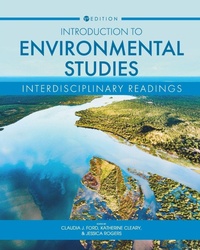
Introduction to Environmental Studies
Interdisciplinary Readings
Published on 30. October 2021
Book
Paperback/Softback
350 pages
978-1-7935-1913-9 (ISBN)
Description
Introduction to Environmental Studies: Interdisciplinary Readings provides students with a carefully selected collection of articles that help them navigate the most important topics in environmental studies, focusing on different connections between humans and the environment. The anthology emphasizes voices outside the white, male canon to provide students with diverse perspectives and a broader understanding of contemporary issues within the discipline.
Opening chapters introduce environmental studies, sustainability, and the connection between humans and the resources we extract from the environment. Subsequent chapters examine the history of environmentalism in North America, how our relationship to the environment has evolved over time, a concise survey of key environmental processes, and issues related to climate change and our climate crisis. Students read about the environmental impact of our food production processes on different countries and groups of people; issues related to environmental justice; the ways in which human population affects the environmental sustainability of our future; and sustainable energy issues. The anthology's final chapters address environmental legislation and policies; ethical issues around consumption and collective responsibility; and the future of our environment.
Featuring compelling and timely readings, Introduction to Environmental Studies is an ideal resource for courses within the discipline.
Opening chapters introduce environmental studies, sustainability, and the connection between humans and the resources we extract from the environment. Subsequent chapters examine the history of environmentalism in North America, how our relationship to the environment has evolved over time, a concise survey of key environmental processes, and issues related to climate change and our climate crisis. Students read about the environmental impact of our food production processes on different countries and groups of people; issues related to environmental justice; the ways in which human population affects the environmental sustainability of our future; and sustainable energy issues. The anthology's final chapters address environmental legislation and policies; ethical issues around consumption and collective responsibility; and the future of our environment.
Featuring compelling and timely readings, Introduction to Environmental Studies is an ideal resource for courses within the discipline.
More details
Language
English
Place of publication
San Diego
United States
Target group
Professional and scholarly
Product notice
Paperback (trade)
Unsewn / adhesive bound
Dimensions
Height: 254 mm
Width: 203 mm
Thickness: 19 mm
Weight
694 gr
ISBN-13
978-1-7935-1913-9 (9781793519139)
Copyright in bibliographic data and cover images is held by Nielsen Book Services Limited or by the publishers or by their respective licensors: all rights reserved.
Schweitzer Classification
Persons
Claudia J. Ford is a professor and chair of the Department of Environmental Studies at State University of New York, Potsdam. She holds a Ph.D. in environmental studies from Antioch University New England.
Katherine Cleary is an assistant professor of environmental studies at State University of New York, Potsdam. She holds a Ph.D. in conservation biology from the University of Idaho.
Jessica Rogers is an associate professor of environmental studies at State University of New York, Potsdam. She holds a Ph.D. in ecology, evolution, and environmental biology from Columbia University.
Katherine Cleary is an assistant professor of environmental studies at State University of New York, Potsdam. She holds a Ph.D. in conservation biology from the University of Idaho.
Jessica Rogers is an associate professor of environmental studies at State University of New York, Potsdam. She holds a Ph.D. in ecology, evolution, and environmental biology from Columbia University.