

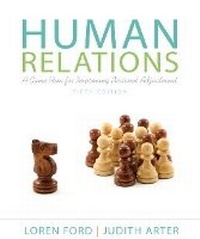
Human Relations
A Game Plan for Improving Personal Adjustment Plus MySearchLab with eText -- Access Card Package
5th Edition
Published on 30. October 2012
Book
Mixed media product
312 pages
978-0-205-86548-2 (ISBN)
Description
A lively and engaging introduction to Human Relations
In this much-anticipated 5th edition, Loren Ford and Judith Arter present the fundamentals of human relations through interesting personal stories, anecdotes, and case studies. This is a book that truly captivates students by engaging them in questions and exercises designed to stimulate active learning and critical thinking.
The 5th edition features new content, a substantial number of updated references, and pedagogical tools like Learning Objectives, Big Ideas, and Review questions.
Learning Goals
Upon completing this book, readers should be able to:
Understand the foundational psychological concepts relevant to Human Relations
Apply the information learned in the course to one's own personal situation
Clarify and express personal beliefs through self examination
Communicate better with others
In this much-anticipated 5th edition, Loren Ford and Judith Arter present the fundamentals of human relations through interesting personal stories, anecdotes, and case studies. This is a book that truly captivates students by engaging them in questions and exercises designed to stimulate active learning and critical thinking.
The 5th edition features new content, a substantial number of updated references, and pedagogical tools like Learning Objectives, Big Ideas, and Review questions.
Learning Goals
Upon completing this book, readers should be able to:
Understand the foundational psychological concepts relevant to Human Relations
Apply the information learned in the course to one's own personal situation
Clarify and express personal beliefs through self examination
Communicate better with others
More details
Edition
5th edition
Language
English
Place of publication
United States
Publishing group
Pearson Education (US)
Target group
Professional and scholarly
Weight
771 gr
ISBN-13
978-0-205-86548-2 (9780205865482)
Copyright in bibliographic data and cover images is held by Nielsen Book Services Limited or by the publishers or by their respective licensors: all rights reserved.
Schweitzer Classification
Other editions
Previous edition
Book
08/2006
4th Edition
Pearson
€63.13
Article exhausted; check for reprint
Persons
Loren Ford earned his master's degree in psychology from California State University, Long Beach in 1974 and did additional graduate work in the 1980s at the Oregon Graduate School for Professional Psychology. He is a Licensed Professional Counselor (LPC) in Oregon with a private practice. In the past 30 years he has worked at several mental health facilities doing therapy with adolescents and families. From 1977 to 2011 he was on the faculty at Clackamas Community College in Oregon City, Oregon, teaching courses on personal development, human relations, college success, life-span human development, human sexuality, introduction to counselling, and history.
Judith Arter has degrees in mathematics (B.S., University of California, San Diego,1971), and special education (Masters and Ph.D., University of Illinois, Champaign-Urbana, 1975 and 1976). After two years working in the research department of Phoenix Unified High School District, she spent 33 years (at Education Northwest and the Assessment Training Institute in Portland, Oregon) researching and training educators at all levels and in several countries on student assessment, focusing especially on using student assessment as an instructional methodology (formative assessment). She is the co-author of numerous publications and books including Classroom Assessment for Student Learning: Doing It Right and Using It Well, 2e (Pearson, in press), and Creating and Recognizing Quality Rubrics (Pearson, 2006).
Judith Arter has degrees in mathematics (B.S., University of California, San Diego,1971), and special education (Masters and Ph.D., University of Illinois, Champaign-Urbana, 1975 and 1976). After two years working in the research department of Phoenix Unified High School District, she spent 33 years (at Education Northwest and the Assessment Training Institute in Portland, Oregon) researching and training educators at all levels and in several countries on student assessment, focusing especially on using student assessment as an instructional methodology (formative assessment). She is the co-author of numerous publications and books including Classroom Assessment for Student Learning: Doing It Right and Using It Well, 2e (Pearson, in press), and Creating and Recognizing Quality Rubrics (Pearson, 2006).
Content
BRIEF TABLE OF CONTENTS
Part I: Learning About Yourself
Chapter 1 Basic Principles and Communication
Chapter 2 Self-Awareness
Chapter 3 Personality and Comfort Zones
Chapter 4 Emotions and Stress Management
Part II: Learning About Interactions with Others
Chapter 5 Family Influences
Chapter 6 Social Influence and Group Behavior
Chapter 7 Developing Close Relationships
Chapter 8 Human Sexuality
Part III: Learning About Adjustment in Life
Chapter 9 Health, Wellness, and Coping Skills
Chapter 10 Lifespan Development and Transitions
Chapter 11 Positive Living and Life Satisfaction
Part I: Learning About Yourself
Chapter 1 Basic Principles and Communication
Chapter 2 Self-Awareness
Chapter 3 Personality and Comfort Zones
Chapter 4 Emotions and Stress Management
Part II: Learning About Interactions with Others
Chapter 5 Family Influences
Chapter 6 Social Influence and Group Behavior
Chapter 7 Developing Close Relationships
Chapter 8 Human Sexuality
Part III: Learning About Adjustment in Life
Chapter 9 Health, Wellness, and Coping Skills
Chapter 10 Lifespan Development and Transitions
Chapter 11 Positive Living and Life Satisfaction