

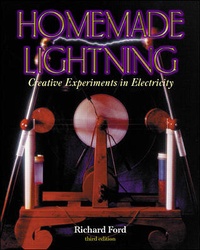
Homemade Lightning: Creative Experiments in Electricity
Creative Experiments in Electricity
3rd Edition
Published on 16. September 2001
Book
Paperback/Softback
272 pages
978-0-07-137323-4 (ISBN)
Description
Publisher's Note: Products purchased from Third Party sellers are not guaranteed by the publisher for quality, authenticity, or access to any online entitlements included with the product.
An excellent first book for the building electrical experimenter and a superb book for accomplished experimenters who haven't spent much time with electrostatics
One of the best books on electrostatics for the hobbyists, inventor, or experimenter is updated and expanded to include newly uncovered information on electrostatic generators and complete instructions for building various types, including Wimshurst and Van de Graaff generators. Throughout the book, the author provides hard-to-find information on electrical anomalies, which represent the frontier of electrostatic research. Covering theory and presenting electroscope and other construction projects and experiments, this handbook also includes experiments with electrohorticulture, gravitation and electricity, cold light, and electric tornadoes. Homemade Lightning is both an excellent first book for the building electrical experimenter and a superb book for accomplished experimenters who haven't spent much time with electrostatics.
An excellent first book for the building electrical experimenter and a superb book for accomplished experimenters who haven't spent much time with electrostatics
One of the best books on electrostatics for the hobbyists, inventor, or experimenter is updated and expanded to include newly uncovered information on electrostatic generators and complete instructions for building various types, including Wimshurst and Van de Graaff generators. Throughout the book, the author provides hard-to-find information on electrical anomalies, which represent the frontier of electrostatic research. Covering theory and presenting electroscope and other construction projects and experiments, this handbook also includes experiments with electrohorticulture, gravitation and electricity, cold light, and electric tornadoes. Homemade Lightning is both an excellent first book for the building electrical experimenter and a superb book for accomplished experimenters who haven't spent much time with electrostatics.
Reviews / Votes
From January/February 2003 issue Hands-on high-voltage experimentalists interested in electrostatic machines will love this book. Filled with design plans for building electrostatic generators and various high-voltage components, this book provides the necessary details to construct these devices. Like the first two editions, there are detailed plans describing the construction of a Wimhurst machine. This edition however, details a more simplified but larger and improved version than previously described. There is also now an entire chapter devoted to Van de Graff generators describing the principles of operation, construction, modifications for improvement, and making accessories. There are many illustrations and photos describing the construction of these generators as well as methods for making electroscopes, large capacitors, and an electrophorus. There are many tips and tricks revealed that show how to make various parts like high-voltage corona spheres, shorting rods, and terminals. Other topics include electrostatic motors, cold light, levitation, exploding wire experiments, and historical notes on unusual electric discharges. A revised bibliography and materials supplier list also made in this new edition. Anyone with an interest in high-voltage electrostatics will find this book to be not only a "cookbook" for designing and building high-voltage generators but also an historical account of the Wimhurst and Van de Graff generators. IEEE Electrical Installation Magazine 20030115More details
Edition
3rd edition
Language
English
Place of publication
United States
Publishing group
McGraw-Hill Education - Europe
Target group
Professional and scholarly
Product notice
Paperback (trade)
Unsewn / adhesive bound
Illustrations
150 Illustrations
Dimensions
Height: 235 mm
Width: 187 mm
Thickness: 20 mm
Weight
562 gr
ISBN-13
978-0-07-137323-4 (9780071373234)
Schweitzer Classification
Other editions
New editions
Book
09/2001
3rd Edition
McGraw-Hill Inc.,US
€39.50
Shipment within 15-20 days
Persons
McGraw-Hill authors represent the leading experts in their fields and are dedicated to improving the lives, careers, and interests of readers worldwide
Richard A. Ford is an electrical experimenter and inventor specializing in turn-of-the-century electrostatic devices. An avid researcher, he developed his own electrostatic generator, which is detailed in the book. Ford also has served as a technical consultant to manufacturers of Wimshurst and Van de Graaff generators. For many years, he has devoted himself to introducing students of all ages to the science and history of electricity. For the past five years, he has worked to develop high voltage equipment for use in high school science fair projects as well as in physics labs and lectures.
Richard A. Ford is an electrical experimenter and inventor specializing in turn-of-the-century electrostatic devices. An avid researcher, he developed his own electrostatic generator, which is detailed in the book. Ford also has served as a technical consultant to manufacturers of Wimshurst and Van de Graaff generators. For many years, he has devoted himself to introducing students of all ages to the science and history of electricity. For the past five years, he has worked to develop high voltage equipment for use in high school science fair projects as well as in physics labs and lectures.
Content
Introduction. Lightning and Electrocution Safety. Part I: Design and Construction. Chapter 1: Types of Electrostatic Generators. Chapter 2: Elements of Good Design. Chapter 3: James Wimshurst's Influence Machine. Chapter 4: The Author's Generators. Chapter 5: Unusual Generator Designs. Chapter 6: Theories of Generator Operation. Chapter 7: Van de Graaff Generators. Part II: Accessory Instruments, Experiments, and Applications. Chapter 8: The Electroscope. Chapter 9: The Leyden Jar Condenser. Chapter 10: The Electrophorus. Chapter 11: Electrostatic Motors. Chapter 12: Electrohorticulture. Chapter 13: Electrotherapy. Chapter 14: High-Voltage Humans. Chapter 15: Cold Light. Chapter 16: Miscellaneous Experiments. Chapter 17: Electroaerodynamics. Chapter 18: Countergravitation. Chapter 19: Exploding Wire Experiments. Chapter 20: Unusual Electric Discharges. Chapter 21: Some Philosophical Conclusions and Insights. Appendix. Research Bibliography.