

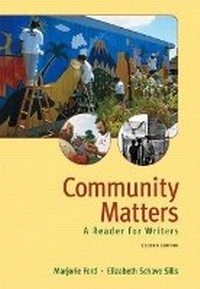
Community Matters
A Reader for Writers
2nd Edition
Published on 3. September 2004
Book
Paperback/Softback
624 pages
978-0-321-20783-8 (ISBN)
Description
Community Matters is a reader/rhetoric that encourages students to think critically about the social, political, and philosophical meanings and importance of community while helping them to build a writer's community within their classroom.
Reading selections and writing assignments throughout the book encourage students to consider the local, national, and global communities in which they live, and to respond to and participate in these communities through writing. Student writing is connected with the community through thematic inquiry, reflection, and structured writing activities.
Reading selections and writing assignments throughout the book encourage students to consider the local, national, and global communities in which they live, and to respond to and participate in these communities through writing. Student writing is connected with the community through thematic inquiry, reflection, and structured writing activities.
More details
Other editions
Previous edition
Book
03/2002
Pearson
€32.18
Article exhausted; check for reprint
Content
1. Reading.
Reading Actively.
Reading as a Process.
Pre-Reading Stage.
Skimming.
Study Stage.
Reflective Response Stage.
Reading Images.
2. Writing.
Purpose.
Audience.
Building Your Self-Confidence As a Writer.
Writing As a Process.
Prewriting Strategies.
Drafting.
Revising.
Editing for Style.
The Class as a Writing Community.
"The Best Seat In the House" by Melissa Burns.
Melissa's Writing Process Reflection.
Writing Strategies.
Description.
Narration.
Example.
Process Analysis
Definition.
Comparison and Contrast.
Classification.
Cause and Effect.
"Hats Off to Helpers!" by Heidi Metzler.
Argument.
"Volunteering" by Hazel Clarke.
3. Research Writing.
Guidelines for Writing a Research Paper.
Choose a General Subject.
Begin a Research Notebook.
Compile a Working Bibliography.
Research Your Topic Thoroughly.
Field Research: Interviews and Case Histories.
"Give of Yourself" by Amy Gillian.
Amy's Project Evluation.
"Bachan's Story" by Donald Matsuda.
"The Healing Power of Listening" by Vanya Choumanova.
Web Research.
Searching the Web.
Evaluating Your Resources.
Taking Notes on Your Sources.
Paraphrasing.
Summarizing.
Quotations.
Avoid Plagiarism.
Developing a Working Thesis.
Developing an Outline.
Write a First Draft.
Sharing Your First Draft.
Preparing Your Final Draft.
"The Standardized Test and Its Implications In the American Classroom" by Elizabeth Derse.
4. Writing About the Community: Resources.
Guide to Worksheets.
Community Action Projects with Reflections.
"Habitat for Humanity: The Gift of Hope" by Ivanka Choumanova.
"Our Class Project: Habitat for Humanity" by Melissa Burns.
5. A Sense of Place.
Memories of Place, Identity, and Community.
My Grandmother's House, Mary Gordon.
The Monkey Garden, Sandra Cisneros.
Bagdad Cafe, Jason Florio.
Political and Natural Challenges.
A Moral Place, Tracy Kidder.
The Invisible Riot, Mike Davis.
Total Eclipse, Annie Dillard.
Activists Rebuilding Communities.
The Art of Change, Sue Halpern.
The Other Side of the Wires, Kimi Eisele.
Habitat for Humanity and the Jimmy Carter Work Project.
6. Family.
Memories of the Traditional Family.
No Name Woman, Maxine Hong Kingston.
Sins of the Mother, Regina Louise.
The Way to Rainy Mountain, N. Scott Momaday.
Complexities of Family Life Today.
I Stand Here Ironing, Tillie Olsen.
Somebody's Baby, Barbara Kongsolver.
The Legacy of Divorce, Judith Wallerstein.
Community Projects that Support Children and Families.
A Family Legacy, Marian Wright Edelman.
How to "YA/YA" in Your Neighborhood, Claudia Barker.
Names Project: The Vision Quilt, Cleve Jones.
7. Education.
Reflecting on Educational Experiences.
Ordinary Resurrections, Jonathon Kozol.
The First Day, Edward P. Jones.
Postcards From the Edge, Jane Tompkins.
Economic, Political, and Technological Issues in School.
Educating a Democracy, Deborah Meier.
Multiple Intelligences, Howard Gardner.
Digital Divide, David Bolt and Ray Crawford
Education Outside of The Classroom.
How People Learn to Be Civic, Michael Shudson.
River of Words, Robert Hass and Pamela Michael.
Jazz Gives Teens New Footing, Janice Ross.
Teach for America.
8. Culture.
Encountering New Cultures and Reexamining Values.
Viet-Kieu, Andrew Pham.
The Olympic Games, Pico Iyer.
Robotic Iguanas, Julia Corbett.
New Cultural Rituals.
Should English Be the Law? Robert D. King.
Virtual Communities, Howard Reingold.
We Are What We Eat, Donna R. Gabaccia.
Artistic Projects That Reflect Cultural Change.
Write This Down, Jacqueline Tobin.
"Coming Home to Manilatown": Resurrecting the International Hotel, Estella Habal.
Culture Sculpture, Mark Applebaum.
Here Is New York, Michael Shulan.
9. Work.
Reconciling Personal Values and Workplace Expectations.
Shooting an Elephant, George Orwell.
On the Street Cars, Maya Angelou.
Getting Close to the Machine, Ellen Ullman.
Revealing the Economic Divide.
In the Strawberry Fields, Eric Schlosser.
Nickel and Dimed, Barbara Ehrenreich.
A Pioneer of Community Wealth, Bill Shore.
Working Toward Solutions in the Community.
Mending Wall, Robert Frost.
Bread Salt and Heart, the International Rescue Committee.
Kathmandu, Craig Kielburger.
10. Health.
New Realities and Roles for Doctors and Patients.
The Case of the Red Leg, Atual Gawande.
The Tennis Partner, Abraham Verghese.
Doctor's Daughter, Julia McMurray.
Solving Today's Health Care Issues.
Fatland America: What Can Be Done? Greg Crister.
Health and Happiness, Robert D. Putnam.
Policies for the Future, Francis Fukuyama.
Building Communities to Address Health Issues.
From the Cancer Journals, Audre Lorde.
The Obliteration of Alienation, Elliott Leyton.
The One Thousand Paper Cranes Casebook, Takayuki Ishii.
Credits.
Index.
Reading Actively.
Reading as a Process.
Pre-Reading Stage.
Skimming.
Study Stage.
Reflective Response Stage.
Reading Images.
2. Writing.
Purpose.
Audience.
Building Your Self-Confidence As a Writer.
Writing As a Process.
Prewriting Strategies.
Drafting.
Revising.
Editing for Style.
The Class as a Writing Community.
"The Best Seat In the House" by Melissa Burns.
Melissa's Writing Process Reflection.
Writing Strategies.
Description.
Narration.
Example.
Process Analysis
Definition.
Comparison and Contrast.
Classification.
Cause and Effect.
"Hats Off to Helpers!" by Heidi Metzler.
Argument.
"Volunteering" by Hazel Clarke.
3. Research Writing.
Guidelines for Writing a Research Paper.
Choose a General Subject.
Begin a Research Notebook.
Compile a Working Bibliography.
Research Your Topic Thoroughly.
Field Research: Interviews and Case Histories.
"Give of Yourself" by Amy Gillian.
Amy's Project Evluation.
"Bachan's Story" by Donald Matsuda.
"The Healing Power of Listening" by Vanya Choumanova.
Web Research.
Searching the Web.
Evaluating Your Resources.
Taking Notes on Your Sources.
Paraphrasing.
Summarizing.
Quotations.
Avoid Plagiarism.
Developing a Working Thesis.
Developing an Outline.
Write a First Draft.
Sharing Your First Draft.
Preparing Your Final Draft.
"The Standardized Test and Its Implications In the American Classroom" by Elizabeth Derse.
4. Writing About the Community: Resources.
Guide to Worksheets.
Community Action Projects with Reflections.
"Habitat for Humanity: The Gift of Hope" by Ivanka Choumanova.
"Our Class Project: Habitat for Humanity" by Melissa Burns.
5. A Sense of Place.
Memories of Place, Identity, and Community.
My Grandmother's House, Mary Gordon.
The Monkey Garden, Sandra Cisneros.
Bagdad Cafe, Jason Florio.
Political and Natural Challenges.
A Moral Place, Tracy Kidder.
The Invisible Riot, Mike Davis.
Total Eclipse, Annie Dillard.
Activists Rebuilding Communities.
The Art of Change, Sue Halpern.
The Other Side of the Wires, Kimi Eisele.
Habitat for Humanity and the Jimmy Carter Work Project.
6. Family.
Memories of the Traditional Family.
No Name Woman, Maxine Hong Kingston.
Sins of the Mother, Regina Louise.
The Way to Rainy Mountain, N. Scott Momaday.
Complexities of Family Life Today.
I Stand Here Ironing, Tillie Olsen.
Somebody's Baby, Barbara Kongsolver.
The Legacy of Divorce, Judith Wallerstein.
Community Projects that Support Children and Families.
A Family Legacy, Marian Wright Edelman.
How to "YA/YA" in Your Neighborhood, Claudia Barker.
Names Project: The Vision Quilt, Cleve Jones.
7. Education.
Reflecting on Educational Experiences.
Ordinary Resurrections, Jonathon Kozol.
The First Day, Edward P. Jones.
Postcards From the Edge, Jane Tompkins.
Economic, Political, and Technological Issues in School.
Educating a Democracy, Deborah Meier.
Multiple Intelligences, Howard Gardner.
Digital Divide, David Bolt and Ray Crawford
Education Outside of The Classroom.
How People Learn to Be Civic, Michael Shudson.
River of Words, Robert Hass and Pamela Michael.
Jazz Gives Teens New Footing, Janice Ross.
Teach for America.
8. Culture.
Encountering New Cultures and Reexamining Values.
Viet-Kieu, Andrew Pham.
The Olympic Games, Pico Iyer.
Robotic Iguanas, Julia Corbett.
New Cultural Rituals.
Should English Be the Law? Robert D. King.
Virtual Communities, Howard Reingold.
We Are What We Eat, Donna R. Gabaccia.
Artistic Projects That Reflect Cultural Change.
Write This Down, Jacqueline Tobin.
"Coming Home to Manilatown": Resurrecting the International Hotel, Estella Habal.
Culture Sculpture, Mark Applebaum.
Here Is New York, Michael Shulan.
9. Work.
Reconciling Personal Values and Workplace Expectations.
Shooting an Elephant, George Orwell.
On the Street Cars, Maya Angelou.
Getting Close to the Machine, Ellen Ullman.
Revealing the Economic Divide.
In the Strawberry Fields, Eric Schlosser.
Nickel and Dimed, Barbara Ehrenreich.
A Pioneer of Community Wealth, Bill Shore.
Working Toward Solutions in the Community.
Mending Wall, Robert Frost.
Bread Salt and Heart, the International Rescue Committee.
Kathmandu, Craig Kielburger.
10. Health.
New Realities and Roles for Doctors and Patients.
The Case of the Red Leg, Atual Gawande.
The Tennis Partner, Abraham Verghese.
Doctor's Daughter, Julia McMurray.
Solving Today's Health Care Issues.
Fatland America: What Can Be Done? Greg Crister.
Health and Happiness, Robert D. Putnam.
Policies for the Future, Francis Fukuyama.
Building Communities to Address Health Issues.
From the Cancer Journals, Audre Lorde.
The Obliteration of Alienation, Elliott Leyton.
The One Thousand Paper Cranes Casebook, Takayuki Ishii.
Credits.
Index.