

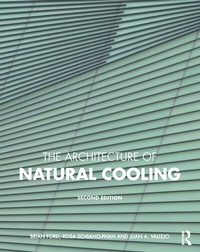
The Architecture of Natural Cooling
2nd Edition
Published on 27. November 2019
Book
Hardback
300 pages
978-1-138-62905-9 (ISBN)
Description
Overheating in buildings is commonplace. This book describes how we can keep cool without conventional air-conditioning: improving comfort and productivity while reducing energy costs and carbon emissions. It provides architects, engineers and policy makers with a 'how-to' guide to the application of natural cooling in new and existing buildings. It demonstrates, through reference to numerous examples, that natural cooling is viable in most climates around the world.
This completely revised and expanded second edition includes:
An overview of natural cooling past and present.
Guidance on the principles and strategies that can be adopted.
A review of the applicability of different strategies.
Explanation of simplified tools for performance assessment.
A review of components and controls.
A detailed evaluation of case studies from the USA, Europe, India and China.
This book is not just for the technical specialist, as it also provides a general grounding in how to avoid or minimise air-conditioning. Importantly, it demonstrates that understanding our environment, rather than fighting it, will help us to live sustainably in our rapidly warming world.
This completely revised and expanded second edition includes:
An overview of natural cooling past and present.
Guidance on the principles and strategies that can be adopted.
A review of the applicability of different strategies.
Explanation of simplified tools for performance assessment.
A review of components and controls.
A detailed evaluation of case studies from the USA, Europe, India and China.
This book is not just for the technical specialist, as it also provides a general grounding in how to avoid or minimise air-conditioning. Importantly, it demonstrates that understanding our environment, rather than fighting it, will help us to live sustainably in our rapidly warming world.
Reviews / Votes
"Natural cooling is one of the most important aspects to tackle while designing, and surely one of the trickiest to master. Through a well-calibrated collection of theoretical principles and practical recommendations, all supported by a set of thoroughly analysed and presented case studies, this volume provides a reference book for the many professionals who, in response to global trends, are just approaching the matter, as well as for those in search for a deeper understanding of natural cooling principles and their possible practical applications." - Mario Cucinella, Architect, Hon FAIA, Int. Fellow RIBA (Founder MCA Bologna and New York)"This book brings together a uniquely comprehensive body of history, architectural science and contemporary practice that will stand as a primary source in the foreseeable future. The understanding of the specificity of climate lies at the heart of the book, serving as one of the foundations for natural cooling design. At the other pole of environmental design, human comfort is an essential parameter. Between these poles the book presents a systematic and comprehensive methodology for design that embraces precedent, science and technology. - Dean Hawkes Emeritus Professor, Welsh School of Architecture & Darwin College, Cambridge
More details
Edition
2nd edition
Language
English
Place of publication
London
United Kingdom
Publishing group
Taylor & Francis Ltd
Target group
Professional and scholarly
Professional Practice & Development
Illustrations
28 s/w Abbildungen, 262 farbige Abbildungen, 6 s/w Photographien bzw. Rasterbilder, 127 Farbfotos bzw. farbige Rasterbilder, 135 farbige Zeichnungen, 1 farbige Tabelle, 22 s/w Zeichnungen
1 Tables, color; 135 Line drawings, color; 22 Line drawings, black and white; 127 Halftones, color; 6 Halftones, black and white; 262 Illustrations, color; 28 Illustrations, black and white
Dimensions
Height: 276 mm
Width: 219 mm
Weight
1280 gr
ISBN-13
978-1-138-62905-9 (9781138629059)
Copyright in bibliographic data and cover images is held by Nielsen Book Services Limited or by the publishers or by their respective licensors: all rights reserved.
Schweitzer Classification
Other editions
Additional editions
Brian Ford | Rosa Schiano-Phan | Juan A. Vallejo
The Architecture of Natural Cooling
Book
11/2019
2nd Edition
Routledge
€61.50
Shipment within 10-20 days
Brian Ford | Rosa Schiano-Phan | Juan A. Vallejo
The Architecture of Natural Cooling
E-Book
11/2019
2nd Edition
Routledge
€52.49
Available for download
Brian Ford | Rosa Schiano-Phan | Juan A. Vallejo
The Architecture of Natural Cooling
E-Book
11/2019
2nd Edition
Routledge
€52.49
Available for download
Persons
Brian Ford (RIBA FRSA) is an architect, an environmental design consultant and Emeritus Professor at the University of Nottingham. He was in private practice for over 25 years, including Peake Short & Partners and Short Ford Associates, where he has worked on innovative low carbon projects in Europe, USA, India, Australia and China. He initiated a series of multi-partner EU funded research projects on natural ventilation and passive cooling and has served as a member of the UK Government's Zero Carbon Task Force for Schools, an advisor to Building Green Futures (Bologna, Italy), and was until recently Vice-President of the International PLEA organisation.
Rosa Schiano-Phan (BSc DiplArch MSc PhD) is Principal Lecturer in Architecture and Environmental Design at the University of Westminster and co-director of Natural Cooling Ltd. She worked as an architect and environmental design consultant internationally before gaining a PhD at the Architectural Association and becoming a Research Fellow at the University of Nottingham, working on EU research into thermal performance of buildings and passive cooling. She taught at the AA and subsequently moved to the University of Westminster where in 2014 she set up new BSc and MSc courses in Architecture and Environmental Design.
Juan A. Vallejo (BSc DiplArch MSc PhD) is Visiting Lecturer in Architecture and Environmental Design (MSc) at the School of Architecture + Cities of the University of Westminster in London (UK) and collaborates with the School of Sustainability (SOS) Team founded by Mario Cucinella Architects in Bologna (Italy). He has worked in Natural Cooling Ltd as an environmental design consultant on projects in the UK and abroad and he is associate of the International Passive Low Energy Architecture (PLEA) organisation. His expertise lies in the field of building environmental simulation software tools, natural ventilation and passive evaporative cooling.
Rosa Schiano-Phan (BSc DiplArch MSc PhD) is Principal Lecturer in Architecture and Environmental Design at the University of Westminster and co-director of Natural Cooling Ltd. She worked as an architect and environmental design consultant internationally before gaining a PhD at the Architectural Association and becoming a Research Fellow at the University of Nottingham, working on EU research into thermal performance of buildings and passive cooling. She taught at the AA and subsequently moved to the University of Westminster where in 2014 she set up new BSc and MSc courses in Architecture and Environmental Design.
Juan A. Vallejo (BSc DiplArch MSc PhD) is Visiting Lecturer in Architecture and Environmental Design (MSc) at the School of Architecture + Cities of the University of Westminster in London (UK) and collaborates with the School of Sustainability (SOS) Team founded by Mario Cucinella Architects in Bologna (Italy). He has worked in Natural Cooling Ltd as an environmental design consultant on projects in the UK and abroad and he is associate of the International Passive Low Energy Architecture (PLEA) organisation. His expertise lies in the field of building environmental simulation software tools, natural ventilation and passive evaporative cooling.
Content
Foreword by Dean Hawkes. 1. Origins and Opportunities. 2. Principles ans Strategies. 3. Climate Applicability Mapping. 4. Integrated Design. 5. Testing the Strategy. 6. Performance Analysis. 7. Component Design. Case Study 1: Torrent Research Centre, Ahmedabad, India. Case Study 2: Centre for Sustainable Energy Technologies, Ningbo, China. Case Study 3: Federal Courthouse, Phoenix, Arizona, USA. Case Study 4: Stock Exchange, Valletta, Malta. Case Study 5: Zion National Park Visitor Centre, Springdale, Utah, USA. Case Study 6: Global Ecology Research Centre, Palo Alto, California, USA. Conclusions. Index