

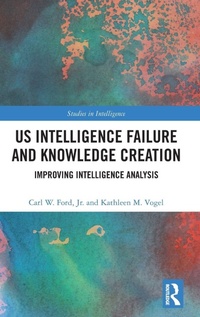
US Intelligence Failure and Knowledge Creation
Improving Intelligence Analysis
1st Edition
Published on 16. October 2025
Book
Hardback
182 pages
978-1-032-75205-1 (ISBN)
Description
This book examines the roots and elements of the research and knowledge-generation problems in US intelligence.
The work identifies the crux of the problem as the lack of a research capability in US intelligence, which has developed over the past 40 years due to a variety of organizational decisions that prioritized current intelligence reporting and a focus on structural solutions to fix intelligence failures. The book argues that this is the principal cause of recent major intelligence failures regarding 9/11, the 2003 Iraq War, and the current Russia-Ukraine War. Throughout the book, the authors aim to provide short-, medium-, and long-term, policy-relevant recommendations to intelligence officials and members of the US Congress, in the form of workforce, leadership, and organizational changes that can be implemented to address existing research shortcomings in intelligence analysis. The book's conclusions will also be relevant to the intelligence agencies of other countries.
This book will be of much interest to students of intelligence studies, national security, US politics, defense studies, and international relations.
The work identifies the crux of the problem as the lack of a research capability in US intelligence, which has developed over the past 40 years due to a variety of organizational decisions that prioritized current intelligence reporting and a focus on structural solutions to fix intelligence failures. The book argues that this is the principal cause of recent major intelligence failures regarding 9/11, the 2003 Iraq War, and the current Russia-Ukraine War. Throughout the book, the authors aim to provide short-, medium-, and long-term, policy-relevant recommendations to intelligence officials and members of the US Congress, in the form of workforce, leadership, and organizational changes that can be implemented to address existing research shortcomings in intelligence analysis. The book's conclusions will also be relevant to the intelligence agencies of other countries.
This book will be of much interest to students of intelligence studies, national security, US politics, defense studies, and international relations.
More details
Series
Language
English
Place of publication
London
United Kingdom
Publishing group
Taylor & Francis Ltd
Target group
College/higher education
Professional and scholarly
Postgraduate, Professional Reference, and Undergraduate Advanced
Illustrations
6 s/w Abbildungen, 5 s/w Photographien bzw. Rasterbilder, 1 s/w Zeichnung
1 Line drawings, black and white; 5 Halftones, black and white; 6 Illustrations, black and white
Dimensions
Height: 240 mm
Width: 161 mm
Thickness: 15 mm
Weight
461 gr
ISBN-13
978-1-032-75205-1 (9781032752051)
Copyright in bibliographic data and cover images is held by Nielsen Book Services Limited or by the publishers or by their respective licensors: all rights reserved.
Schweitzer Classification
Other editions
Additional editions
Carl W. Ford, Jr. | Kathleen M. Vogel
US Intelligence Failure and Knowledge Creation
Improving Intelligence Analysis
E-Book
10/2025
Routledge
€60.49
Available for download
Carl W. Ford, Jr. | Kathleen M. Vogel
US Intelligence Failure and Knowledge Creation
Improving Intelligence Analysis
E-Book
10/2025
Routledge
€60.49
Available for download
Persons
Carl W. Ford, Jr. is a 40-year veteran of US intelligence and policy work. He began his intelligence career as a HUMINT case officer in Vietnam and worked as an analyst following the Chinese military at both the DIA and CIA. After serving as the NIO for East Asia at the National Intelligence Council, he was put on loan by the CIA to the Office of the Secretary of Defense, where he served as the Principal Deputy Secretary of Defense, ISA, and concurrently as the Deputy Secretary of Defense for East Asia, and, after the Gulf War, as the Deputy Secretary of Defense for the Middle East and South Asia. President George W. Bush selected him to be the Assistant Secretary of State for the Bureau of Intelligence and Research. He currently is an independent researcher focused on intelligence analysis and consults on Asian and Middle Eastern affairs.
Kathleen M. Vogel is Professor in the School for the Future of Innovation in Society, Associate Dean in the College of Global Futures, and Senior Global Futures Scientist, Julie Ann Wrigley Global Futures Laboratory at Arizona State University. She is author of Phantom Menace or Looming Danger? A New Framework for Assessing Bioweapons Threats (2013).
Kathleen M. Vogel is Professor in the School for the Future of Innovation in Society, Associate Dean in the College of Global Futures, and Senior Global Futures Scientist, Julie Ann Wrigley Global Futures Laboratory at Arizona State University. She is author of Phantom Menace or Looming Danger? A New Framework for Assessing Bioweapons Threats (2013).
Content
Chapter 1: Introduction Chapter 2: What is Intelligence Analysis? Chapter 3: Analysis is broken in the IC: How did we get here? Chapter 4: Different types of data used for knowledge creation Chapter 5: Going Beyond Current Intelligence Reporting Chapter 6: Lack of Expertise Chapter 7: Will AI save us?: The role of artificial intelligence in intelligence analysis Chapter 8: Politicization of intelligence Chapter 9: Fixing the Problem: Recommendations Chapter 10: Epilogue