

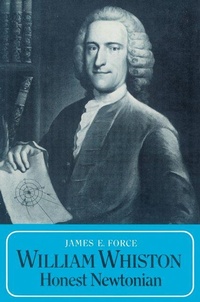
William Whiston
Honest Newtonian
Published on 20. June 2002
Book
Paperback/Softback
240 pages
978-0-521-52488-9 (ISBN)
Description
William Whiston succeeded Sir Isaac Newton as Lucasian Professor of Mathematics at Cambridge in 1703. Like his predecessor, Whiston presents an interesting combination of the scientific and the theological mind, but whereas Newton carefully concealed the true nature of his religious beliefs, Whiston, a well-known preacher, did not. This is the first modern full-length study of Whiston's Newtonian rapprochement between science and religion. Professor Force examines the writings in which Whiston applies his Newtonian Biblical interpretation to social, political, and theological issues in the context of the Newtonian movement at the turn of the eighteenth century. The book revises the conventional view of Whiston as a figure peripheral to the Newtonian movement and reveals the nature of Whiston's 'Newtonianism' and his individual eccentricities. It also offers valuable insights into Newton himself and the religious beliefs he so often concealed.
More details
Language
English
Place of publication
Cambridge
United Kingdom
Target group
Professional and scholarly
Product notice
Paperback (trade)
Illustrations
Worked examples or Exercises
Dimensions
Height: 229 mm
Width: 152 mm
Thickness: 14 mm
Weight
396 gr
ISBN-13
978-0-521-52488-9 (9780521524889)
Copyright in bibliographic data and cover images is held by Nielsen Book Services Limited or by the publishers or by their respective licensors: all rights reserved.
Schweitzer Classification
Other editions
Additional editions
Book
03/1985
Cambridge University Press
€122.60
Shipment within 15-20 days
Person
Content
List of illustrations; Foreword Richard H. Popkin; Preface; Introduction: Erkennen and Verstehen in the history of philosophy, and William Whiston's 'Newtonianism'; 1. The temper and times of a Newtonian controversialist; 2. Whiston, the Burnet controversy, and Newtonian biblical interpretation; 3. Whiston's Newtonian argument from prophecy; divine providence; and the criticism of Anthony Collins; 4. Whiston's Newtonian biblical interpretation and the rage of party, radical Arianism, and millennial expectations; 5. Deism and divine providence in Whiston and Newton; Notes; Index.