

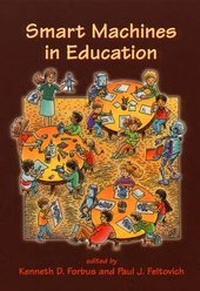
Smart Machines in Education
Published on 9. November 2001
Book
Paperback/Softback
489 pages
978-0-262-56141-9 (ISBN)
Description
The emerging widespread use of artificial intelligence in education.
Multimedia, simulation, computer-mediated communication networks, and distance learning have all become part of the educational toolkit. The next major technology to change the face of education will be based on the widespread use of artificial intelligence (AI). Progress in AI has led to a deeper understanding of how to represent knowledge, to reason, and to describe procedural knowledge. Progress in cognitive science has led to a deeper understanding of how people think, solve problems, and learn. AI scientists use results from cognitive science to create software with more humanlike abilities, which can help students learn better. This book looks at some of the results of this synergy among AI, cognitive science, and education. Examples include virtual students whose misconceptions force students to reflect on their own knowledge, intelligent tutoring systems, and speech recognition technology that helps students learn to read. Some of the systems described are already used in classrooms and have been evaluated; a few are still laboratory efforts. The book also addresses cultural and political issues involved in the deployment of new educational technologies.
Multimedia, simulation, computer-mediated communication networks, and distance learning have all become part of the educational toolkit. The next major technology to change the face of education will be based on the widespread use of artificial intelligence (AI). Progress in AI has led to a deeper understanding of how to represent knowledge, to reason, and to describe procedural knowledge. Progress in cognitive science has led to a deeper understanding of how people think, solve problems, and learn. AI scientists use results from cognitive science to create software with more humanlike abilities, which can help students learn better. This book looks at some of the results of this synergy among AI, cognitive science, and education. Examples include virtual students whose misconceptions force students to reflect on their own knowledge, intelligent tutoring systems, and speech recognition technology that helps students learn to read. Some of the systems described are already used in classrooms and have been evaluated; a few are still laboratory efforts. The book also addresses cultural and political issues involved in the deployment of new educational technologies.
More details
Series
Language
English
Place of publication
Cambridge
United States
Publishing group
MIT Press Ltd
Target group
College/higher education
Professional and scholarly
Interest Age: From 18 years
Product notice
Paperback (trade)
Dimensions
Height: 229 mm
Width: 152 mm
Thickness: 38 mm
Weight
771 gr
ISBN-13
978-0-262-56141-9 (9780262561419)
Copyright in bibliographic data and cover images is held by Nielsen Book Services Limited or by the publishers or by their respective licensors: all rights reserved.
Schweitzer Classification
Persons
Kenneth D. Forbus is Walter P. Murphy Professor of Computer Science and Professor of Education at Northwestern University. He is the coauthor of Building Problem Solvers and the coeditor of Smart Machines in Education, both published by the MIT Press. Paul J. Feltovich is Professor of Medical Education and Psychiatry at Southern Illinois University School of Medicine. He is the coeditor of Expertise in Context (AAAI Press/MIT Press, 1997).