

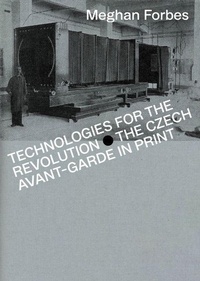
Technologies for the Revolution
The Czech Avant-Garde in Print
Will be published approx. on 11. November 2025
Book
Paperback/Softback
503 pages
978-80-246-6050-9 (ISBN)
Description
Offers a close look at the collaboration of the Czechoslovak avant-garde with print technicians to produce radical experiments in book and periodical production.
The most influential avant-garde group in interwar Czechoslovakia called for a revolution enacted via print. Devetsil, founded in 1920 and comprised of leftist artists, architects, actors, and poets, undertook an ambitious publishing effort, aiming to reach urban individuals on the street and in their homes in the years following the First World War. It was a revolution that explicitly condemned any call to arms; instead, it proposed taking up new technologies that expanded possibilities for the photomechanical reproduction and dissemination of text and image in print. This utopic vision was embodied in thousands of physical revolutions made by the machine of the printing press.
Technologies for the Revolution offers a cultural history of print that engages questions of labor and capital embedded in material culture and in the history of the book. This new publication offers a nuanced portrait of leftist art practices in Czechoslovakia in the interwar period and charts networks of exchange across Europe by exploring the ways in which Devetsil used its printed matter. The Czech -ism of Poetism is articulated as a sustained working through of Devetsil's position as the group aimed to accommodate both new technology and the role of poets and artists in a postwar society, all while striving for a socialist utopia.
Technologies for the Revolution is the result of nearly a decade of research conducted in the libraries and archives of Prague, Berlin, Paris, and New York, as well as close work with museum and private collections. Conceived as an exhibition space in print, this book sheds new light on Devetsil and Poetism, as well as on the group's social and artistic activities through an object-based analysis of various media- architecture, typography, poetry, photography, film, and performance-to propose a more synthetic and variegated understanding of Devetsil's unique contribution to the European avant-gardes.
The most influential avant-garde group in interwar Czechoslovakia called for a revolution enacted via print. Devetsil, founded in 1920 and comprised of leftist artists, architects, actors, and poets, undertook an ambitious publishing effort, aiming to reach urban individuals on the street and in their homes in the years following the First World War. It was a revolution that explicitly condemned any call to arms; instead, it proposed taking up new technologies that expanded possibilities for the photomechanical reproduction and dissemination of text and image in print. This utopic vision was embodied in thousands of physical revolutions made by the machine of the printing press.
Technologies for the Revolution offers a cultural history of print that engages questions of labor and capital embedded in material culture and in the history of the book. This new publication offers a nuanced portrait of leftist art practices in Czechoslovakia in the interwar period and charts networks of exchange across Europe by exploring the ways in which Devetsil used its printed matter. The Czech -ism of Poetism is articulated as a sustained working through of Devetsil's position as the group aimed to accommodate both new technology and the role of poets and artists in a postwar society, all while striving for a socialist utopia.
Technologies for the Revolution is the result of nearly a decade of research conducted in the libraries and archives of Prague, Berlin, Paris, and New York, as well as close work with museum and private collections. Conceived as an exhibition space in print, this book sheds new light on Devetsil and Poetism, as well as on the group's social and artistic activities through an object-based analysis of various media- architecture, typography, poetry, photography, film, and performance-to propose a more synthetic and variegated understanding of Devetsil's unique contribution to the European avant-gardes.
Reviews / Votes
"Just as Meghan Forbes shows the printed output of Devetsil to be revolutionary for transmitting the impulses of the pan-European avant-garde movement into a cooperation with local printers, we can claim a comparable revolutionary force in her own book, which situates Devetsil publications within transnational networks." * Karel Cisar, professor, Academy of Arts, Architecture and Design in Prague * "This book is an extremely well-researched study on the printing and image reproduction practices of the Devetsil movement. It makes use of ample documentation to bring a new perspective to the practical functioning of the Czech avant-garde and its network." * Anna Pravdova, curator, National Gallery Prague * "Multidisciplinary scholar Forbes's broad and deep study of the Czech avant-garde group Devetsil is a model of scholarship, bringing new insights into the ideas, sociopolitical context, and material culture of its era." * Jennifer Tobias, librarian and Modernist scholar; coauthor of Extra Bold *More details
Language
English
Place of publication
Ovocny
Czech Republic
Target group
Professional and scholarly
Product notice
Paperback (trade)
Unsewn / adhesive bound
Illustrations
476 halftones
Dimensions
Height: 237 mm
Width: 176 mm
Thickness: 50 mm
Weight
1277 gr
ISBN-13
978-80-246-6050-9 (9788024660509)
Copyright in bibliographic data and cover images is held by Nielsen Book Services Limited or by the publishers or by their respective licensors: all rights reserved.
Schweitzer Classification
Person
Meghan Forbes is a writer, translator, and curator. She received her PhD from the University of Michigan, Ann Arbor, taught at the University of Texas at Austin, and has held postdoctoral fellowships at The Museum of Modern Art and the Metropolitan Museum of Art in New York.
Content
13 ACKNOWLEDGMENTS
19 NOTES ON STYLE
23 INTRODUCTION
A Poetist Politics of Work and Play
Devetsil's Foundations
Forging Further Networks through Print
Chapter Summaries
77 CHAPTER I
Design in Process: Photomechanical Reproduction and the Tools of the Press as the Building Blocks of Avant-Garde Print
97 Stavba a basen - A Retrospective Summary
Technologies of Circulation
The Typecase as Source of Text and Image
130 Zivot 2 and Revolucni sbornik - Early Outputs
Process Blocks Visualize Networks
The Trace of the Printer's Hand
161 CHAPTER II
Pictures as Poetry: The Development of Poetism through the Text and Image of Devetsil's Early Publications
173 Disk 1 - Devetsil's First (Not-)Periodical
A Circle of Images in Print and on View
Pictures as Graphic Language
Making Poems out of Pictures
198 Pantomima - Poetist Play
Cut-and-Paste Clownerie
What Is a Picture Poem?
222 Na vlnach TSF - A New Wave of Typographic Experiment
From Picture Poem to Typographic Poetics (A Printer's Nightmare?)
A Poetist Circus
237 CHAPTER III
Films on Paper: Quotation and the Genre of the Film Poem as an Economical Cinema
249 Film - Photogenie in Translation
Photogenie Becomes Fotogenie
Copying Pictures
266 Disk - 2 Film Poems in Action
Poetry as Graphic Craft
Photogenie and the Film Poem
278 Pasmo vol. 1 - Cinematic Expression in Collage
Mechanics of Montage
Typography, Photography, Film
More Film Poems
303 CHAPTER IV
The Page Is a Stage: Devetsil's Osvobozene Divadlo and Iterations of Performance in Print
329 Roztocene jeviste - Proletarian on Paper
A Working Theater
Deep Dive for Visual References
Staging Exchange
354 Pasmo vol. 2 - Osvobozene Divadlo Enters Left
Platforms of Influence and Association
Local Adaptation and Innovation
371 ReD vol. 1 - Synthesis of Art and Life
Performing Poetism
389 CHAPTER V
Typophoto and Typomontage: The Apex of Devetsil Design
412 ReD vol. 2 - Photo-Synthesis of Late Devetsil
Talking about (New) Typography
429 S lodi jez dovazi caj a kavu - Typomontage
and the Deconstruction of Abstraction
The Printer and Poetism
Building Pictures from Type
Antipodal Politics in Poetry and Pictures
463 Postscript
471 BIBLIOGRAPHY
INDEX
19 NOTES ON STYLE
23 INTRODUCTION
A Poetist Politics of Work and Play
Devetsil's Foundations
Forging Further Networks through Print
Chapter Summaries
77 CHAPTER I
Design in Process: Photomechanical Reproduction and the Tools of the Press as the Building Blocks of Avant-Garde Print
97 Stavba a basen - A Retrospective Summary
Technologies of Circulation
The Typecase as Source of Text and Image
130 Zivot 2 and Revolucni sbornik - Early Outputs
Process Blocks Visualize Networks
The Trace of the Printer's Hand
161 CHAPTER II
Pictures as Poetry: The Development of Poetism through the Text and Image of Devetsil's Early Publications
173 Disk 1 - Devetsil's First (Not-)Periodical
A Circle of Images in Print and on View
Pictures as Graphic Language
Making Poems out of Pictures
198 Pantomima - Poetist Play
Cut-and-Paste Clownerie
What Is a Picture Poem?
222 Na vlnach TSF - A New Wave of Typographic Experiment
From Picture Poem to Typographic Poetics (A Printer's Nightmare?)
A Poetist Circus
237 CHAPTER III
Films on Paper: Quotation and the Genre of the Film Poem as an Economical Cinema
249 Film - Photogenie in Translation
Photogenie Becomes Fotogenie
Copying Pictures
266 Disk - 2 Film Poems in Action
Poetry as Graphic Craft
Photogenie and the Film Poem
278 Pasmo vol. 1 - Cinematic Expression in Collage
Mechanics of Montage
Typography, Photography, Film
More Film Poems
303 CHAPTER IV
The Page Is a Stage: Devetsil's Osvobozene Divadlo and Iterations of Performance in Print
329 Roztocene jeviste - Proletarian on Paper
A Working Theater
Deep Dive for Visual References
Staging Exchange
354 Pasmo vol. 2 - Osvobozene Divadlo Enters Left
Platforms of Influence and Association
Local Adaptation and Innovation
371 ReD vol. 1 - Synthesis of Art and Life
Performing Poetism
389 CHAPTER V
Typophoto and Typomontage: The Apex of Devetsil Design
412 ReD vol. 2 - Photo-Synthesis of Late Devetsil
Talking about (New) Typography
429 S lodi jez dovazi caj a kavu - Typomontage
and the Deconstruction of Abstraction
The Printer and Poetism
Building Pictures from Type
Antipodal Politics in Poetry and Pictures
463 Postscript
471 BIBLIOGRAPHY
INDEX