

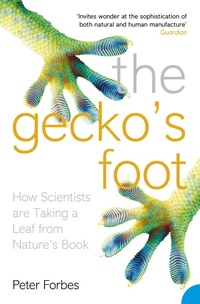
The Gecko's Foot
How Scientists are Taking a Leaf from Nature's Book
Published on 7. August 2006
Book
Paperback/Softback
356 pages
978-0-00-717989-3 (ISBN)
Description
A cutting-edge science book in the style of 'Fermat's Last Theorem' and 'Chaos' from an exciting and accessible new voice in popular science writing.
Bio-inspiration is a form of engineering but not in the conventional sense. Extending beyond our established and preconceived notions, scientists, architects and engineers are looking at imitating nature by manufacturing 'wet' materials such as spider silk or the surface of the gecko's foot.
The amazing power of the gecko's foot has long been known - it can climb a vertical glass wall and even walk upside down on the ceiling - but no ideas could be harnessed from it because its mechanism could not be seen with the power of optical microscopes. Recently however the secret was solved by a team of scientists in Oregon who established that the mechanism really is dry, and that it does not involve suction, capillary action or anything else the lay person might imagine. Each foot has half a million bristles and each bristle ramifies into hundreds of finer spatula-shaped projections. The fine scale of the gecko's foot is beyond the capacity of conventional microengineering, but a team of nanotechnologists have already made a good initial approximation.
The gecko's foot is just one of many examples of this new 'smart' science. We also discover, amongst other things, how George de Mestral's brush with the spiny fruits of the cocklebur inspired him to invent Velcro; how the shape of leaves opening from a bud has inspired the design of solar-powered satellites; and the parallels between cantilever bridges and the spines of large mammals such as the bison.
The new 'smart' science of Bio-inspiration is going to produce a plethora of products over the next decades that will transform our lives, and force us to look at the world in a completely new way. It is science we will be reading about in our papers very soon; it is the science of tomorrow's world.
Bio-inspiration is a form of engineering but not in the conventional sense. Extending beyond our established and preconceived notions, scientists, architects and engineers are looking at imitating nature by manufacturing 'wet' materials such as spider silk or the surface of the gecko's foot.
The amazing power of the gecko's foot has long been known - it can climb a vertical glass wall and even walk upside down on the ceiling - but no ideas could be harnessed from it because its mechanism could not be seen with the power of optical microscopes. Recently however the secret was solved by a team of scientists in Oregon who established that the mechanism really is dry, and that it does not involve suction, capillary action or anything else the lay person might imagine. Each foot has half a million bristles and each bristle ramifies into hundreds of finer spatula-shaped projections. The fine scale of the gecko's foot is beyond the capacity of conventional microengineering, but a team of nanotechnologists have already made a good initial approximation.
The gecko's foot is just one of many examples of this new 'smart' science. We also discover, amongst other things, how George de Mestral's brush with the spiny fruits of the cocklebur inspired him to invent Velcro; how the shape of leaves opening from a bud has inspired the design of solar-powered satellites; and the parallels between cantilever bridges and the spines of large mammals such as the bison.
The new 'smart' science of Bio-inspiration is going to produce a plethora of products over the next decades that will transform our lives, and force us to look at the world in a completely new way. It is science we will be reading about in our papers very soon; it is the science of tomorrow's world.
Reviews / Votes
'[Forbes has] An easy style and an innocence of jargon, and he treads softly on his scientists' dreams. Forbes prefers the term "bio-inspiration" to "biomimetics". The aim is not slavishly to imitate nature, but to learn from it to develop our own solutions to engineering problems. And he is surely right to pounce now, before inspiration turns to perspiration. He has succeeded splendidly.' Hugh Aldersey-Williams, Independent'The book is a witty blend of anecdote and analysis.' Rita Carter, Daily Mail
'[Forbes] provides an illuminating discussion of the evolution of visual systems and the emergence of contemporary understandings of the nature of light.' Dr Brendan Kelly, Sunday Business Post
More details
Language
English
Place of publication
London
United Kingdom
Publishing group
HarperCollins Publishers
Product notice
Unsewn / adhesive bound
Paperback (UK-B)
Dimensions
Height: 203 mm
Width: 127 mm
Thickness: 17 mm
Weight
352 gr
ISBN-13
978-0-00-717989-3 (9780007179893)
Copyright in bibliographic data and cover images is held by Nielsen Book Services Limited or by the publishers or by their respective licensors: all rights reserved.
Schweitzer Classification
Other editions
Additional editions
E-Book
10/2010
1st Edition
HarperPerennial
€6.75
Available for download
Person
Peter Forbes has written a series of articles Biomimetics for the Guardian and a chapter on the same subject for the Guardian's book, 'Frontiers 03' (Atlantic Books). He was the editor of Poetry Review from 1986 to 2002 and his anthology 'Scanning the Century: The Penguin Book of the Twentieth Century in Verse' was widely acclaimed. He translated Primo Levi's personal anthology, 'The Search for Roots', (Penguin Press) in 2001 and Bloodaxe published his latest poetry anthology 'We have come through' in 2003.