

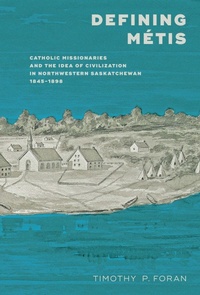
Defining Metis
Catholic Missionaries and the Idea of Civilizations in Northwestern Saskatchewan,1845-1898
Published on 30. April 2017
Book
Paperback/Softback
264 pages
978-0-88755-774-3 (ISBN)
Description
Defining Métis examineds categories used in the latter half of the nineteenth century by Catholic missionaries to describe Indigenous people in what is now northwestern Saskatchewan. It argues that the construction and evolution of these categories reflected missionaries' changing interests and agendas.
Defining Métis sheds light on the earliest phases of Catholic missionary work among Indigenous peoples in western and northern Canada. It examines various interrelated aspects of this work, including the beginings of residential schooling, transportation and communications and relations between the Church, the Hudson's Bay Company and the federal government.
While focusing on the the Oblates of Mary Immaculate and their central mission at Ile-à-la-Crosse, this study illuminates broad processes that informed Catholic missionary perceptions and impelled their evolution over a fifty-three-year period. In particular, this study illuminates processes that shaped Oblate conceptions of sauvage and métis. It does this through a qualitative analysis of documents that were produced within the Oblates' institutional apparatus—offical correspondence, mission journals, registers, and published reports.
Foran challenges the orthodox notion that Oblate commentators simply discovered and described a singular, empirically exisiting, and readily identifiable Métis population. Rather, he contends that Oblates played an important role in the conceptual production ofles métis.
Defining Métis sheds light on the earliest phases of Catholic missionary work among Indigenous peoples in western and northern Canada. It examines various interrelated aspects of this work, including the beginings of residential schooling, transportation and communications and relations between the Church, the Hudson's Bay Company and the federal government.
While focusing on the the Oblates of Mary Immaculate and their central mission at Ile-à-la-Crosse, this study illuminates broad processes that informed Catholic missionary perceptions and impelled their evolution over a fifty-three-year period. In particular, this study illuminates processes that shaped Oblate conceptions of sauvage and métis. It does this through a qualitative analysis of documents that were produced within the Oblates' institutional apparatus—offical correspondence, mission journals, registers, and published reports.
Foran challenges the orthodox notion that Oblate commentators simply discovered and described a singular, empirically exisiting, and readily identifiable Métis population. Rather, he contends that Oblates played an important role in the conceptual production ofles métis.
More details
Language
English
Place of publication
Winnipeg
Canada
Target group
Professional and scholarly
Product notice
Paperback (trade)
Unsewn / adhesive bound
Illustrations
Maps
Dimensions
Height: 226 mm
Width: 152 mm
Thickness: 18 mm
Weight
358 gr
ISBN-13
978-0-88755-774-3 (9780887557743)
Copyright in bibliographic data and cover images is held by Nielsen Book Services Limited or by the publishers or by their respective licensors: all rights reserved.
Schweitzer Classification
Person
Timothy P. Foran is the Curator of British North America at the Canadian Museum of History, Gatineau, Quebec.