

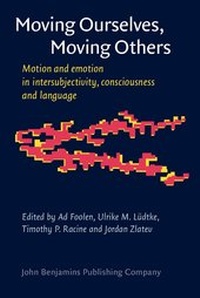
Moving Ourselves, Moving Others
Motion and emotion in intersubjectivity, consciousness and language
Published on 12. April 2012
Book
Hardback
492 pages
978-90-272-4156-6 (ISBN)
Description
The close relationship between motion (bodily movement) and emotion (feelings) is not an etymological coincidence. While moving ourselves, we move others; in observing others move - we are moved ourselves. The fundamentally interpersonal nature of mind and language has recently received due attention, but the key role of (e)motion in this context has remained something of a blind spot. The present book rectifies this gap by gathering contributions from leading philosophers, psychologists and linguists working in the area. Framed by an introducing prologue and a summarizing epilogue (written by Colwyn Trevarthen, who brought the phenomenological notion of intersubjectivity to a wider audience some 30 years ago) the volume elaborates a dynamical, active view of emotion, along with an affect-laden view of motion - and explores their significance for consciousness, intersubjectivity, and language. As such, it contributes to the emerging interdisciplinary field of mind science, transcending hitherto dominant computationalist and cognitivist approaches.
As of February 2018, this e-book is freely available, thanks to the support of libraries working with Knowledge Unlatched.
As of February 2018, this e-book is freely available, thanks to the support of libraries working with Knowledge Unlatched.
Reviews / Votes
Moving Ourselves, Moving Others is an indispensable contribution to the human science of mutuality in meaning, feeling and understanding. It belongs on the shelves of all students of subjectivity, intersubjectivity and sociality, with contributions by leading researchers from a host of disciplines and a profusion of perspectives. -- Chris Sinha, University of Portsmouth, Co-editor of The Shared MindMore details
Other editions
Additional editions
Ad Foolen | Ulrike M. Lüdtke | Timothy P. Racine
Moving Ourselves, Moving Others
Motion and emotion in intersubjectivity, consciousness and language
E-Book
04/2012
John Benjamins Publishing Company
€123.99
Available for download
Persons
Content
1. Introduction; 2. Prologue: Bodily motion, emotion and mind science (by Zlatev, Jordan); 3. Part I. Consciousness; 4. Fundamental and inherently interrelated aspects of animation (by Sheets-Johnstone, Maxine); 5. Could moving ourselves be the link between emotion and consciousness? (by Ellis, Ralph D.); 6. Visual perception and self-movement: Another look (by Overgaard, Soren); 7. Emotion regulation through the ages (by Shanker, Stuart G.); 8. Moving others matters (by Reddy, Vasudevi); 9. Part II. Intersubjectivity; 10. Neurons, neonates and narrative: From empathic resonance to empathic understanding (by Gallagher, Shaun); 11. Intersubjectivity in the lifeworld: Meaning, cognition, and affect (by Fultner, Barbara); 12. Primates, motion and emotion: To what extent nonhuman primates are intersubjective and why (by Racine, Timothy P.); 13. Reaching, requesting and reflecting: From interpersonal engagement to thinking (by Carpendale, Jeremy I.M.); 14. Intuitive meaning: Supporting impulses for interpersonal life in the sociosphere of human knowledge, practice and language (by Frank, Bodo); 15. Relational emotions in semiotic and linguistic development: Towards an intersubjective theory of language learning and language therapy (by Ludtke, Ulrike M.); 16. Part III. Language; 17. The relevance of emotion for language and linguistics (by Foolen, Ad); 18. From pre-symbolic gestures to language: Multisensory early intervention in deaf children (by Gunther, Klaus-B.); 19. The challenge of complexity: Body, mind and language in interaction (by Weigand, Edda); 20. (E)motion in the XVIIth century: A closer look at the changing semantics of the French verbs emouvoir and mouvoir (by Bloem, Annelies); 21. Metaphor and subjective experience: A study of motion-emotion metaphors in English, Swedish, Bulgarian, and Thai (by Zlatev, Jordan); 22. Epilogue: Natural sources of meaning in human sympathetic vitality (by Trevarthen, Colwyn); 23. Index