

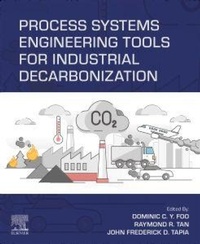
Process Systems Engineering Tools for Industrial Decarbonization
Will be published approx. on 1. August 2026
Book
Paperback/Softback
250 pages
978-0-443-21721-0 (ISBN)
Description
Process Systems Engineering Tools for Industrial Decarbonization explores the latest mathematical methods driving large-scale adoption of technologies aimed at reducing carbon emissions in industrial systems. By examining systematic strategies for planning, decision-making, and designing low-carbon industrial processes, the book offers readers-both experts and newcomers-a comprehensive understanding of how recent advances in process engineering can support a sustainable future. Special emphasis is placed on the integration and optimization of cutting-edge technologies such as Carbon Capture, Utilization, and Storage (CCUS), Negative Emission Technologies (NETs), and other innovative decarbonization solutions as they mature and become viable at scale.
Beyond technical frameworks, the book addresses the urgent need to manage rising atmospheric CO? levels, which now average 420 ppm-well above safe thresholds. It highlights the importance of using decision-making tools to efficiently deploy and systematize available technologies, ensuring the industrial sector contributes effectively to climate mitigation.
Beyond technical frameworks, the book addresses the urgent need to manage rising atmospheric CO? levels, which now average 420 ppm-well above safe thresholds. It highlights the importance of using decision-making tools to efficiently deploy and systematize available technologies, ensuring the industrial sector contributes effectively to climate mitigation.
More details
Language
English
Place of publication
Philadelphia
United States
Target group
Professional and scholarly
Product notice
Paperback (trade)
Unsewn / adhesive bound
Dimensions
Height: 229 mm
Width: 152 mm
Weight
450 gr
ISBN-13
978-0-443-21721-0 (9780443217210)
Copyright in bibliographic data and cover images is held by Nielsen Book Services Limited or by the publishers or by their respective licensors: all rights reserved.
Schweitzer Classification
Persons
Dominic Foo is a Professor of Process Design and Integration at the University of Nottingham Malaysia and is the Founding Director for the Centre of Excellence for Green Technologies. He is a Fellow of the Institution of Chemical Engineers (IChemE), Fellow of the Academy of Sciences Malaysia (ASM), Fellow of the Institution of Engineers Malaysia (IEM), Chartered Engineer (CEng) with the Engineering Council UK, Professional Engineer (PEng) with the Board of Engineer Malaysia (BEM), ASEAN Chartered Professional Engineers (ACPE), as well as the President for the Asia Pacific Confederation of Chemical Engineering (APCChE). He is top 1% world-renowned scientist according to Stanford List, working in process integration for resource conservation and CO2 reduction. Professor Foo is an active author, with eight books, more than 190 journal papers and made more than 240 conference presentations, with more than 30 keynote/plenary speeches. Professor Foo is the Editor-in-Chief for Process Integration and Optimization for Sustainability (Springer Nature), Subject Editor for Process Safety & Environmental Protection (Elsevier), and editorial board members for several other renowned journals. He is the winners of the Innovator of the Year Award 2009 of IChemE, Young Engineer Award 2010 of IEM, Outstanding Young Malaysian Award 2012 of Junior Chamber International (JCI), Outstanding Asian Researcher and Engineer 2013 (Society of Chemical Engineers, Japan), and Top Research Scientist Malaysia 2016 (ASM). Raymond Tan is a full professor of chemical engineering, University Fellow and current Vice-Chancellor for Research and Innovation at De La Salle University, Manila, Philippines. His main areas of research are process systems engineering (PSE) and process integration (PI). Professor Tan received his BS and MS degrees in chemical engineering and PhD in mechanical engineering from De La Salle University. He has authored more than 220 Scopus-listed publications and is co-editor-in-chief of Process Integration and Optimization for Sustainability (Springer/Nature), subject editor of Sustainable Production and Consumption (Elsevier/IChemE), and an editorial board member of Clean Technologies and Environmental Policy (Springer/Nature) and Int. J. of Supply Chain and Operations Resilience (Inderscience). He is also editor of the books Recent Advances in Sustainable Process Design and Optimization (World Scientific) and Process Design Strategies for Biomass Conversion Systems (Wiley). John Frederick D. Tapia is an associate professor in the Department of Chemical Engineering at the De La Salle University, Manila, Philippines. He develops research on optimization tools such as for carbon, capture, utilization, and storage (CCUS) and oil palm value chain.
The team has a combined H-index of 113. It is composed of a junior faculty (Dr. Tapia) whose experience is on the development of mathematical tools for planning and design of industrial systems such as CCUS, and oil palm value chain, and two professors (Prof Tan and Prof Foo) with extensive experience as editors on process integration and optimizations. Their background in industrial decarbonization research (e.g., CCUS, bioenergy, etc.) enables the development of high-quality book chapters that, together create a collection of systematic tools for industrial decarbonization.
The team has a combined H-index of 113. It is composed of a junior faculty (Dr. Tapia) whose experience is on the development of mathematical tools for planning and design of industrial systems such as CCUS, and oil palm value chain, and two professors (Prof Tan and Prof Foo) with extensive experience as editors on process integration and optimizations. Their background in industrial decarbonization research (e.g., CCUS, bioenergy, etc.) enables the development of high-quality book chapters that, together create a collection of systematic tools for industrial decarbonization.
Editor
Professor of Process Design and Integration, Center of Excellence for Green Technologies, University of Nottingham Malaysia, Malaysia
Professor, Department of Chemical Engineering, De La Salle University Manila, Philippines
Associate Professor, Department of Chemical Engineering, De La Salle University Manila, Philippines
Content
1: A state-of-the-art review of mathematical tools for industrial decarbonization
2 to 3: Optimization of Energy Systems with Negative Emissions Technologies (NETs) using Mathematical Programming Approaches
5: Carbon-constrained Energy Planning with CCUS using Mathematical Programming Approaches
6 to 7: P-graph Approaches for Industrial Decarbonization with CCUS Technology
8 to 9: P-graph Approaches for Biomass and Bioenergy for Industrial Decarbonization
10 to 11: Pinch Analysis and Targeting Techniques for Industrial Decarbonization
2 to 3: Optimization of Energy Systems with Negative Emissions Technologies (NETs) using Mathematical Programming Approaches
5: Carbon-constrained Energy Planning with CCUS using Mathematical Programming Approaches
6 to 7: P-graph Approaches for Industrial Decarbonization with CCUS Technology
8 to 9: P-graph Approaches for Biomass and Bioenergy for Industrial Decarbonization
10 to 11: Pinch Analysis and Targeting Techniques for Industrial Decarbonization