

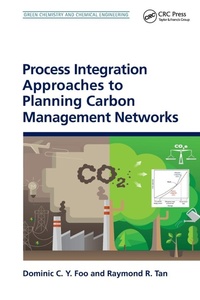
Process Integration Approaches to Planning Carbon Management Networks
1st Edition
Published on 13. December 2021
Book
Paperback/Softback
172 pages
978-1-032-24281-1 (ISBN)
Description
Process Integration Approaches to Planning Carbon Management Networks provides a comprehensive treatment of carbon emissions pinch analysis (CEPA), covering the fundamentals as well as more advanced variants based on mathematical programming. A significant portion of the book is dedicated to case studies that provide a range of examples to demonstrate how CEPA can be applied to practical energy planning problems. Selected chapters also include electronic supplements (e.g., spreadsheet templates and software code) to aid the reader in applying these methods to new sets of data. This book is ideal for academic researchers and graduate students interested in carbon-constrained energy planning models and applications.
This book
Provides essential information on CEPA and mathematical programming
Gives illustrative examples and case studies drawn from contemporary climatic issues
Covers state-of-the-art methodological developments
Discusses about applications in various countries
Offers additional support through supplementary spreadsheet templates and software code
Professor Dominic Foo is a professor of process design and integration at the University of Nottingham Malaysia. He is a fellow of the Institution of Chemical Engineers, a fellow of the Academy of Science Malaysia, a chartered engineer with the UK Engineering Council, and a professional engineer with the Board of Engineers Malaysia. He works on process integration for resource conservation and CO2 reduction, with more than 400 published works. Prof. Foo is the co-editor-in-chief for Process Integration and Optimization for Sustainability, subject editor for Process Safety & Environmental Protection, and an editorial board member for several other renowned journals.
Raymond R. Tan is a professor of chemical engineering and university fellow at De La Salle University, Philippines. He is also a member of the National Academy of Science and Technology of the Philippines. His main areas of research are process systems engineering and process integration, where he has over 300 published works. Prof. Tan received his BS and MS degrees in chemical engineering and PhD in mechanical engineering from De La Salle University. He is also a co-editor-in-chief of Process Integration and Optimization for Sustainability, subject editor of Sustainable Production and Consumption, and an editorial board member of Clean Technologies and Environmental Policy.
This book
Provides essential information on CEPA and mathematical programming
Gives illustrative examples and case studies drawn from contemporary climatic issues
Covers state-of-the-art methodological developments
Discusses about applications in various countries
Offers additional support through supplementary spreadsheet templates and software code
Professor Dominic Foo is a professor of process design and integration at the University of Nottingham Malaysia. He is a fellow of the Institution of Chemical Engineers, a fellow of the Academy of Science Malaysia, a chartered engineer with the UK Engineering Council, and a professional engineer with the Board of Engineers Malaysia. He works on process integration for resource conservation and CO2 reduction, with more than 400 published works. Prof. Foo is the co-editor-in-chief for Process Integration and Optimization for Sustainability, subject editor for Process Safety & Environmental Protection, and an editorial board member for several other renowned journals.
Raymond R. Tan is a professor of chemical engineering and university fellow at De La Salle University, Philippines. He is also a member of the National Academy of Science and Technology of the Philippines. His main areas of research are process systems engineering and process integration, where he has over 300 published works. Prof. Tan received his BS and MS degrees in chemical engineering and PhD in mechanical engineering from De La Salle University. He is also a co-editor-in-chief of Process Integration and Optimization for Sustainability, subject editor of Sustainable Production and Consumption, and an editorial board member of Clean Technologies and Environmental Policy.
More details
Series
Language
English
Place of publication
London
United Kingdom
Publishing group
Taylor & Francis Ltd
Target group
College/higher education
Professional Practice & Development
Illustrations
57 s/w Abbildungen
57 Illustrations, black and white
Dimensions
Height: 234 mm
Width: 156 mm
Thickness: 10 mm
Weight
275 gr
ISBN-13
978-1-032-24281-1 (9781032242811)
Copyright in bibliographic data and cover images is held by Nielsen Book Services Limited or by the publishers or by their respective licensors: all rights reserved.
Schweitzer Classification
Other editions
Additional editions
Dominic C. Y. Foo | Raymond R. Tan
Process Integration Approaches to Planning Carbon Management Networks
Book
04/2020
1st Edition
CRC Press
€232.70
Shipment within 15-20 days
Dominic C. Y. Foo | Raymond R. Tan
Process Integration Approaches to Planning Carbon Management Networks
E-Book
03/2020
1st Edition
CRC Press
€101.99
Available for download
Dominic C. Y. Foo | Raymond R. Tan
Process Integration Approaches to Planning Carbon Management Networks
E-Book
03/2020
1st Edition
CRC Press
€101.99
Available for download
Persons
Professor Dominic Foo is a Professor of Process Design and Integration at the University of Nottingham Malaysia. He is a Fellow of the Institution of Chemical Engineers, a Fellow of the Academy of Science Malaysia, a Chartered Engineer with the UK Engineering Council, a Professional Engineer with the Board of Engineer Malaysia. He works on process integration for resource conservation and CO2 reduction, with more than 400 published works. Professor Foo is the co-Editor-in-Chief for Process Integration and Optimization for Sustainability, Subject Editor for Process Safety & Environmental Protection, and editorial board members for several other renowned journals.
Raymond R. Tan is Professor of Chemical Engineering and University Fellow at De La Salle University, Philippines. He is also a member of the National Academy of Science and Technology of the Philippines. His main areas of research are process systems engineering and process integration, where he has over 300 published works. Prof. Tan received his BS and MS degrees in chemical engineering and PhD in mechanical engineering from De La Salle University. He is also co-editor-in-chief of Process Integration and Optimization for Sustainability, subject editor of Sustainable Production and Consumption, and an editorial board member of Clean Technologies and Environmental Policy.
Raymond R. Tan is Professor of Chemical Engineering and University Fellow at De La Salle University, Philippines. He is also a member of the National Academy of Science and Technology of the Philippines. His main areas of research are process systems engineering and process integration, where he has over 300 published works. Prof. Tan received his BS and MS degrees in chemical engineering and PhD in mechanical engineering from De La Salle University. He is also co-editor-in-chief of Process Integration and Optimization for Sustainability, subject editor of Sustainable Production and Consumption, and an editorial board member of Clean Technologies and Environmental Policy.
Content
Section A. Basic Methodology for Carbon Management Networks. 1. Global Energy and Climate Landscape. 2. Graphical Targeting Techniques for Carbon Emission Pinch analysis (CEPA). 3. Algebraic and Automated Targeting Techniques for Carbon Emission Pinch Analysis (CEPA). 4. Pinch Analysis Techniques for Carbon Capture and Storage (CCS). 5. Superstructure-Based Mathematical Programming. Section B. Applications of Carbon Management Networks. 6. Applications of Carbon Emission Pinch Analysis (CEPA) for China. 7. Applications of Carbon Emission Pinch Analysis (CEPA) for Indian Electricity Sector. 8. Multi-Period Power Generation Planning for the United Arab Emirates (UAE). 9. Carbon Emission Reduction Targeting for Bioenergy Supply Chain in Malaysia. 10. Carbon and Resource Constrained Energy Sector Planning for Taiwan. Index.