

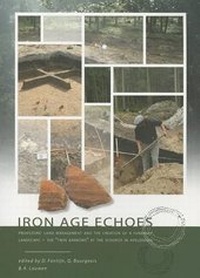
Iron Age Echoes
Prehistoric land management and the creation of a funerary landscape - the "twin barrows" at the Echoput in Apeldoorn
Published on 30. September 2012
Book
Paperback/Softback
174 pages
978-90-8890-073-0 (ISBN)
Description
Groups of burial mounds may be among the most tangible and visible remains of Europe's prehistoric past. Yet, not much is known on how "barrow landscapes" came into being . This book deals with that topic, by presenting the results of archaeological research carried out on a group of just two barrows that crown a small hilltop near the Echoput ("echo-well") in Apeldoorn, the Netherlands.
In 2007, archaeologists of the Ancestral Mounds project of Leiden University carried out an excavation of parts of these mounds and their immediate environment. They discovered that these mounds are rare examples of monumental barrows from the later part of the Iron Age. They were probably built at the same time, and their similarities are so conspicuous that one might speak of "twin barrows".
The research team was able to reconstruct the long-term history of this hilltop. We can follow how the hilltop that is now deep in the forests of the natural reserve of the Kroondomein Het Loo, once was an open place in the landscape. With pragmatism not unlike our own, we see how our prehistoric predecessors carefully managed and maintained the open area for a long time, before it was transformed into a funerary site. The excavation yielded many details on how people built the barrows by cutting and arranging heather sods, and how the mounds were used for burial rituals in the Iron Age.
In 2007, archaeologists of the Ancestral Mounds project of Leiden University carried out an excavation of parts of these mounds and their immediate environment. They discovered that these mounds are rare examples of monumental barrows from the later part of the Iron Age. They were probably built at the same time, and their similarities are so conspicuous that one might speak of "twin barrows".
The research team was able to reconstruct the long-term history of this hilltop. We can follow how the hilltop that is now deep in the forests of the natural reserve of the Kroondomein Het Loo, once was an open place in the landscape. With pragmatism not unlike our own, we see how our prehistoric predecessors carefully managed and maintained the open area for a long time, before it was transformed into a funerary site. The excavation yielded many details on how people built the barrows by cutting and arranging heather sods, and how the mounds were used for burial rituals in the Iron Age.
More details
Language
English
Place of publication
Leiden
Netherlands
Target group
College/higher education
Professional and scholarly
Illustrations
26x01 | 72x02
Dimensions
Height: 297 mm
Width: 210 mm
ISBN-13
978-90-8890-073-0 (9789088900730)
Copyright in bibliographic data and cover images is held by Nielsen Book Services Limited or by the publishers or by their respective licensors: all rights reserved.
Schweitzer Classification
Persons
Quentin performed his PhD study within the research project Ancestral Mounds.In his research he dealt with groups of barrows and their position within the landscape. Through extensive GIS-analyses he attempted to shed some light on the choice of location for the placement of the burial monuments. Why were they placed there, what could be seen from that location, and how did this develop through time?