

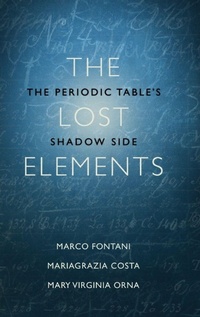
The Lost Elements
The Periodic Table's Shadow Side
Published on 20. November 2014
Book
Hardback
576 pages
978-0-19-938334-4 (ISBN)
Description
In the mid-nineteenth century, chemists came to the conclusion that elements should be organized by their atomic weights. However, the atomic weights of various elements were calculated erroneously, and chemists also observed some anomalies in the properties of other elements. Over time, it became clear that the periodic table as currently comprised contained gaps, missing elements that had yet to be discovered. A rush to discover these missing pieces followed, and a seemingly endless amount of elemental discoveries were proclaimed and brought into laboratories. It wasn't until the discovery of the atomic number in 1913 that chemists were able to begin making sense of what did and what did not belong on the periodic table, but even then, the discovery of radioactivity convoluted the definition of an element further. Throughout its formation, the periodic table has seen false entries, good-faith errors, retractions, and dead ends; in fact, there have been more elemental "discoveries" that have proven false than there are current elements on the table.
The Lost Elements: The Shadow Side of Discovery collects the most notable of these instances, stretching from the nineteenth century to the present. The book tells the story of how scientists have come to understand elements, by discussing the failed theories and false discoveries that shaped the path of scientific progress. Chapters range from early chemists' stubborn refusal to disregard alchemy as legitimate practice, to the effects of the atomic number on discovery, to the switch in influence from chemists to physicists, as elements began to be artificially created in the twentieth century. Along the way, Fontani, Costa, and Orna introduce us to the key figures in the development of the periodic table as we know it. And we learn, in the end, that this development was shaped by errors and gaffs as much as by correct assumptions and scientific conclusions.
The Lost Elements: The Shadow Side of Discovery collects the most notable of these instances, stretching from the nineteenth century to the present. The book tells the story of how scientists have come to understand elements, by discussing the failed theories and false discoveries that shaped the path of scientific progress. Chapters range from early chemists' stubborn refusal to disregard alchemy as legitimate practice, to the effects of the atomic number on discovery, to the switch in influence from chemists to physicists, as elements began to be artificially created in the twentieth century. Along the way, Fontani, Costa, and Orna introduce us to the key figures in the development of the periodic table as we know it. And we learn, in the end, that this development was shaped by errors and gaffs as much as by correct assumptions and scientific conclusions.
Reviews / Votes
Recommended. All academic, general, and professional history of chemistry collections. * CHOICE * Rarely has so much been written so authoritatively about things that do not exist. In their marvellous The Lost Elements, chemists Marco Fontani, Mariagrazia Costa and Mary Virginia Orna detail the discovery of dozens of elements that turned out not to be ... staggeringly comprehensive, well researched book * Theodore Gray, Nature * Thank goodness these stories have been brought back to life. * Peter Wothers, Times Higher Education Supplement * This reasonably-priced book has excellent indexes of discoverers' names, the lost elements (preceded by a chronological list of these) and general subjects. The literature coverage is heroic, with 1500 up-to-date references, often from obscure journals. * Chemistry World * The book is meticulously researched and fills a void in the history of chemistry ... A valuable reference for historians of science and an essential read for anyone with a serious interest in the elements and their discovery. * Ashley Augustyniak, Distillations, the Chemical Heritage Foundation Magazine * The Lost Elements: The Periodic Tables Shadow Side is a book to be savored, read and reread, because it reveals the real history of chemistry in the form of adventure stories. * Jeffrey Kovac, Journal of Chemical Education *More details
Language
English
Place of publication
New York
United States
Target group
College/higher education
Professional and scholarly
Illustrations
55 illustrations
Dimensions
Height: 240 mm
Width: 161 mm
Thickness: 37 mm
Weight
1087 gr
ISBN-13
978-0-19-938334-4 (9780199383344)
Copyright in bibliographic data and cover images is held by Nielsen Book Services Limited or by the publishers or by their respective licensors: all rights reserved.
Schweitzer Classification
Other editions
Additional editions
Marco Fontani | Mariagrazia Costa | Mary Virginia Orna
The Lost Elements
The Periodic Table's Shadow Side
E-Book
10/2014
OUP USA
€39.49
Available for download
Persons
Marco Fontani and Mariagrazia Costa both are affiliated with the Department of Chemistry at the University of Florence. Mary Virginia Orna is affiliated with the Department of Chemistry at the College of New Rochelle.
Content
Table of Contents ; Part I. Before 1789: Early Errors and Early Elements ; Part II. 1789-1869: From Lavoisier to Mendeleev: The First Errors at the Dawn of Concept ; Part III. 1869-1914: From the Periodic Table to Moseley's Revolution: Rips and Tears in Medeleev's Net ; Part IV. 1914-1939: From Nuclear Classification to the First Accelerators: Chemists' Paradise Lost...(and Physicists' Paradise Regained) ; Part V. 1939 to the Present. Beyond Uranium, to the Stars ; Part VI. No Place for Them in the Periodic Table: Bizarre Elements ; Part VII. Modern Alchemy: The Dream to Transmute the Elements Has Always Been with Us