

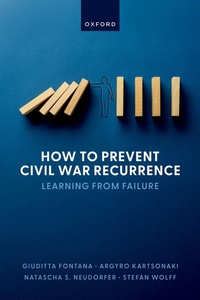
How to Prevent Civil War Recurrence
Learning from Failure
Will be published approx. on 12. March 2026
Book
Hardback
256 pages
978-0-19-899381-0 (ISBN)
Description
Civil wars remain the most frequent form of political violence worldwide. They are becoming deadlier and more contagious, often spilling over state borders and drawing in regional and global powers. Despite sustained efforts to end them through negotiations, civil wars are also becoming more intractable: Frequently peace agreements break down and widespread conflict-related violence resumes.
This book explores whether and how civil war recurrence can be prevented. It examines the full course of peace processes that experienced conflict recurrence - often multiple times - before ultimately achieving the end of large-scale conflict-related violence. The authors use their innovative research design, the Multi-Stage Mixed Method Framework, which sequences machine learning, inferential statistical analysis, and congruence analysis, to transparently identify the factors that may help break the cycle of recurring civil war in 14 protracted peace processes, test them on a global dataset of the political agreements concluded between 1989 and 2016, and examine their impact on the protracted peace processes in Bangsamoro, Burundi, Cote d'Ivoire, Liberia, and Sierra Leone.
Through a complexity-informed theoretical lens, the book argues that the impact of peace accords is highly context-specific, but the careful crafting and implementation of peace agreements can help prevent civil war recurrence by fostering the emergence of coalitions for peace, i.e. multiple flexible and cooperative relationships between actors invested in building peace. The book demonstrates that the context-sensitive crafting of peace agreements, the committed international leadership of peace processes, and the adaptive implementation of the components of peace settlements in cooperation with grassroots actors, can mitigate the risk of civil war recurrence. In particular, the authors find robust evidence that UN leadership of peace processes and the incorporation of provisions to include women in post-conflict society substantially increase the probability of a stable end to conflict-related violence.
This book explores whether and how civil war recurrence can be prevented. It examines the full course of peace processes that experienced conflict recurrence - often multiple times - before ultimately achieving the end of large-scale conflict-related violence. The authors use their innovative research design, the Multi-Stage Mixed Method Framework, which sequences machine learning, inferential statistical analysis, and congruence analysis, to transparently identify the factors that may help break the cycle of recurring civil war in 14 protracted peace processes, test them on a global dataset of the political agreements concluded between 1989 and 2016, and examine their impact on the protracted peace processes in Bangsamoro, Burundi, Cote d'Ivoire, Liberia, and Sierra Leone.
Through a complexity-informed theoretical lens, the book argues that the impact of peace accords is highly context-specific, but the careful crafting and implementation of peace agreements can help prevent civil war recurrence by fostering the emergence of coalitions for peace, i.e. multiple flexible and cooperative relationships between actors invested in building peace. The book demonstrates that the context-sensitive crafting of peace agreements, the committed international leadership of peace processes, and the adaptive implementation of the components of peace settlements in cooperation with grassroots actors, can mitigate the risk of civil war recurrence. In particular, the authors find robust evidence that UN leadership of peace processes and the incorporation of provisions to include women in post-conflict society substantially increase the probability of a stable end to conflict-related violence.
More details
Language
English
Place of publication
Oxford
United Kingdom
Target group
Professional and scholarly
Product notice
sewn/stitched
Cloth over boards
With dust jacket
Dimensions
Height: 234 mm
Width: 156 mm
Thickness: 16 mm
Weight
553 gr
ISBN-13
978-0-19-899381-0 (9780198993810)
Copyright in bibliographic data and cover images is held by Nielsen Book Services Limited or by the publishers or by their respective licensors: all rights reserved.
Schweitzer Classification
Persons
Giuditta Fontana is Associate Professor in International Security at the University of Birmingham. She is a political scientist specialising in war-to-peace transitions, with a particular interest in peace agreements and post-conflict political and cultural institutions. She holds degrees from the London School of Economics and Political Science (B.Sc.) and King's College London (M.A., Ph.D.). Her publications include the monograph Education Policy and Power-Sharing in Post-Conflict Societies (2016), and dozens of book chapters and peer reviewed journal articles. She co-convenes the Political Studies Association's Specialist Group on Ethnopolitics and is Associate Editor of Nationalism and Ethnic Politics.
Argyro Kartsonaki is a Senior Researcher at the Institute for Peace Research and Security Policy (IFSH) at the University of Hamburg. Her area of expertise is peace and security with a particular interest in secessionist conflicts and war-to-peace transitions after civil wars. Her work has been published in Global Studies Quarterly, Conflict Management and Peace Science, and Nations and Nationalism, among others. Argyro is the author of the book Breaking Away: Kosovo's Unilateral Secession (2018). She is the co-editor of Ethnopolitics and of OSCE Insights.
Natascha S. Neudorfer is Professor of Political Economy at Heinrich-Heine-Universitaet Duesseldorf, Germany. She was previously Associate Professor and Birmingham Fellow at the University of Birmingham. Her expertise centres on how economic conditions interact with political institutions, influencing corruption levels, civil war likelihood, and recurrence. She focuses on measurement problems and quantitative research designs, including inferential statistics and machine learning, alongside mixed-methods approaches. Since 2024, Professor Neudorfer has been a commissioning editor for International Affairs. She also served as an associate editor for the Journal of Global Security Studies from 2019 to 2024.
Stefan Wolff is Professor of International Security at the University of Birmingham. A political scientist by background, he specialises in the management of contemporary security challenges. With three decades of experience in UK higher education, Wolff has a publication record that includes 24 books and over 100 journal articles and book chapters. He is the founding editor of Ethnopolitics, co-founder of Navigating the Vortex , and a regular international affairs contributor to The Conversation.
Argyro Kartsonaki is a Senior Researcher at the Institute for Peace Research and Security Policy (IFSH) at the University of Hamburg. Her area of expertise is peace and security with a particular interest in secessionist conflicts and war-to-peace transitions after civil wars. Her work has been published in Global Studies Quarterly, Conflict Management and Peace Science, and Nations and Nationalism, among others. Argyro is the author of the book Breaking Away: Kosovo's Unilateral Secession (2018). She is the co-editor of Ethnopolitics and of OSCE Insights.
Natascha S. Neudorfer is Professor of Political Economy at Heinrich-Heine-Universitaet Duesseldorf, Germany. She was previously Associate Professor and Birmingham Fellow at the University of Birmingham. Her expertise centres on how economic conditions interact with political institutions, influencing corruption levels, civil war likelihood, and recurrence. She focuses on measurement problems and quantitative research designs, including inferential statistics and machine learning, alongside mixed-methods approaches. Since 2024, Professor Neudorfer has been a commissioning editor for International Affairs. She also served as an associate editor for the Journal of Global Security Studies from 2019 to 2024.
Stefan Wolff is Professor of International Security at the University of Birmingham. A political scientist by background, he specialises in the management of contemporary security challenges. With three decades of experience in UK higher education, Wolff has a publication record that includes 24 books and over 100 journal articles and book chapters. He is the founding editor of Ethnopolitics, co-founder of Navigating the Vortex , and a regular international affairs contributor to The Conversation.
Author
Associate Professor in International SecurityAssociate Professor in International Security, University of Birmingham
Senior ResearcherSenior Researcher, University of Hamburg
Professor of Political EconomyProfessor of Political Economy, Heinrich-Heine-Universitaet Duesseldorf
Professor of International SecurityProfessor of International Security, University of Birmingham