

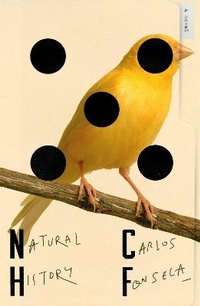
Natural History
A Novel
Published on 1. August 2020
Book
Hardback
320 pages
978-0-374-21630-6 (ISBN)
Description
Just before the dawn of the new millennium, a curator at a New Jersey museum of natural history receives an unusual invitation from a celebrated fashion designer. She shares the curator's fascination with the hidden forms of the animal kingdom - with camouflage and subterfuge - and she proposes that they collaborate on an exhibition, the form of which itself remains largely obscure, even as they enter into a strange relationship marked by evasion and elision.
Seven years later, after the death of the designer, the curator recovers the archive of their never-completed project. During a long night of insomnia, he finds within the archive a series of clues to the true story of the designer's family, a mind-bending puzzle that winds from Haifa, Israel, to bohemian 1970s New York to the Latin American jungle. On the way, he discovers a cast of characters whose own fixations interrogate the unstable frontiers between art, science, politics, and religion: an aging photographer, living nearly alone in an abandoned mining town where subterranean fires rage without end, who creates models of ruined cities; a former model turned conceptual artist - and a defendant in a trial over the very nature and purpose of art; a young indigenous boy who has received a vision of the end of the world. Reality is a curtain, as the curator realises, and to draw it back is to reveal the theater of obsession.
Natural History is the portrait of a world trapped between faith and irony, between tragedy and farce. A defiantly contemporary and impressively ambitious novel in the tradition of Italo Calvino and Ricardo Piglia, it confirms Carlos Fonseca as one of the most daring writers of his generation.
Seven years later, after the death of the designer, the curator recovers the archive of their never-completed project. During a long night of insomnia, he finds within the archive a series of clues to the true story of the designer's family, a mind-bending puzzle that winds from Haifa, Israel, to bohemian 1970s New York to the Latin American jungle. On the way, he discovers a cast of characters whose own fixations interrogate the unstable frontiers between art, science, politics, and religion: an aging photographer, living nearly alone in an abandoned mining town where subterranean fires rage without end, who creates models of ruined cities; a former model turned conceptual artist - and a defendant in a trial over the very nature and purpose of art; a young indigenous boy who has received a vision of the end of the world. Reality is a curtain, as the curator realises, and to draw it back is to reveal the theater of obsession.
Natural History is the portrait of a world trapped between faith and irony, between tragedy and farce. A defiantly contemporary and impressively ambitious novel in the tradition of Italo Calvino and Ricardo Piglia, it confirms Carlos Fonseca as one of the most daring writers of his generation.
More details
Language
English
Place of publication
New York
United States
Illustrations
8 Black-and-White Illustrations
Dimensions
Height: 236 mm
Width: 160 mm
Thickness: 31 mm
Weight
541 gr
ISBN-13
978-0-374-21630-6 (9780374216306)
Copyright in bibliographic data and cover images is held by Nielsen Book Services Limited or by the publishers or by their respective licensors: all rights reserved.
Schweitzer Classification
Other editions
Additional editions
E-Book
07/2020
Farrar, Straus and Giroux
€11.49
Available for download
Person
Carlos Fonseca was born in San Jose, Costa Rica, and spent half of his childhood and adolescence in Puerto Rico. In 2016, he was named one of the twenty best Latin American writers born in the 1980s at the Guadalajara Book Fair, and in 2017 he was included in the Bogota39 list of the best Latin American writers under forty. In 2018, he won the National Prize for Literature in Costa Rica, for his book of essays La Lucidez del Miope. He teaches at Trinity College, Cambridge, and lives in London.
Megan McDowell is a Spanish-language literary translator from Kentucky. Her work includes books by Alejandro Zambra, Samanta Schweblin, Mariana Enriquez, Gonzalo Torne, Lina Meruane, and Diego Zuniga. Her translations have been published in The New Yorker, Tin House, The Paris Review, Harper's, McSweeney's, Words Without Borders, and Vice, among others. Her translation of Zambra's novel Ways of Going Home won the 2013 PEN Award for Writing in Translation. She lives in Santiago, Chile.
Megan McDowell is a Spanish-language literary translator from Kentucky. Her work includes books by Alejandro Zambra, Samanta Schweblin, Mariana Enriquez, Gonzalo Torne, Lina Meruane, and Diego Zuniga. Her translations have been published in The New Yorker, Tin House, The Paris Review, Harper's, McSweeney's, Words Without Borders, and Vice, among others. Her translation of Zambra's novel Ways of Going Home won the 2013 PEN Award for Writing in Translation. She lives in Santiago, Chile.