

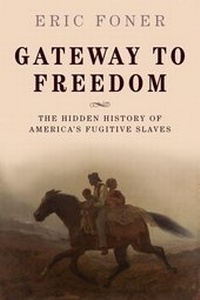
Gateway to Freedom
The Hidden History of America's Fugitive Slaves
Published on 26. February 2015
Book
Hardback
320 pages
978-0-19-873790-2 (ISBN)
Description
When slavery was a routine part of life in America's South, a secret network of activists and escape routes enabled slaves to make their way to freedom in what is now Canada. The 'underground railroad' has become part of folklore, but one part of the story is only now coming to light. In New York, a city whose banks, business and politics were deeply enmeshed in the slave economy, three men played a remarkable part, at huge personal risk.
In Gateway to Freedom, Pulitzer Prize-winning historian Eric Foner tells the story of Sydney Howard Gay, an abolitionist newspaper editor; Louis Napoleon, furniture polisher; and Charles B. Ray, a black minister. Between 1830 and 1860, with the secret help of black dockworkers, the network led by these three men helped no fewer than 3,000 fugitives to liberty. The previously unexamined records compiled by Gay offer a portrait of fugitive slaves who passed through New York City -- where they originated, how they escaped, who helped them in both North and South, and how they were forwarded to freedom in Canada.
In Gateway to Freedom, Pulitzer Prize-winning historian Eric Foner tells the story of Sydney Howard Gay, an abolitionist newspaper editor; Louis Napoleon, furniture polisher; and Charles B. Ray, a black minister. Between 1830 and 1860, with the secret help of black dockworkers, the network led by these three men helped no fewer than 3,000 fugitives to liberty. The previously unexamined records compiled by Gay offer a portrait of fugitive slaves who passed through New York City -- where they originated, how they escaped, who helped them in both North and South, and how they were forwarded to freedom in Canada.
Reviews / Votes
a serious, well-researched book * Times, Gerard DeGroot * A terrific and powerful story. * New York Post * There's suspense and drama on nearly every page.... It's the art of historical narrative at its very best with individual heroes caught up in the larger sweep of social movements. * Huffington Post, Jonah Raskin * Makes palpable the nuances and complexities of the past.... Intellectually probing and emotionally resonant, "Gateway to Freedom" reminds us that history can be as stirring as the most gripping fiction. * Los Angeles Times, Wendy Smith * Gripping ... excellent.... He merits high praise for contributing solid information and thoughtful analysis to the history of this shadowy, extensive network. * Wall Street Journal, David S. Reynolds * A consummate narrative ... Mandatory and riveting reading.... In 1855, an abolitionist newspaper predicted that 'these acts of sublime heroism ... will excite the admiration, the reverence and the indignation of generations yet to come.' This book finally redeems that faith. * New York Times, Sam Roberts * Illuminating ... Superb ... an invaluable addition to our history. * New York Times Book Review, Kevin Baker *More details
Language
English
Place of publication
Oxford
United Kingdom
Illustrations
35 black & white halftones, 3 maps
Dimensions
Height: 241 mm
Width: 162 mm
Thickness: 32 mm
Weight
668 gr
ISBN-13
978-0-19-873790-2 (9780198737902)
Copyright in bibliographic data and cover images is held by Nielsen Book Services Limited or by the publishers or by their respective licensors: all rights reserved.
Schweitzer Classification
Other editions
Additional editions
E-Book
02/2015
1st Edition
OUP eBook
€20.49
Available for download
E-Book
02/2015
1st Edition
OUP eBook
€20.49
Available for download
Person
Eric Foner is DeWitt Clinton Professor of History at Columbia University, and one of the United States' most prominent historians. A fellow of the American Academy of Arts and Sciences and the British Academy, he has held visiting professorships at both Oxford and Cambridge universities, as well as at Queen Mary University of London and Moscow State University. His publications include Nothing But Freedom: Emancipation and Its Legacy (1983), the multi-award-winning Reconstruction: America's Unfinished Revolution, 1863-1877 (1988), and The Story of American Freedom (1998). The Fiery Trial: Abraham Lincoln and American Slavery (2010) was awarded, amongst others, both the Bancroft Prize and the Lincoln Prize, as well as the Pulitzer Prize for History.
Content
1. Introduction ; 2. Slavery, Freedom, and Fugitive Slaves in New York City to 1840 ; 3. New York's Two Stations on the Underground Railroad ; 4. The Fugitive Slave Act in New York ; 5. The Record of Fugitives ; 6. And the War Came ; Notes ; Further Reading ; Index