

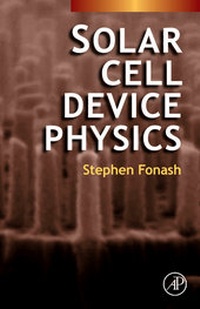
Solar Cell Device Physics
2nd Edition
Published on 17. June 2010
Book
Hardback
381 pages
978-0-12-374774-7 (ISBN)
Description
There has been an enormous infusion of new ideas in the field of solar cells over the last 15 years; discourse on energy transfer has gotten much richer, and nanostructures and nanomaterials have revolutionized the possibilities for new technological developments. However, solar energy cannot become ubiquitous in the world's power markets unless it can become economically competitive with legacy generation methods such as fossil fuels.
The new edition of Dr. Stephen Fonash's definitive text points the way toward greater efficiency and cheaper production by adding coverage of cutting-edge topics in plasmonics, multi-exiton generation processes, nanostructures and nanomaterials such as quantum dots. The book's new structure improves readability by shifting many detailed equations to appendices, and balances the first edition's semiconductor coverage with an emphasis on thin-films. Further, it now demonstrates physical principles with simulations in the well-known AMPS computer code developed by the author.
The new edition of Dr. Stephen Fonash's definitive text points the way toward greater efficiency and cheaper production by adding coverage of cutting-edge topics in plasmonics, multi-exiton generation processes, nanostructures and nanomaterials such as quantum dots. The book's new structure improves readability by shifting many detailed equations to appendices, and balances the first edition's semiconductor coverage with an emphasis on thin-films. Further, it now demonstrates physical principles with simulations in the well-known AMPS computer code developed by the author.
Reviews / Votes
"I'm a big fan of this book. It's one of the best PV textbooks out there, and in particular it provides unparalleled discussion of the device physics of solar cells." --Associate Professor Kylie Catchpole, Research School of Engineering, Australian National UniversityMore details
Edition
2nd edition
Language
English
Place of publication
San Diego
United States
Publishing group
Elsevier Science Publishing Co Inc
Target group
College/higher education
Engineering professionals, researchers and students developing & implementing solar technologies in government and private labs, leading universities, major corporations and small start-ups. Includes Civil, Environmental, Energy and Materials Engineers.
Dimensions
Height: 229 mm
Width: 152 mm
Weight
640 gr
ISBN-13
978-0-12-374774-7 (9780123747747)
Copyright in bibliographic data and cover images is held by Nielsen Book Services Limited or by the publishers or by their respective licensors: all rights reserved.
Schweitzer Classification
Other editions
New editions
Stephen J. Fonash
Photovoltaic Device Physics and Materials
Solar Cell, Photovoltronic, and Sensor Structures
Book
12/2025
3rd Edition
Academic Press
€132.46
Shipment within 15-20 days
Additional editions
Stephen J. Fonash
Solar Cell Device Physics
E-Book
06/2010
2nd Edition
Academic Press
€96.95
Available for download
Stephen Fonash
Solar Cell Device Physics
Book
11/2009
2nd Edition
Academic Press
€124.79
Shipment within 15-20 days
Person
Dr. Stephen Fonash is Bayard D. Kunkle Chair Professor Emeritus of Engineering Sciences at Penn State University and Chief Technology Officer of Solarity LCCM, LLC. His activities at Penn State include serving as the director of Penn State's Center for Nanotechnology Education and Utilization (CNEU), director of the National Science Foundation Advanced Technology Education Center, and director of the Pennsylvania Nanofabrication Manufacturing Technology Partnership.
Prof. Fonash's education contributions focus on nanotechnology post-secondary education and workforce development. His research activities encompass the processing and device physics of micro- and nanostructures including solar cells, sensors, and transistors. He has published over 300 refereed papers in the areas of education, nanotechnology, photovoltaics, microelectronics devices and processing, sensors, and thin film transistors. His book "Solar Cell Device Physics? has been termed the "bible of solar cell physics? and his solar cell computer modeling code AMPS is used by almost 800 groups around the world. Dr. Fonash holds 29 patents in his research areas, many of which are licensed to industry. He is on multiple journal boards, serves as an advisor to university and government groups, has consulted for a variety of firms, and has co-founded two companies. Prof. Fonash received his Ph.D. from the University of Pennsylvania. He is a Fellow of the Institute of Electrical and Electronics Engineers and a Fellow of the Electrochemical Society
Prof. Fonash's education contributions focus on nanotechnology post-secondary education and workforce development. His research activities encompass the processing and device physics of micro- and nanostructures including solar cells, sensors, and transistors. He has published over 300 refereed papers in the areas of education, nanotechnology, photovoltaics, microelectronics devices and processing, sensors, and thin film transistors. His book "Solar Cell Device Physics? has been termed the "bible of solar cell physics? and his solar cell computer modeling code AMPS is used by almost 800 groups around the world. Dr. Fonash holds 29 patents in his research areas, many of which are licensed to industry. He is on multiple journal boards, serves as an advisor to university and government groups, has consulted for a variety of firms, and has co-founded two companies. Prof. Fonash received his Ph.D. from the University of Pennsylvania. He is a Fellow of the Institute of Electrical and Electronics Engineers and a Fellow of the Electrochemical Society
Content
1. Introduction 2. Properties Basic to Photovoltaic Energy Conversion 3. Solar Cell Materials and Structures 4. Homojunction Solar Cells5. Semiconductor-Semiconductor Heterojunction Cells6. Surface-Barrier Solar Cells