

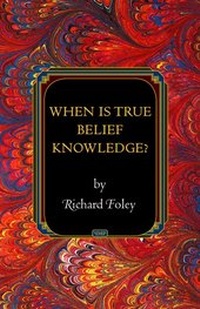
When Is True Belief Knowledge?
Will be published approx. on 22. July 2012
Book
Hardback
168 pages
978-0-691-15472-5 (ISBN)
Description
A woman glances at a broken clock and comes to believe it is a quarter past seven. Yet, despite the broken clock, it really does happen to be a quarter past seven. Her belief is true, but it isn't knowledge. This is a classic illustration of a central problem in epistemology: determining what knowledge requires in addition to true belief. In this provocative book, Richard Foley finds a new solution to the problem in the observation that whenever someone has a true belief but not knowledge, there is some significant aspect of the situation about which she lacks true beliefs--something important that she doesn't quite "get." This may seem a modest point but, as Foley shows, it has the potential to reorient the theory of knowledge. Whether a true belief counts as knowledge depends on the importance of the information one does or doesn't have. This means that questions of knowledge cannot be separated from questions about human concerns and values. It also means that, contrary to what is often thought, there is no privileged way of coming to know. Knowledge is a mutt. Proper pedigree is not required. What matters is that one doesn't lack important nearby information.
Challenging some of the central assumptions of contemporary epistemology, this is an original and important account of knowledge.
Challenging some of the central assumptions of contemporary epistemology, this is an original and important account of knowledge.
Reviews / Votes
"[Foley's] book impressively combines breadth, succinctness, and readability. It will profit both professional philosophers and advanced students in epistemology."--Choice "This book is an illustrative and erudite contribution to the field of epistemology. Foley departs from the typical rational objective and presents an intuitive account of knowledge and true belief."--Diana Karbonowska, European Legacy "This highly original book will be of interest to both epistemologists and philosophers from other sub-disciplines whose work engages with the theory of knowledge. Thought provoking and well argued, it is well worth the reader's time."--Lisa Warenski, MindMore details
Series
Language
English
Place of publication
New Jersey
United States
Target group
College/higher education
Professional and scholarly
Product notice
Trade binding
Dimensions
Height: 203 mm
Width: 127 mm
Weight
340 gr
ISBN-13
978-0-691-15472-5 (9780691154725)
Copyright in bibliographic data and cover images is held by Nielsen Book Services Limited or by the publishers or by their respective licensors: all rights reserved.
Schweitzer Classification
Other editions
Additional editions
Richard Foley
When Is True Belief Knowledge?
E-Book
07/2012
1st Edition
Princeton University Press
€42.99
Available for download
Person
Richard Foley is professor of philosophy and vice chancellor for strategic planning at New York University. He is the author of Intellectual Trust in Oneself and Others, Working Without a Net: A Study of Egocentric Epistemology, and The Theory of Epistemic Rationality.
Content
Part I: The Basic Idea Chapter 1: An Observation 3 Chapter 2: Post-Gettier Accounts of Knowledge 6 Chapter 3: Knowledge Stories 9 Chapter 4: Intuitions about Knowledge 12 Chapter 5: Important Truths 19 Chapter 6: Maximally Accurate and Comprehensive Beliefs 32 Chapter 7: The Beetle in the Box 41 Chapter 8: Knowledge Blocks 46 Chapter 9: The Theory of Knowledge and Theory of Justified Belief 51 Part II: Puzzles and Questions Chapter 10: The Value of True Belief 59 Chapter 11: The Value of Knowledge 65 Chapter 12: The Lottery and Preface 70 Chapter 13: Reverse Lottery Stories 73 Chapter 14: Lucky Knowledge 78 Chapter 15: Closure and Skepticism 81 Chapter 16: Disjunctions 86 Chapter 17: Fixedness and Knowledge 88 Chapter 18: Instability and Knowledge 91 Chapter 19: Misleading Defeaters 95 Chapter 20: Believing That I Don't Know 99 Chapter 21: Introspective Knowledge 102 Chapter 22: Perceptual Knowledge 106 Chapter 23: A Priori Knowledge 110 Chapter 24: Collective Knowledge 113 Part III: The Structure of Epistemology Chapter 25: A Look Back 121 Chapter 26: Epistemology within a General Theory of Rationality 124 Chapter 27: The Core Concepts of Epistemology 134 Notes 137 Index 149