

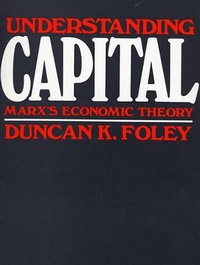
Understanding Capital
Marx's Economic Theory
Published on 23. November 1986
Book
Paperback/Softback
200 pages
978-0-674-92088-0 (ISBN)
Description
Understanding Capital is a brilliantly lucid introduction to Marxist economic theory. Duncan Foley builds an understanding of the theory systematically, from first principles through the definition of central concepts to the development of important applications. All of the topics in the three volumes of Capital are included, providing the reader with a complete view of Marxist economics.
Foley begins with a helpful discussion of philosophical problems readers often encounter in tackling Marx, including questions of epistemology, explanation, prediction, determinism, and dialectics. In an original extension of theory, he develops the often neglected concept of the circuit of capital to analyze Marx's theory of the reproduction of capital. He also takes up central problems in the capitalist economy: equalization of the rates of profit (the "transformation problem"); productive and unproductive labor and the division of surplus value; and the falling rate of profit. He concludes with a discussion of the theory of capitalist crisis and of the relation of Marx's critique of capitalism to his conception of socialism.
Through a careful treatment of the theory of money in relation to the labor theory of value, Foley clarifies the relation of prices to value and of Marx's categories of analysis to conventional business and national income accounts, enabling readers to use Marx's theory as a tool for the analysis of practical problems. The text is closely keyed throughout to the relevant chapters in Capital and includes suggestions for further reading on the topics discussed.
Foley begins with a helpful discussion of philosophical problems readers often encounter in tackling Marx, including questions of epistemology, explanation, prediction, determinism, and dialectics. In an original extension of theory, he develops the often neglected concept of the circuit of capital to analyze Marx's theory of the reproduction of capital. He also takes up central problems in the capitalist economy: equalization of the rates of profit (the "transformation problem"); productive and unproductive labor and the division of surplus value; and the falling rate of profit. He concludes with a discussion of the theory of capitalist crisis and of the relation of Marx's critique of capitalism to his conception of socialism.
Through a careful treatment of the theory of money in relation to the labor theory of value, Foley clarifies the relation of prices to value and of Marx's categories of analysis to conventional business and national income accounts, enabling readers to use Marx's theory as a tool for the analysis of practical problems. The text is closely keyed throughout to the relevant chapters in Capital and includes suggestions for further reading on the topics discussed.
More details
Language
English
Place of publication
Cambridge, Mass
United States
Target group
Professional and scholarly
US School Grade: College Graduate Student
Illustrations
5 line illustrations
Dimensions
Height: 229 mm
Width: 152 mm
Weight
272 gr
ISBN-13
978-0-674-92088-0 (9780674920880)
Copyright in bibliographic data and cover images is held by Nielsen Book Services Limited or by the publishers or by their respective licensors: all rights reserved.
Schweitzer Classification
Other editions
Additional editions
E-Book
07/2009
Harvard University Press
€36.19
Available for download
Person
Duncan K. Foley is Leo Model Professor of Economics at The New School for Social Research.
Content
On Reading Marx: Method The Commodity: Labor, Value, Money The Theory of Capital and Surplus Value Production under Capitalism The Reproduction of Capital The Equalization of the Rate of Profit The Division of Surplus Value The Falling Rate of Profit The Theory of Capitalist Crisis Socialism Suggested Readings References Index