

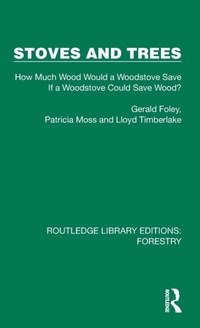
Stoves and Trees
How Much Wood Would a Woodstove Save If a Woodstove Could Save Wood?
1st Edition
Published on 25. June 2024
Book
Hardback
88 pages
978-1-032-76730-7 (ISBN)
Description
Originally published in 1984, Stoves and Trees asks whether better stoves really help the two billion people in the developing world who rely on wood and charcoal for cooking and heating their homes. It also asks if improved stoves actually save fuel and if they can help slow down tropical deforestation. The book not only examines newer stoves but also ascertains how people buy, collect and use wood in the developing world. It finds that most forests are cleared for timber or farmland not fuelwood and explains why stoves which show 50% energy savings in European laboratories often save little or none in village homes.
More details
Series
Language
English
Place of publication
London
United Kingdom
Publishing group
Taylor & Francis Ltd
Target group
College/higher education
Postgraduate, Undergraduate Advanced, and Undergraduate Core
Dimensions
Height: 222 mm
Width: 145 mm
Thickness: 9 mm
Weight
258 gr
ISBN-13
978-1-032-76730-7 (9781032767307)
Copyright in bibliographic data and cover images is held by Nielsen Book Services Limited or by the publishers or by their respective licensors: all rights reserved.
Schweitzer Classification
Other editions
Additional editions
Gerald Foley | Patricia Moss | Lloyd Timberlake
Stoves and Trees
How Much Wood Would a Woodstove Save If a Woodstove Could Save Wood?
Book
05/2026
1st Edition
Routledge
€46.30
Shipment within 10-20 days
Gerald Foley | Patricia Moss | Lloyd Timberlake
Stoves and Trees
How Much Wood Would a Woodstove Save If a Woodstove Could Save Wood?
E-Book
06/2024
1st Edition
Routledge
€39.49
Available for download
Gerald Foley | Patricia Moss | Lloyd Timberlake
Stoves and Trees
How Much Wood Would a Woodstove Save If a Woodstove Could Save Wood?
E-Book
06/2024
1st Edition
Routledge
€39.49
Available for download
Persons
Gerald Foley started his professional life as a civil engineer and in the early 1970s wrote his first book, The Energy Question, which was re-published in 1992. His work became increasingly focussed on the global south, and he joined the International Institute for Environment and Development. He then became Director of Policy Research at the Panos Institute and finally a partner in the Nordic Consulting Group. Gerald is the author of 9 books and numerous reports, technical studies and academic articles.
Lloyd Timberlake, former Reuter global science editor, is an award-winning journalist and author who has worked in more than 65 countries covering issues of the environment, development and sustainable development.
Patricia Moss
Lloyd Timberlake, former Reuter global science editor, is an award-winning journalist and author who has worked in more than 65 countries covering issues of the environment, development and sustainable development.
Patricia Moss
Content
Summary. Introduction. 1. Improved Stove Programmes: Why? 2. The Open Fire: Pros and Cons 3. Traditional, 'unimproved' Stoves 4. Domestic Fuels and How They are Used 5. Designing 'New' Stoves 6. Stove Programmes: Past and Present 7. But Do They Save Wood? 8. Improving Improved Stove Programmes.