

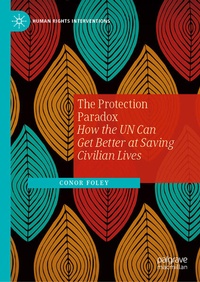
The Protection Paradox
How the UN Can Get Better at Saving Civilian Lives
Published on 14. March 2023
Book
Hardback
XVII, 168 pages
978-3-031-27426-8 (ISBN)
Description
The book provides an up to date and authoritative account of how the UN is re[1]thinking its obligations to protect civilians during conflicts. Based on hundreds of interviews with senior UN officials and humanitarian protection staff in headquarters and in the field and a review of the UN´s ´grey literature´. It also draws on the author´s own experience of working on human rights and protection in some of the world´s most violent conflicts. It is written not about what the UN ought to do - or how it could have behaved differently in an abstract or theoretically ideal world - but what the UN is actually doing to fulfil the fundamental purposes set forth in its Charter.
More details
Series
Edition
2023 ed.
Language
English
Place of publication
Cham
Switzerland
Publishing group
Springer International Publishing
Target group
Professional and scholarly
Illustrations
1 s/w Abbildung
XVII, 168 p. 1 illus.
Dimensions
Height: 216 mm
Width: 153 mm
Thickness: 15 mm
Weight
363 gr
ISBN-13
978-3-031-27426-8 (9783031274268)
DOI
10.1007/978-3-031-27427-5
Schweitzer Classification
Other editions
Additional editions
Book
03/2024
Palgrave Macmillan
€48.14
Shipment within 15-20 days
E-Book
03/2023
1st Edition
Palgrave Macmillan
€48.14
Available for download
Person
Conor Foley teaches at the Pontifícia Universidade Católica do Rio de Janeiro and works as a consultant on legal reform, human rights, and humanitarian protection in conflict zones. His previous books include UN Peacekeeping Operations and the Protection of Civilians, saving succeeding generations (2017) The Thin Blue Line, how humanitarianism went to war (2008) and In Spite of You: Bolsonaro and the new Brazilian resistance (2019).
Content
Chapter 1: Introduction.- Chapter 2: Understanding Protection.- Chapter 3: Understanding Peacekeeping.- Chapter 4: Understanding the Applicable Legal Framework.- Chapter 5: Human rights and humanitarianism.- Chapter 6: Protection of civilians through working with armed non-state actors.- Chapter 7: Conclusions.