

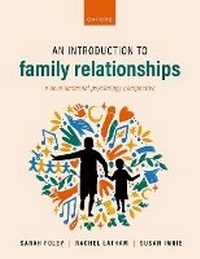
An Introduction to Family Relationships
Will be published approx. on 15. February 2026
Book
Paperback/Softback
200 pages
978-0-19-896676-0 (ISBN)
Description
The most accessible and engaging introduction to family psychology, which explores the ways families and family relationships influence development across infancy, childhood, and adolescence.
An Introduction to Family Relationships provides a concise, up-to-date overview of the foundations of family psychology and child development. It covers key theories and research evidence and considers the differences within and between families, and of family life across diverse cultures.
Key Features
- The only accessible introduction to the field of family psychology.
- Discusses a diverse range of family-structures and the influence that cultural differences can have on family relationships.
- Discusses recent and innovative research that helps lay a foundation for students' understanding of the field.
- Figures and illustrations help to demonstrate key points and increase students' engagement with the text.
This edition is available for students and institutions to purchase in a variety of formats: the e-book and Psychology Trove offer a mobile experience and convenient access along with functionality tools, navigation features, and links that offer extra learning support.
For more information about e-books, please visit www.oxfordtextbooks.co.uk/ebooks
An Introduction to Family Relationships provides a concise, up-to-date overview of the foundations of family psychology and child development. It covers key theories and research evidence and considers the differences within and between families, and of family life across diverse cultures.
Key Features
- The only accessible introduction to the field of family psychology.
- Discusses a diverse range of family-structures and the influence that cultural differences can have on family relationships.
- Discusses recent and innovative research that helps lay a foundation for students' understanding of the field.
- Figures and illustrations help to demonstrate key points and increase students' engagement with the text.
This edition is available for students and institutions to purchase in a variety of formats: the e-book and Psychology Trove offer a mobile experience and convenient access along with functionality tools, navigation features, and links that offer extra learning support.
For more information about e-books, please visit www.oxfordtextbooks.co.uk/ebooks
Reviews / Votes
A comprehensive and research-driven exploration of family dynamics and development. The materials are methodologically robust, covering a range of study designs and ethical considerations to ensure a nuanced understanding of family life. * Antonion Bova, Catholic University of the Sacred Heart (Milan, Italy) * A comprehensive, contemporary, and inclusive overview of family dynamics, covering both traditional and non-traditional family structures. The content is engaging, well-researched, and relevant to current societal trends, with clear explanations of key concepts and theoretical frameworks. The materials are particularly strong in their focus on the diversity of family types, including LGBTQ+ families, families formed through assisted reproductive technologies, and those with single parents. This inclusivity is essential for fostering a broad and realistic understanding of family life in today's world. * Valentina Sclafani, University of Lincoln *More details
Language
English
Place of publication
Oxford
United Kingdom
Target group
College/higher education
Dimensions
Height: 246 mm
Width: 189 mm
Thickness: 14 mm
Weight
402 gr
ISBN-13
978-0-19-896676-0 (9780198966760)
Copyright in bibliographic data and cover images is held by Nielsen Book Services Limited or by the publishers or by their respective licensors: all rights reserved.
Schweitzer Classification
Persons
Sarah Foley is a Lecturer in Developmental Psychology in Moray House School of Education and a Fellow of the Higher Education Academy at the University of Edinburgh.
Rachel M. Latham is a Postdoctoral Research Associate at the Social, Genetic, and Developmental Centre in King's College London.
Susan Imrie is a Supernumerary Fellow and the Head of Wellbeing at Murrary Edwards College in the University of Cambridge.
Rachel M. Latham is a Postdoctoral Research Associate at the Social, Genetic, and Developmental Centre in King's College London.
Susan Imrie is a Supernumerary Fellow and the Head of Wellbeing at Murrary Edwards College in the University of Cambridge.
Content
1: Why and how do we study the family?
2: Transition to parenthood: New roles and relationships
3: Mother-infant relationships: A spotlight on attachment theory
4: Father-child relationships
5: Sibling relationships
6: Family life: Going to the school gates
7: Family life during adolescence
8: Families in challenging circumstances
9: The future of families
2: Transition to parenthood: New roles and relationships
3: Mother-infant relationships: A spotlight on attachment theory
4: Father-child relationships
5: Sibling relationships
6: Family life: Going to the school gates
7: Family life during adolescence
8: Families in challenging circumstances
9: The future of families