

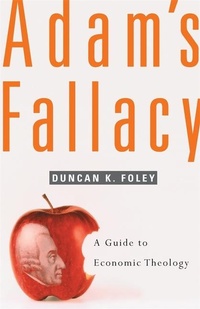
Adam's Fallacy
A Guide to Economic Theology
Published on 1. April 2008
Book
Paperback/Softback
288 pages
978-0-674-02729-9 (ISBN)
Description
This book could be called "The Intelligent Person's Guide to Economics." Like Robert Heilbroner's The Worldly Philosophers, it attempts to explain the core ideas of the great economists, beginning with Adam Smith and ending with Joseph Schumpeter. In between are chapters on Thomas Malthus, David Ricardo, Karl Marx, the marginalists, John Maynard Keynes, Friedrich Hayek, and Thorstein Veblen. The title expresses Duncan Foley's belief that economics at its most abstract and interesting level is a speculative philosophical discourse, not a deductive or inductive science. Adam's fallacy is the attempt to separate the economic sphere of life, in which the pursuit of self-interest is led by the invisible hand of the market to a socially beneficial outcome, from the rest of social life, in which the pursuit of self-interest is morally problematic and has to be weighed against other ends.
Smith and his successors argued that the market and the division of labor that is fostered by it result in tremendous gains in productivity, which lead to a higher standard of living. Yet the market does not address the problem of distribution-that is, how is the gain in wealth to be divided among the classes and members of society? Nor does it address such problems as the long-run well-being of the planet.
Adam's Fallacy is beautifully written and contains interesting observations and insights on almost every page. It will engage the reader's thoughts and feelings on the deepest level.
Smith and his successors argued that the market and the division of labor that is fostered by it result in tremendous gains in productivity, which lead to a higher standard of living. Yet the market does not address the problem of distribution-that is, how is the gain in wealth to be divided among the classes and members of society? Nor does it address such problems as the long-run well-being of the planet.
Adam's Fallacy is beautifully written and contains interesting observations and insights on almost every page. It will engage the reader's thoughts and feelings on the deepest level.
Reviews / Votes
Duncan Foley has written a fair-minded and very well-written history of economic thinking organized by the theme announced in his title. He contends that economic thinking has been dominated by fallacious attempts to separate positive analysis from moral judgment. This leitmotif has enabled him to create a unified presentation, which will be very useful to the general reader. -- Kenneth Arrow, Stanford University This learned and lively book reconnects economics to the complexities and conflicts of politics and society, and powerfully reminds us that there are no fixed, necessary, or inevitable laws that govern markets. By tracing the history of economic thinking as a form of engagement with values and policies, it also thoughtfully beckons us to grasp together the twin challenges of scientific understanding and moral reasoning. -- Ira Katznelson, Columbia University Adam's Fallacy is a stimulating tour d'horizon of the ideas of the great economists. In clear, accessible prose, Duncan Foley, a noted theorist himself, describes what they wrote and what their work means today, providing an insightful and thought-provoking critique of economics. -- Stanley Engerman, University of Rochester Foley gets deep into the analytical content of major schools of thought, ranking Adam's Fallacy up there with Heilbroner's classic. -- Robert Solow * New York Review of Books * So what is 'Adam's Fallacy?'...It is the idea that the economic sphere of life constitutes a separate realm 'in which the pursuit of self-interest is guided by objective laws to a socially beneficent outcome'...Professor Foley's book is simultaneously an introduction to economic theory and a critique of it. It is his version of the classic introduction for the economically challenged by Robert L. Heilbroner, The Worldly Philosophers, now in its seventh edition. Adam's Fallacy concentrates more on the worldly philosophies rather than on the philosophers, on economic theory rather than on the characters and events that along with Mr. Heilbroner's masterly storytelling gave The Worldly Philosophers so much color and verve...By questioning economic theory's cordoning off of an economic spheres of life ruled by its own laws and expertise, Professor Foley is implicitly proposing limits to the secularization that is an underlying characteristic of modernity. Secularization has meant that in a cultural transformation, major areas of human activity set themselves up as quasi-autonomous, with their own standards, authorities, and guiding principles. -- Peter Steinfels * New York Times * [A] passionate book, to be welcomed in a discipline notably devoid of passion. [Adam's Fallacy] can be read for pleasure and enlightenment by economists and non-economists alike. -- David Throsby * Times Literary Supplement *More details
Language
English
Place of publication
Cambridge, Mass.
United States
Publishing group
Harvard University Press
Target group
College/higher education
US School Grade: College Graduate Student
Product notice
Paperback (trade)
Unsewn / adhesive bound
Illustrations
7 line illustrations, 1 table
Dimensions
Height: 202 mm
Width: 134 mm
Thickness: 21 mm
Weight
331 gr
ISBN-13
978-0-674-02729-9 (9780674027299)
Copyright in bibliographic data and cover images is held by Nielsen Book Services Limited or by the publishers or by their respective licensors: all rights reserved.
Schweitzer Classification
Other editions
Additional editions
E-Book
07/2009
The Belknap Press
€37.69
Available for download
Person
Duncan K. Foley is Leo Model Professor of Economics at The New School for Social Research.
Content
Preface 1. Adam"s Vision The Division of Labor The Theory of Value Capital Accumulation The Invisible Hand and the State Smith's Theory of Money Adam's Fallacy Revisited 2. Gloomy Science Second Thoughts Malthus and Population The Context of Malthus's Essay Malthus's Postulates Malthusian Logic Population and Food since Malthus's Time Ricardo and the Limits to Growth Ricardo's Labor Theory of Value Accumulation and the Stationary State Ricardo's Views on Machinery The Political Economy of Poverty 3. The Severest Critic Historical Materialism The Commodity and the Theory of Value Capitalist Exploitation Accumulation and the Falling Rate of Profit Primitive Accumulation The Transition to Socialism Marx and Proletarian Revolution Marxist Theory and Social Change 4. On the Margins Adam's Fallacy Needs New Shoes Marginalism Where Do Prices Come From? Marginalism and Social Welfare Marginalism and Time Veblen and Conspicuous Consumption 5. Voices in the Air John Maynard Keynes World Capitalism in Keynes's Time Say's Law and Laissez-Faire Labor Markets and Unemployment Expectations and Money The Fate of Capitalism Complexity vs. Collectivism The Prophet of Technology 6. Grand Illusions Looking in the Mirror Two-Armed Economists Escaping Adam's Fallacy Face to Face with Adam's Curse Reading Further Appendix Demographic Equilibrium Theories of Money and Prices Ricardo's Theory of Rent and Accumulation Decomposition of the Value of Commodities The Working Day Index