

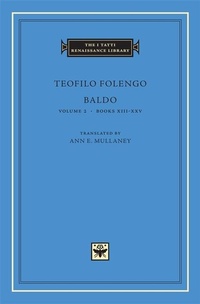
Baldo: Volume 2
Books XIII-XXV
Published on 1. November 2008
Book
Hardback
560 pages
978-0-674-03124-1 (ISBN)
Description
Teofilo Folengo (1491-1544) was born in Mantua and joined the Benedictine order, but became a runaway monk and a satirist of monasticism. In 1517 he published, under the pseudonym Merlin Cocaio, the first version of his macaronic narrative poem Baldo, later enlarged and elaborated. It blended Latin with various Italian dialects in hexameter verse, inventing a deliberately droll language whose humor depends on the mixture of high and low tonalities. An important example of the mock-heroic epic, the work was a model for Rabelais and was frequently reprinted.
Baldo, the hero of these picaresque adventures, is a descendant of French royalty who starts out as something of a juvenile delinquent. The poem narrates episodes that include imprisonment; battles with local authorities, pirates, shepherds, witches, and demons; and a journey to the underworld. Throughout Baldo is accompanied by various companions, among them a giant, a centaur, a magician, and his best friend Cingar, a wickedly inventive trickster ("practicus ad beffas"). This edition provides the first English translation of this hilarious send-up of ancient epic and Renaissance chivalric romance.
Baldo, the hero of these picaresque adventures, is a descendant of French royalty who starts out as something of a juvenile delinquent. The poem narrates episodes that include imprisonment; battles with local authorities, pirates, shepherds, witches, and demons; and a journey to the underworld. Throughout Baldo is accompanied by various companions, among them a giant, a centaur, a magician, and his best friend Cingar, a wickedly inventive trickster ("practicus ad beffas"). This edition provides the first English translation of this hilarious send-up of ancient epic and Renaissance chivalric romance.
Reviews / Votes
The "Baldus," as it also became known, is the Renaissance's masterpiece of macaronic poetry, a burlesque satire that blends farce, humor and social commentary in hexameters that knead together Latin and various Italian dialects. The overall effect sounds like so many slips of the tongue, double entendres, or the Latinate effusions of an improviser akin to the 1950s prototypical rapper Lord Buckley...Published in two volumes with the original macaronic-Latin text on facing pages, this is a very accessible prose translation of Folengo's last revised edition of the Baldus, which was published posthumously in 1552. Apart from the fact that this last edition was over twice the length of the first 1517 edition, its polish and fine-tuning reflect the dedication Folengo bestowed on it over three decades--gradually removing personal grudges, refining and increasing its macaronic quality, and making it more delightful...Baldo is not for the faint of heart or delicate of nose, and at times one needs an iron gut to digest it. But keep Folengo's injunction in mind--to at all times laugh with and not at its author--and welcome to the world of macaroni. Eat your fill, hold your sides; words will never taste the same again. -- Olivier Burckhardt * The Guardian *More details
Series
Language
English
Place of publication
Cambridge, Mass
United States
Target group
College/higher education
Product notice
sewn/stitched
Cloth over boards
With dust jacket
Dimensions
Height: 203 mm
Width: 140 mm
Thickness: 36 mm
Weight
640 gr
ISBN-13
978-0-674-03124-1 (9780674031241)
Copyright in bibliographic data and cover images is held by Nielsen Book Services Limited or by the publishers or by their respective licensors: all rights reserved.
Schweitzer Classification