

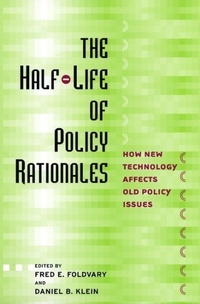
The Half-Life of Policy Rationales
How New Technology Affects Old Policy Issues
Published on 3. May 2003
Book
Hardback
276 pages
978-0-8147-4776-6 (ISBN)
Description
The Half-Life of Policy Rationales argues that the appropriateness of policy depends on the state of technology, and that the justifications for many public policies are dissolving as technology advances. As new detection and metering technologies are being developed for highways, parking, and auto emissions, and information becomes more accessible and user-friendly, this volume argues that quality and safety are better handled by the private sector. As for public utilities, new means of producing and delivering electricity, water, postal, and telephone services dissolve the old natural-monopolies rationales of the government.
This volume includes essays on marine resources, lighthouses, highways, parking, auto emissions, consumer product safety, money and banking, medical licensing, electricity, water delivery, postal service, community governance, and endangered species. The editors have mobilized the hands-on knowledge of field experts to develop theories about technology and public policy. The Half-Life of Policy Rationales will be of interest to readers in public policy, technology, property rights, and economics.
This volume includes essays on marine resources, lighthouses, highways, parking, auto emissions, consumer product safety, money and banking, medical licensing, electricity, water delivery, postal service, community governance, and endangered species. The editors have mobilized the hands-on knowledge of field experts to develop theories about technology and public policy. The Half-Life of Policy Rationales will be of interest to readers in public policy, technology, property rights, and economics.
Reviews / Votes
"Whether you are interested in the role of government and markets, or the role of technology in society, or in specific policy areas, Half-Life makes for stimulating reading. Foldvary and Klein should be commended for bringing together many disparate policy areas under one roof, and assessing the role of technology in promoting choice, freedom, and prosperity." (Knowledge, Technology, & Policy) "This makes for provocative and profitable reading." (Markets & Morality) "Points out a serious gap in the current theory of economic policy: it treats the current state of technology as fixed. New technologies can in fact solve many problems that otherwise appear to be market failures. This volume is one of the freshest and most vital contributions to the public policy debate in years." - Tyler Cowen,George Mason University and author of Creative Destruction: How Globalization Is Changing the World's Cultures "The thoughtful collection of papers shows that developments and technology will in the future preferentially favor individuals over governments as long as we get the policy framework right." - Terence Kealey,author of The Economic Laws of Scientific Research "The Half-Life of Policy Rationales is one clever book. Nothing in recent years on economics of new technology comes close." (The Independent Review)More details
Language
English
Place of publication
New York
United States
Target group
College/higher education
Professional and scholarly
Product notice
Trade binding
Dimensions
Height: 235 mm
Width: 159 mm
Thickness: 22 mm
Weight
494 gr
ISBN-13
978-0-8147-4776-6 (9780814747766)
Copyright in bibliographic data and cover images is held by Nielsen Book Services Limited or by the publishers or by their respective licensors: all rights reserved.
Schweitzer Classification
Other editions
Additional editions
Fred E. Foldvary | Daniel B. Klein
The Half-Life of Policy Rationales
How New Technology Affects Old Policy Issues
E-Book
05/2003
New York University Press
€142.99
Available for download
Persons
Fred E. Foldvary is a Lecturer in Economics at Santa Clara University. He is author of Public Goods and Private Communities and Dictionary of Free Market Economics.
Daniel B. Klein is Associate Professor of Economics at Santa Clara University. He is co-author of Curb Rights: A Foundation for Free Enterprise in Urban Transit and editor of Reputation: Studies in the Voluntary Elicitation of Good Conduct and What Do Economists Contribute?, available from NYU Press.
Daniel B. Klein is Associate Professor of Economics at Santa Clara University. He is co-author of Curb Rights: A Foundation for Free Enterprise in Urban Transit and editor of Reputation: Studies in the Voluntary Elicitation of Good Conduct and What Do Economists Contribute?, available from NYU Press.
Content
part i Metering, Excluding, and Charging1 Technology, Marine Conservation, and Fisheries Management2 The Lighthouse as a Private-Sector Collective Good3 Motorway Financing and Provision: Technology Favors a New Approach4 Buying Time at the Curb5 Fencing the Airshed: Using Remote Sensing to Police Auto Emissionspart ii Quality Assurance and Consumer Protection6 Technology and the Case for Free Banking7 Consumer Protection Regulation and Information on the Internet8 Medical Licensing: Existing Public Policy and Technological Changepart iii Natural Monopoly?9 Technology and Electricity: Overcoming the Umbilical Mentality10 Avoiding the Grid: Technology and the Decentralization of Water11 Technological Change and the Case for Government Intervention in Postal Servicespart iv Other Areas of Policy12 The Entrepreneurial Community in Light of Advancing Business Practices and Technologies13 Technology and the Protection of Endangered Species