

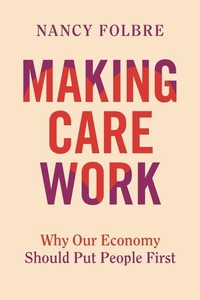
Making Care Work
Why Our Economy Should Put People First
1st Edition
Published on 31. March 2026
Book
Hardback
384 pages
978-0-520-40562-2 (ISBN)
Description
A bold critique of conventional economics that reveals why the time and money we devote to care work is vital to our economic future.
Our economy is much bigger than the dollar value of things we buy and sell. It depends on us-our health, our creativity, and our moral commitments. These capabilities don't have price tags but are crucial to a sustainable future. We need to acknowledge and reward the value of caring for ourselves and others, especially our children, our elderly, and those experiencing illness or disability.
From leading feminist economist Nancy Folbre, Making Care Work provides a compelling historical and economic account of care provision in the United States. Folbre traces the long and colorful history of resistance to bogus claims that only paid work "counts" and that employees in care services are always paid what they deserve. Explaining why care providers remain economically vulnerable today, she argues that more attention to the public benefits of care provision could help build the political coalitions needed to implement policies that put people first.
In this comprehensive and bold book, Folbre upends conventional economic thinking and maps a hopeful path toward a more equitable and sustainable economy.
Our economy is much bigger than the dollar value of things we buy and sell. It depends on us-our health, our creativity, and our moral commitments. These capabilities don't have price tags but are crucial to a sustainable future. We need to acknowledge and reward the value of caring for ourselves and others, especially our children, our elderly, and those experiencing illness or disability.
From leading feminist economist Nancy Folbre, Making Care Work provides a compelling historical and economic account of care provision in the United States. Folbre traces the long and colorful history of resistance to bogus claims that only paid work "counts" and that employees in care services are always paid what they deserve. Explaining why care providers remain economically vulnerable today, she argues that more attention to the public benefits of care provision could help build the political coalitions needed to implement policies that put people first.
In this comprehensive and bold book, Folbre upends conventional economic thinking and maps a hopeful path toward a more equitable and sustainable economy.
Reviews / Votes
"[Folbre's] belief that providing care 'is a precious and productive achievement' is compelling and urgent-surely a value that we should not only nurture throughout our entire society but also enshrine in law and policy." * Ms. Magazine *More details
Edition
First Edition
Language
English
Place of publication
Berkerley
United States
Target group
Professional and scholarly
Product notice
Cloth over boards
Illustrations
5 b-w figures, 2 tables
Dimensions
Height: 233 mm
Width: 159 mm
Thickness: 34 mm
Weight
742 gr
ISBN-13
978-0-520-40562-2 (9780520405622)
Copyright in bibliographic data and cover images is held by Nielsen Book Services Limited or by the publishers or by their respective licensors: all rights reserved.
Schweitzer Classification
Other editions
Additional editions
E-Book
03/2026
1st Edition
Naval Institute Press
€27.49
Available for download
Person
Nancy Folbre is Director of the Program on Gender and Care Work at the Political Economy Research Institute and Professor Emerita of Economics at UMass Amherst. She is the author of many books, including The Invisible Heart: Economics and Family Values.
Content
Contents
List of Illustrations
Introduction: Care Provision: An Achievement?
1. Human Capabilities: More Than Commodities?
2. Defining the Gainful: Who Are "Workers"?
3. Time Use Surveys: What Were You Doing?
4. Domestic Products: What Is Our Output?
5. Living Standards: Who's Better Off?
6. Valuing People: What's Your Life Worth?
7. The Care Diamond: Who Provides?
8. Household and Community Care: Will It Endure?
9. Care Services for Sale: Good Enough?
10. Public Social Spending: Waste or Investment?
Conclusion: Possible Futures?
Acknowledgments
Glossary
Notes
References
Index
List of Illustrations
Introduction: Care Provision: An Achievement?
1. Human Capabilities: More Than Commodities?
2. Defining the Gainful: Who Are "Workers"?
3. Time Use Surveys: What Were You Doing?
4. Domestic Products: What Is Our Output?
5. Living Standards: Who's Better Off?
6. Valuing People: What's Your Life Worth?
7. The Care Diamond: Who Provides?
8. Household and Community Care: Will It Endure?
9. Care Services for Sale: Good Enough?
10. Public Social Spending: Waste or Investment?
Conclusion: Possible Futures?
Acknowledgments
Glossary
Notes
References
Index