

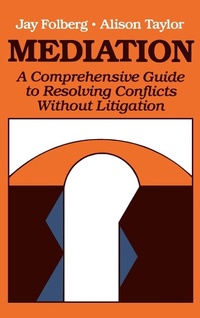
Mediation
A Comprehensive Guide to Resolving Conflicts Without Litigation
1st Edition
Published on 9. May 1984
Book
Hardback
420 pages
978-0-87589-594-9 (ISBN)
Description
Provides practical, how-to advice for mediating a variety of conflicts, including those arising from divorces, custody and visitation decisions, family conflict, neighborhood grievances, educational disagreements, environmental disputes, and problems in the workplace.
Reviews / Votes
"An invaluable guide for most practicing mediators, a volume that no one should be without." "A thorough as well as comprehensive guide to mediation. . . . Should be on every mediator's 'must read' list."More details
Language
English
Place of publication
New York
United States
Publishing group
John Wiley & Sons Inc
Target group
College/higher education
Product notice
sewn/stitched
Cloth over boards
Dimensions
Height: 235 mm
Width: 157 mm
Thickness: 29 mm
Weight
831 gr
ISBN-13
978-0-87589-594-9 (9780875895949)
Copyright in bibliographic data and cover images is held by Nielsen Book Services Limited or by the publishers or by their respective licensors: all rights reserved.
Schweitzer Classification
Persons
Jay Folberg and Alison Taylor are the authors of Mediation: A Comprehensive Guide to Resolving Conflicts Without Litigation, published by Wiley.
Content
Part one: Introduction to mediation and conflict resolution Development, definition, and functions of mediation
Nature of conflict and dispute resolution processes
Part two: Mediation stages, concepts, and skills
Stages in the mediation process
Counseling concepts for developing mediation skills
Methods for enhancing communication
Part three: Varieties of mediation and applications to practice
Diverse styles and approaches to mediating conflict
Family and divorce mediation
Applications to various conflict situations
Part four: Mediation as a profession
education, ethical, and practical dimensions
Education and training of mediators
Ethical, professional, and legal issues
Specific considerations in setting in a mediation service
Receiving and making referrals
Dealing with special concerns
Conclusion
Resources A.: Employment agreement
B.: Mediation guidelines
C.: Mediated custody and child support plan
D.: Code of professional conduct for mediators
E.: Selected list of national organizations
Nature of conflict and dispute resolution processes
Part two: Mediation stages, concepts, and skills
Stages in the mediation process
Counseling concepts for developing mediation skills
Methods for enhancing communication
Part three: Varieties of mediation and applications to practice
Diverse styles and approaches to mediating conflict
Family and divorce mediation
Applications to various conflict situations
Part four: Mediation as a profession
education, ethical, and practical dimensions
Education and training of mediators
Ethical, professional, and legal issues
Specific considerations in setting in a mediation service
Receiving and making referrals
Dealing with special concerns
Conclusion
Resources A.: Employment agreement
B.: Mediation guidelines
C.: Mediated custody and child support plan
D.: Code of professional conduct for mediators
E.: Selected list of national organizations