

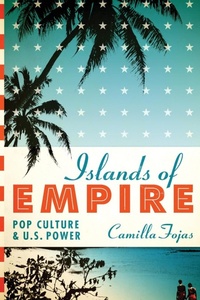
Islands of Empire
Pop Culture and U.S. Power
Published on 1. March 2014
Book
Paperback/Softback
252 pages
978-1-4773-0755-7 (ISBN)
Description
Camilla Fojas explores a broad range of popular culture media-film, television, journalism, advertisements, travel writing, and literature-with an eye toward how the United States as an empire imagined its own military and economic projects. Impressive in its scope, Islands of Empire looks to Cuba, Guam, Hawai'i, Puerto Rico, and the Philippines, asking how popular narratives about these island outposts expressed the attitudes of the continent throughout the twentieth century. Through deep textual readings of Bataan, Victory at Sea, They Were Expendable, and Back to Bataan (Philippines); No Man Is an Island and Max Havoc: Curse of the Dragon (Guam); Cuba, Havana, and Dirty Dancing: Havana Nights (Cuba); Blue Hawaii, Gidget Goes Hawaiian, and Paradise, Hawaiian Style (Hawai'i); and West Side Story, Fame, and El Cantante (Puerto Rico), Fojas demonstrates how popular texts are inseparable from U.S. imperialist ideology.
Drawing on an impressive array of archival evidence to provide historical context, Islands of Empire reveals the role of popular culture in creating and maintaining U.S. imperialism. Fojas's textual readings deftly move from location to location, exploring each island's relationship to the United States and its complementary role in popular culture. Tracing each outpost's varied and even contradictory political status, Fojas demonstrates that these works of popular culture mirror each location's shifting alignment to the U.S. empire, from coveted object to possession to enemy state.
Drawing on an impressive array of archival evidence to provide historical context, Islands of Empire reveals the role of popular culture in creating and maintaining U.S. imperialism. Fojas's textual readings deftly move from location to location, exploring each island's relationship to the United States and its complementary role in popular culture. Tracing each outpost's varied and even contradictory political status, Fojas demonstrates that these works of popular culture mirror each location's shifting alignment to the U.S. empire, from coveted object to possession to enemy state.
Reviews / Votes
"With Islands of Empire, Fojas, a professor of Latino and Latin American Studies at Chicago's DePaul University, shines a light through the screens of illusion that continue to form our mental picture of America's role in world affairs." (Milwaukee Shepherd Express) "Drawing on an impressive array of archival evidence to provide historical context, Islands of Empire reveals the role of popular culture in creating and maintaining American imperialism." (Utne Reader) "Islands of Empire may well be a very gratifying read for the wider public, beyond the strictly academic audience, as much for the writing style as for its references to the celebrated films and actors that form part of contemporary imagery." (Symploke)More details
Language
English
Place of publication
Austin, TX
United States
Target group
College/higher education
Professional and scholarly
Dimensions
Height: 229 mm
Width: 152 mm
Thickness: 15 mm
Weight
418 gr
ISBN-13
978-1-4773-0755-7 (9781477307557)
Copyright in bibliographic data and cover images is held by Nielsen Book Services Limited or by the publishers or by their respective licensors: all rights reserved.
Schweitzer Classification
Person
Camilla Fojas is an associate professor of media studies and affiliated faculty in American studies at the University of Virginia. Her most recent books are Border Bandits: Hollywood on the Southern Frontier and Transnational Crossroads: Remapping the Americas and the Pacific, coedited with Rudy Guevarra.
Content
Preface. Our Island Frontier: The Philippines, Guam, Hawaii, Puerto Rico, and Cuba
Acknowledgments
Introduction. Islands of Empire
Chapter One. Foreign Domestics: The Filipino "Home Front" in World War II Popular Culture
Chapter Two. Imperial Grief: Loss and Longing in Havana before Castro
Chapter Three. Paradise, Hawaiian Style: Pop Tourism and the State of Hawaii
Chapter Four. Tropical Metropolis: West Side Stories and Colonial Redemption
Chapter Five. The Guam Doctrine: Colonial Limbo in the Pacific
Afterword. Whither Empire? The Colonial Complex of U.S. Popular Culture
Notes
Works Cited
Index
Acknowledgments
Introduction. Islands of Empire
Chapter One. Foreign Domestics: The Filipino "Home Front" in World War II Popular Culture
Chapter Two. Imperial Grief: Loss and Longing in Havana before Castro
Chapter Three. Paradise, Hawaiian Style: Pop Tourism and the State of Hawaii
Chapter Four. Tropical Metropolis: West Side Stories and Colonial Redemption
Chapter Five. The Guam Doctrine: Colonial Limbo in the Pacific
Afterword. Whither Empire? The Colonial Complex of U.S. Popular Culture
Notes
Works Cited
Index