

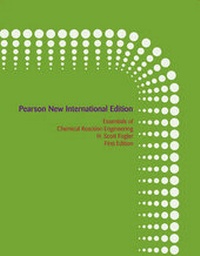
Essentials of Chemical Reaction Engineering: Pearson New International Edition
Published on 2. August 2013
Book
Mixed media product
966 pages
978-1-292-02586-5 (ISBN)
Description
This is the complete, modern introduction to chemical reaction engineering for today's readers: students who demand instantaneous access to information, have no time to waste, and want to enjoy the learning process while building their skills with both critical thinking and creative problem solving. H. Scott Fogler and M. Nihat Gurmen build on the strengths of their classic Elements of Chemical Reaction Engineering, Fourth Edition, enabling students to learn chemical reaction engineering through logic rather than memorization. They also provide extensive new resources to help students gain a deep intuitive understanding of how reactors behave in diverse situations. For example, they provide more than 60 realistic interactive simulations on CD-ROM - just one of many tools, videos, and games designed to support students with many different learning styles. Much of this book's content has been revised based on feedback from 200+ University of Michigan students who classroom-tested this book. Coverage includes: mole balances; conversion and reactor sizing; rate laws; stoichiometry; isothermal reactor design; conversion; molar flow rates; collection and analysis of rate data; multiple reactions; reaction mechanisms, pathways, bioreactions, and bioreactors; catalysis and catalytic reactors; nonisothermal reactor design; steady state energy balance and adiabatic PFR applications; and both steady-state and unsteady-state nonisothermal reactor design.
More details
Language
English
Place of publication
Harlow
United Kingdom
Target group
Professional and scholarly
Dimensions
Height: 276 mm
Width: 216 mm
ISBN-13
978-1-292-02586-5 (9781292025865)
Copyright in bibliographic data and cover images is held by Nielsen Book Services Limited or by the publishers or by their respective licensors: all rights reserved.
Schweitzer Classification
Other editions
New editions
Book
11/2010
Prentice Hall
€119.60
Article exhausted; check for reprint
Previous edition
Book
08/2011
Pearson
€122.05
Article exhausted; check for reprint
Content
Preface xv
About the Author xxix
Chapter 1: Mole Balances 1
1.1 The Rate of Reaction, -rA 4
1.2 The General Mole Balance Equation 8
1.3 Batch Reactors (BRs) 10
1.4 Continuous-Flow Reactors 12
1.5 Industrial Reactors 22
Chapter 2: Conversion and Reactor Sizing 33
2.1 Definition of Conversion 34
2.2 Batch Reactor Design Equations 34
2.3 Design Equations for Flow Reactors 37
2.4 Sizing Continuous-Flow Reactors 40
2.5 Reactors in Series 49
2.6 Some Further Definitions 60
Chapter 3: Rate Laws 73
3.1 Basic Definitions 74
3.2 The Reaction Order and the Rate Law 76
3.3 The Reaction Rate Constant 86
3.4 Present Status of Our Approach to Reactor Sizing and Design 93
Chapter 4: Stoichiometry 105
4.1 Batch Systems 107
4.2 Flow Systems 113
Chapter 5: Isothermal Reactor Design: Conversion 139
5.1 Design Structure for Isothermal Reactors 140
5.2 Batch Reactors (BRs) 144
5.3 Continuous Stirred Tank Reactors (CSTRs) 152
5.4 Tubular Reactors 162
5.5 Pressure Drop in Reactors 169
5.6 Synthesizing the Design of a Chemical Plant 188
Chapter 6: Isothermal Reactor Design: Molar Flow Rates 207
6.1 The Molar Flow Rate Balance Algorithm 208
6.2 Mole Balances on CSTRs, PFRs, PBRs, and Batch Reactors 208
6.3 Applications of the Molar Flow Rate Algorithm to Microreactors 212
6.4 Membrane Reactors 217
6.5 Unsteady-State Operation of Stirred Reactors 225
6.6 Semibatch Reactors 226
Chapter 7: Collection and Analysis of Rate Data 245
7.1 The Algorithm for Data Analysis 246
7.2 Determining the Reaction Order for Each of Two Reactants Using the Method of Excess 248
7.3 Integral Method 249
7.4 Differential Method of Analysis 253
7.5 Nonlinear Regression 259
7.6 Reaction Rate Data from Differential Reactors 264
7.7 Experimental Planning 271
Chapter 8: Multiple Reactions 283
8.1 Definitions 283
8.2 Algorithm for Multiple Reactions 286
8.3 Parallel Reactions 289
8.4 Reactions in Series 298
8.5 Complex Reactions 308
8.6 Membrane Reactors to Improve Selectivity in Multiple Reactions 316
8.7 Sorting It All Out 321
8.8 The Fun Part 321
Chapter 9: Reaction Mechanisms, Pathways, Bioreactions, and Bioreactors 339
9.1 Active Intermediates and Nonelementary Rate Laws 340
9.2 Enzymatic Reaction Fundamentals 349
9.3 Inhibition of Enzyme Reactions 364
9.4 Bioreactors and Biosynthesis 371
Chapter 10: Catalysis and Catalytic Reactors 409
10.1 Catalysts 409
10.2 Steps in a Catalytic Reaction 415
10.3 Synthesizing a Rate Law, Mechanism, and Rate-Limiting Step 431
10.4 Heterogeneous Data Analysis for Reactor Design 446
10.5 Reaction Engineering in Microelectronic Fabrication 456
10.6 Model Discrimination 461
Chapter 11: Nonisothermal Reactor Design-The Steady State Energy Balance and Adiabatic PFR Applications 477
11.1 Rationale 478
11.2 The Energy Balance 479
11.3 The User Friendly Energy Balance Equations 486
11.4 Adiabatic Operation 492
11.5 Adiabatic Equilibrium Conversion and Reactor Staging 502
11.6 Optimum Feed Temperature 509
Chapter 12: Steady-State Nonisothermal Reactor Design-Flow Reactors with Heat Exchange 521
12.1 Steady-State Tubular Reactor with Heat Exchange 522
12.2 Balance on the Heat Transfer Fluid 525
12.3 Algorithm for PFR/PBR Design with Heat Effects 527
12.4 CSTR with Heat Effects 545
12.5 Multiple Steady States (MSS) 556
12.6 Nonisothermal Multiple Chemical Reactions 563
12.7 Safety 577
Chapter 13: Unsteady-State Nonisothermal Reactor Design 601
13.1 The Unsteady-State Energy Balance 602
13.2 Energy Balance on Batch Reactors 604
13.3 Semibatch Reactors with a Heat Exchanger 615
13.4 Unsteady Operation of a CSTR 620
13.5 Nonisothermal Multiple Reactions 624
Appendix A: Numerical Techniques 649
Appendix B: Ideal Gas Constant and Conversion Factors 655
Appendix C: Thermodynamic Relationships Involving the Equilibrium Constant 659
Appendix D: Nomenclature 665
Appendix E: Software Packages 669
E.1 Polymath 669
E.2 AspenTech 670
E.3 COMSOL 671
E.4 Software Packages 671
Appendix F: Rate Law Data 673
Appendix G: Open-Ended Problems 675
G.1 Design of Reaction Engineering Experiment 675
G.2 Effective Lubricant Design 675
G.3 Peach Bottom Nuclear Reactor 675
G.4 Underground Wet Oxidation 675
G.5 Hydrodesulfurization Reactor Design 676
G.6 Continuous Bioprocessing 676
G.7 Methanol Synthesis 676
G.8 Alcohol Metabolism 676
G.9 Methanol Poisoning 676
G.10 Cajun Seafood Gumbo 676
Appendix H: How to Use the DVD-ROM 679
H.1 DVD-ROM Components 679
H.2 How the DVD-ROM/Web Can Help Learning Styles 682
H.3 Navigation 683
Index 685
About the Author xxix
Chapter 1: Mole Balances 1
1.1 The Rate of Reaction, -rA 4
1.2 The General Mole Balance Equation 8
1.3 Batch Reactors (BRs) 10
1.4 Continuous-Flow Reactors 12
1.5 Industrial Reactors 22
Chapter 2: Conversion and Reactor Sizing 33
2.1 Definition of Conversion 34
2.2 Batch Reactor Design Equations 34
2.3 Design Equations for Flow Reactors 37
2.4 Sizing Continuous-Flow Reactors 40
2.5 Reactors in Series 49
2.6 Some Further Definitions 60
Chapter 3: Rate Laws 73
3.1 Basic Definitions 74
3.2 The Reaction Order and the Rate Law 76
3.3 The Reaction Rate Constant 86
3.4 Present Status of Our Approach to Reactor Sizing and Design 93
Chapter 4: Stoichiometry 105
4.1 Batch Systems 107
4.2 Flow Systems 113
Chapter 5: Isothermal Reactor Design: Conversion 139
5.1 Design Structure for Isothermal Reactors 140
5.2 Batch Reactors (BRs) 144
5.3 Continuous Stirred Tank Reactors (CSTRs) 152
5.4 Tubular Reactors 162
5.5 Pressure Drop in Reactors 169
5.6 Synthesizing the Design of a Chemical Plant 188
Chapter 6: Isothermal Reactor Design: Molar Flow Rates 207
6.1 The Molar Flow Rate Balance Algorithm 208
6.2 Mole Balances on CSTRs, PFRs, PBRs, and Batch Reactors 208
6.3 Applications of the Molar Flow Rate Algorithm to Microreactors 212
6.4 Membrane Reactors 217
6.5 Unsteady-State Operation of Stirred Reactors 225
6.6 Semibatch Reactors 226
Chapter 7: Collection and Analysis of Rate Data 245
7.1 The Algorithm for Data Analysis 246
7.2 Determining the Reaction Order for Each of Two Reactants Using the Method of Excess 248
7.3 Integral Method 249
7.4 Differential Method of Analysis 253
7.5 Nonlinear Regression 259
7.6 Reaction Rate Data from Differential Reactors 264
7.7 Experimental Planning 271
Chapter 8: Multiple Reactions 283
8.1 Definitions 283
8.2 Algorithm for Multiple Reactions 286
8.3 Parallel Reactions 289
8.4 Reactions in Series 298
8.5 Complex Reactions 308
8.6 Membrane Reactors to Improve Selectivity in Multiple Reactions 316
8.7 Sorting It All Out 321
8.8 The Fun Part 321
Chapter 9: Reaction Mechanisms, Pathways, Bioreactions, and Bioreactors 339
9.1 Active Intermediates and Nonelementary Rate Laws 340
9.2 Enzymatic Reaction Fundamentals 349
9.3 Inhibition of Enzyme Reactions 364
9.4 Bioreactors and Biosynthesis 371
Chapter 10: Catalysis and Catalytic Reactors 409
10.1 Catalysts 409
10.2 Steps in a Catalytic Reaction 415
10.3 Synthesizing a Rate Law, Mechanism, and Rate-Limiting Step 431
10.4 Heterogeneous Data Analysis for Reactor Design 446
10.5 Reaction Engineering in Microelectronic Fabrication 456
10.6 Model Discrimination 461
Chapter 11: Nonisothermal Reactor Design-The Steady State Energy Balance and Adiabatic PFR Applications 477
11.1 Rationale 478
11.2 The Energy Balance 479
11.3 The User Friendly Energy Balance Equations 486
11.4 Adiabatic Operation 492
11.5 Adiabatic Equilibrium Conversion and Reactor Staging 502
11.6 Optimum Feed Temperature 509
Chapter 12: Steady-State Nonisothermal Reactor Design-Flow Reactors with Heat Exchange 521
12.1 Steady-State Tubular Reactor with Heat Exchange 522
12.2 Balance on the Heat Transfer Fluid 525
12.3 Algorithm for PFR/PBR Design with Heat Effects 527
12.4 CSTR with Heat Effects 545
12.5 Multiple Steady States (MSS) 556
12.6 Nonisothermal Multiple Chemical Reactions 563
12.7 Safety 577
Chapter 13: Unsteady-State Nonisothermal Reactor Design 601
13.1 The Unsteady-State Energy Balance 602
13.2 Energy Balance on Batch Reactors 604
13.3 Semibatch Reactors with a Heat Exchanger 615
13.4 Unsteady Operation of a CSTR 620
13.5 Nonisothermal Multiple Reactions 624
Appendix A: Numerical Techniques 649
Appendix B: Ideal Gas Constant and Conversion Factors 655
Appendix C: Thermodynamic Relationships Involving the Equilibrium Constant 659
Appendix D: Nomenclature 665
Appendix E: Software Packages 669
E.1 Polymath 669
E.2 AspenTech 670
E.3 COMSOL 671
E.4 Software Packages 671
Appendix F: Rate Law Data 673
Appendix G: Open-Ended Problems 675
G.1 Design of Reaction Engineering Experiment 675
G.2 Effective Lubricant Design 675
G.3 Peach Bottom Nuclear Reactor 675
G.4 Underground Wet Oxidation 675
G.5 Hydrodesulfurization Reactor Design 676
G.6 Continuous Bioprocessing 676
G.7 Methanol Synthesis 676
G.8 Alcohol Metabolism 676
G.9 Methanol Poisoning 676
G.10 Cajun Seafood Gumbo 676
Appendix H: How to Use the DVD-ROM 679
H.1 DVD-ROM Components 679
H.2 How the DVD-ROM/Web Can Help Learning Styles 682
H.3 Navigation 683
Index 685