

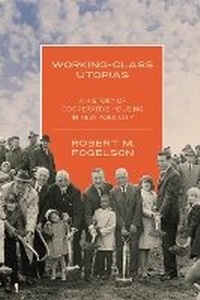
Working-Class Utopias
A History of Cooperative Housing in New York City
Published on 18. October 2022
Book
Hardback
408 pages
978-0-691-23474-8 (ISBN)
Description
One of the nation's foremost urban historians traces the history of cooperative housing in New York City from the 1920s through the 1970s
As World War II ended and Americans turned their attention to problems at home, union leaders and other prominent New Yorkers came to believe that cooperative housing would solve the city's century-old problem of providing decent housing at a reasonable cost for working-class families. Working-Class Utopias tells the story of this ambitious movement from the construction of the Amalgamated Houses after World War I to the building of Co-op City, the world's largest housing cooperative, four decades later.
Robert Fogelson brings to life a tumultuous era in the life of New York, drawing on a wealth of archival materials such as community newspapers, legal records, and personal and institutional papers. In the early 1950s, a consortium of labor unions founded the United Housing Foundation under the visionary leadership of Abraham E. Kazan, who was supported by Nelson A. Rockefeller, Robert F. Wagner Jr., and Robert Moses. With the help of the state, which provided below-market-rate mortgages, and the city, which granted tax abatements, Kazan's group built large-scale cooperatives in every borough except Staten Island. Then came Co-op City, built in the Bronx in the 1960s as a model for other cities but plagued by unforeseen fiscal problems, culminating in the longest and costliest rent strike in American history. Co-op City survived, but the United Housing Foundation did not, and neither did the cooperative housing movement.
Working-Class Utopias is essential reading for anyone seeking to understand the housing problem that continues to plague New York and cities across the nation.
As World War II ended and Americans turned their attention to problems at home, union leaders and other prominent New Yorkers came to believe that cooperative housing would solve the city's century-old problem of providing decent housing at a reasonable cost for working-class families. Working-Class Utopias tells the story of this ambitious movement from the construction of the Amalgamated Houses after World War I to the building of Co-op City, the world's largest housing cooperative, four decades later.
Robert Fogelson brings to life a tumultuous era in the life of New York, drawing on a wealth of archival materials such as community newspapers, legal records, and personal and institutional papers. In the early 1950s, a consortium of labor unions founded the United Housing Foundation under the visionary leadership of Abraham E. Kazan, who was supported by Nelson A. Rockefeller, Robert F. Wagner Jr., and Robert Moses. With the help of the state, which provided below-market-rate mortgages, and the city, which granted tax abatements, Kazan's group built large-scale cooperatives in every borough except Staten Island. Then came Co-op City, built in the Bronx in the 1960s as a model for other cities but plagued by unforeseen fiscal problems, culminating in the longest and costliest rent strike in American history. Co-op City survived, but the United Housing Foundation did not, and neither did the cooperative housing movement.
Working-Class Utopias is essential reading for anyone seeking to understand the housing problem that continues to plague New York and cities across the nation.
Reviews / Votes
"Robert Fogelson deserves recognition for Working-Class Utopias. It is the product of deep and extensive research in primary and secondary sources, which he synthesizes elegantly. Readers interested in New York City history will find much to enjoy in this book."---John Lepley, New York Labor History AssociationMore details
Language
English
Place of publication
New Jersey
United States
Target group
College/higher education
Professional and scholarly
Product notice
Trade binding
Illustrations
26 b/w illus.
Dimensions
Height: 235 mm
Width: 156 mm
ISBN-13
978-0-691-23474-8 (9780691234748)
Copyright in bibliographic data and cover images is held by Nielsen Book Services Limited or by the publishers or by their respective licensors: all rights reserved.
Schweitzer Classification
Other editions
Additional editions
E-Book
09/2022
1st Edition
Princeton University Press
€40.99
Available for download
Person
Robert M. Fogelson is professor emeritus of urban studies and history at the Massachusetts Institute of Technology. He is the author of several books about American urban history, including The Great Rent Wars: New York, 1917-1929; Bourgeois Nightmares: Suburbia, 1870-1930; and Downtown: Its Rise and Fall, 1880-1950.