

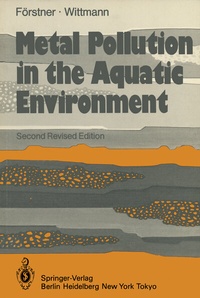
Metal Pollution in the Aquatic Environment
2nd Edition
Published on 31. October 1983
Book
Paperback/Softback
XVIII, 488 pages
978-3-540-12856-4 (ISBN)
Description
Aquatic chemistry is becoming both a rewarding and substantial area of inquiry and is drawing many prominent scientists to its fold. Its literature has changed from a compilation of compositional tables to studies of the chemical reactions occurring within the aquatic environments. But more than this is the recognition that human society in part is determining the nature of aquatic systems. Since rivers deliver to the world ocean most of its dissolved and particulate components, the interactions of these two sets of waters determine the vitality of our coastal waters. This significant vol ume provides not only an introduction to the dynamics of aquatic chem istries but also identifies those materials that jeopardize the resources of both the marine and fluvial domains. Its very title provides its emphasis but clearly not its breadth in considering natural processes. The book will be of great value to those environmental scientists who are dedicated to keeping the resources of the hydrosphere renewable. As the size of the world population becomes larger in the near future and as the uses of materials and energy show parallel increases, the rivers and oceans must be considered as a resource to accept some of the wastes of society. The ability of these waters and the sediments below them to accommodate wastes must be assessed continually. The key questions relate to the capacities of aqueous systems to carry one or more pollutants.
More details
Series
Edition
Second Edition 1981
Language
English
Place of publication
Berlin
Germany
Publishing group
Springer Berlin
Target group
Professional and scholarly
Research
Illustrations
33 s/w Abbildungen
XVIII, 488 p. 33 illus.
Dimensions
Height: 24.4 cm
Width: 17 cm
Weight
874 gr
ISBN-13
978-3-540-12856-4 (9783540128564)
DOI
10.1007/978-3-642-69385-4
Schweitzer Classification
Other editions
Additional editions
U. Förstner | G. T. W. Wittmann
Metal Pollution in the Aquatic Environment
E-Book
12/2012
2nd Edition
Springer
€96.29
Available for download
U. Forstner | G. T. W. Wittmann
Metal Pollution in the Aquatic Environment
Book
05/1981
2nd Edition
Springer
€89.13
Article exhausted; check different version
Previous edition
U. Förstner | G.T.W. Wittmann
Metal Pollution in the Aquatic Environment
Book
01/2012
Springer
€85.55
Article exhausted; check for reprint
Persons
Content
A Introduction.- 1 Environmental Pollution.- 2 Sources, Pathways and Reservoirs.- 3 Aquatic Ecosystems.- B Toxic Metals.- 1 Metals.- 2 Trace Metals and Organic Life.- 3 Water Quality Criteria: Standards.- 4 The Sources of Metal Pollution.- 5 Metal Analysis.- C Metal Concentrations in River, Lake, and Ocean Waters.- 1 Distribution of Major Ions.- 2 Chemical Conditions for Trace Metals in Natural Waters.- 3 Trace Metals in Seawater.- 4 Trace Metals in Inland Waters.- D Metal Pollution Assessment from Sediment Analysis.- 1 Introduction.- 2 Metal Investigations on Aquatic Sediments.- 3 Geochemical Reconnaissance of Aquatic Sediments.- 4 Grain-Size Effects.- 5 Factors Controlling the Distribution of Metals in Aquatic Sediments.- 6 Natural Metal Content-Civilizational Accumulation.- 7 Lake Sediments as Indicators of Heavy Metal Pollution.- 8 Metal Pollution in River Sediments.- 9 Assessing Metal Pollution in the Sea by Sediment Study.- E Metal Transfer Between Solid and Aqueous Phases.- 1 Residence Times of Metals in Aquatic Systems.- 2 Types of Metal Association in Sediments.- 3 Metal Accumulation in Aquatic Sediments-Interactions and Effects of Various Processes and Sinks.- 4 Determination of Chemical Phases in Natural and Polluted Sediments.- 5 Mobilization of Heavy Metals from Sediments.- F Heavy Metals in Aquatic Organisms.- 1 Physico-Chemical Influences on the Toxicity and the Uptake of Heavy Metals with Respect to Organisms.- 2 Biologic Factors Affecting Heavy Metal Concentrations in Aquatic Organisms.- 3 Heavy Metal Enrichment in Limnic and Marine Organisms at Different Trophic Levels.- G Trace Metals in Water Purification Processes.- 1 Heavy Metal Removal for the Production of Drinking Water.- 2 Heavy Metals in Industrial and Domestic Effluents.- 3 Heavy Metalsin Sewage Sludges.- H Concluding Remarks.- 1 Disposal Versus Reuse.- 2 Alternative Materials.- References.