

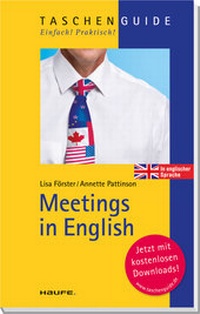
Meetings in English
Description
Inhalte:
- Wie man mit internationalen Geschäftspartnern und Kollegen Besprechungen zielorientiert und effektiv durchführt
- Sprachlich korrekt: von der Einladung über die Begrüßung bis zum Abschluss der Besprechung und Protokoll
- Argumentieren wie ein Muttersprachler: nützliche Wendungen und Ausdrücke sowie Tipps für den richtigen Ton
- Mit Beispielen, interkulturellen Tipps und Hinweisen auf typisch deutsche Fehler. Das beste Training: Alles auf Englisch!
More details
Other editions
Additional editions
Persons
Content
Preparing a meeting
- Inviting people to a meeting
- Making meeting arrangements
- Rescheduling, cancelling or confirming a meeting
- Making the agenda
- Hands-on organisation
Arriving at the meeting
- Arriving in reception
- Introducing oneself and others
- Small talk
- Setting up the meeting room
Conducting a meeting
- Opening the meeting
- Guiding the discussion
- Bringing about a decision
- Closing the meeting
The meeting itself
- Roles at a meeting
- Active participation and asking for more information
- Expressing agreement and disagreement
- Making suggestions and having your say
- Enquiring and resolving misunderstandings
- Diplomacy and politeness
- What to do in case of language problems
- Voting
After the meeting
- Making the minutes
- Following up the meeting
Special types of meetings
- Meetings with customers
- Negotiations
- Briefing and brainstorming
- Jours fixes and kick offs
- Telephone conferences
Literature
Index
All well-structured meetings should have an agenda, which is
usually prepared by the chairperson. Depending on the type
of meeting, agendas can be formal or informal, but all should
start by stating the date, time and location of the meeting.
It is useful to include the name of the person who will be
presenting a specific agenda item. You may also find it help-
ful to include a note of the time allocated to each point.
Some more detailed agendas also state objectives for indi-
vidual agenda items, for example: "Agree on product design".
Formal agendas differ from informal agendas in that they
start with routine items, which always appear in a specific
order. In addition, each point on the agenda is clearly num-
bered. Nowadays, agendas for all but the most important
company meetings (board meetings, annual general meet-
ings) tend to use an informal style.
Catchwords and abbreviations
Note how both informal and formal agendas have a concise style and
tend to be written in note-like form, often omitting articles before nouns
and using abbreviations. For example, AOB stands for "any other busi-
ness", which refers to topics that are not covered by other agenda items
or which have arisen after the agenda was distributed.
Compiling the agenda
Besides giving the meeting structure, the purpose of the
agenda is to ensure that the time available is only used for
discussing the items listed. Some people hold that topics that
are important enough to be discussed should be included as
items on the agenda, keeping AOB to a minimum. This can be
done by asking participants to submit items for inclusion on
the agenda. Email is a practical means of doing this, espe-
cially when a large group of people is involved. If the agenda
is long, or in the case of a formal meeting, you may wish to
circulate the draft agenda to participants as an email at-
tachment, rather than including it in the body of an email.