

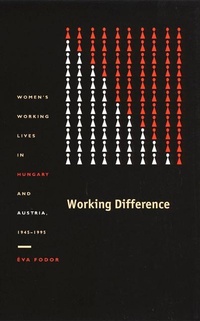
Working Difference
Women's Working Lives in Hungary and Austria, 1945-1995
Published on 20. January 2003
Book
Paperback/Softback
224 pages
978-0-8223-3090-5 (ISBN)
Description
Working Difference is one of the first comparative, historical studies of women's professional access to public institutions in a state socialist and a capitalist society. Eva Fodor examines women's inclusion in and exclusion from positions of authority in Austria and Hungary in the latter half of the twentieth century. Until the end of World War II women's lives in the two countries, which were once part of the same empire, followed similar paths, which only began to diverge after the communist takeover in Hungary in the late 1940s. Fodor takes advantage of Austria and Hungary's common history to carefully examine the effects of state socialism and the differing trajectories to social mobility and authority available to women in each country.Fodor brings qualitative and quantitative analyses to bear, combining statistical analyses of survey data, interviews with women managers in both countries, and archival materials including those from the previously classified archives of the Hungarian communist party and transcripts from sessions of the Austrian Parliament. She shows how women's access to power varied in degree and operated through different principles and mechanisms in accordance with the stratification systems of the respective countries. In Hungary women's mobility was curtailed by political means (often involving limited access to communist party membership), while in Austria women's professional advancement was affected by limited access to educational institutions and the labor market. Fodor discusses the legacies of Austria's and Hungary's "gender regimes" following the demise of state socialism and during the process of integration into the European Union.
Reviews / Votes
"Eva Fodor's compelling analysis of gendered mechanisms of exclusion and inclusion in the workplaces of state-socialist Hungary and capitalist Austria provides a welcome set of comparative insights to the burgeoning literature on gender, states, and societies, and speaks to core questions in feminism and studies of inequality."-Ann Shola Orloff, coauthor, States, Markets, Families: Gender, Liberalism and Social Policy in Australia, Canada, Great Britain and the United States "Working Difference contains much fascinating new material and exciting analysis. It will make an important contribution to gender theory and to the study of postsocialist stratification. This book is one of only a small handful that directly compare Eastern and Western European political economies and one of the only ones that compares gender regimes. It will have a wide influence on discussions of gender regimes, welfare states, and the historical role of state socialism."-Susan Gal, coauthor of The Politics of Gender after SocialismMore details
Series
Language
English
Place of publication
North Carolina
United States
Target group
Professional and scholarly
Product notice
Paperback (trade)
Illustrations
15 tables
Dimensions
Height: 233 mm
Width: 153 mm
Thickness: 17 mm
Weight
363 gr
ISBN-13
978-0-8223-3090-5 (9780822330905)
Copyright in bibliographic data and cover images is held by Nielsen Book Services Limited or by the publishers or by their respective licensors: all rights reserved.
Schweitzer Classification
Other editions
Additional editions
Éva Fodor | Andrew Gordon | Daniel James
Working Difference
Women's Working Lives in Hungary and Austria, 1945-1995
E-Book
01/2003
1st Edition
De Gruyter
€198.99
Available for download
Person
Eva Fodor is Assistant Professor of Sociology at Dartmouth College.
Content
Acknowledgments ix
1. Three Generations of Women in Central Europe 1
2. Gender Regimes in East and West 17
3. From "K und K" to "Communism versus Capitalism": The Social Worlds of Austria and Hungary 39
4. Exclusion versus Limited Inclusion 61
5. Mechanisms of Exclusion 76
6. Conditions of Inclusion: Examining State Policies in Austria and Hungary, 1945-1995 104
7. Difference at Work: A Case Study of Hungary
136
8. Convergence in the Twenty-First Century?
151
Appendix A. Data Sets, Samples, and Definition of Variables
163
Appendix B. Chronology of Legislation Targeting or Affecting Women
167
Notes 173
References 189
Index 201
1. Three Generations of Women in Central Europe 1
2. Gender Regimes in East and West 17
3. From "K und K" to "Communism versus Capitalism": The Social Worlds of Austria and Hungary 39
4. Exclusion versus Limited Inclusion 61
5. Mechanisms of Exclusion 76
6. Conditions of Inclusion: Examining State Policies in Austria and Hungary, 1945-1995 104
7. Difference at Work: A Case Study of Hungary
136
8. Convergence in the Twenty-First Century?
151
Appendix A. Data Sets, Samples, and Definition of Variables
163
Appendix B. Chronology of Legislation Targeting or Affecting Women
167
Notes 173
References 189
Index 201