

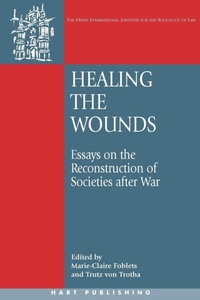
Healing the Wounds
Essays on the Reconstruction of Societies after War
Published on 20. October 2004
Book
Paperback/Softback
300 pages
978-1-84113-469-7 (ISBN)
Description
In recent decades the world has experienced the rise of so-called 'low intensity conflicts'. Unlike conventional wars these very bloody armed conflicts are no longer the affair of state governments and their armies. In their place appear police-like armed units,security services and secret services, groups and organizations of religious, political and social fanatics ready to resort to violence, 'militias', bands of mercenaries, or just gangs of thugs, led by the condottiere of the 21st century, consisting of militant charismatics, militia 'generals', 'drug barons' and 'warlords' of various kinds. They conduct wars in which the soldiers no longer wear uniforms and there is no meeting of armies in open battle. The armed organizations fight in urban agglomerations and in difficult, inaccessible regions. The combatants fight for religion and quasi-religious ideologies, for the 'rights of the people' or 'national liberation', for power, gain, and booty, and above all for recognition.
For the practice of peace, this kind of war has far-reaching consequences. In this book the authors examine various paths to peace and reconciliation in low intensity conflicts. They look at processes of peace making from South Africa and the North of Mali to Indonesia and South East Asia. Common to most studies is that they stress the particular local contexts of peace making tied to the highly localized nature of most low intensity conflicts. The logic of peace has become a logic of local and regional power. The articles shed new light not only on ways and chances of interventions by the international community but also on the role of nongovernmental organisations in violent conflicts.
For the practice of peace, this kind of war has far-reaching consequences. In this book the authors examine various paths to peace and reconciliation in low intensity conflicts. They look at processes of peace making from South Africa and the North of Mali to Indonesia and South East Asia. Common to most studies is that they stress the particular local contexts of peace making tied to the highly localized nature of most low intensity conflicts. The logic of peace has become a logic of local and regional power. The articles shed new light not only on ways and chances of interventions by the international community but also on the role of nongovernmental organisations in violent conflicts.
Reviews / Votes
Each essay in the collection tends to be learned, detailed, and carefully documented, so it is difficult to do justice to the whole volume in a brief review...a valuable contribution..the authors offer convincing evidence of the importance of legal anthropology in peace-building efforts.. -- Michael True * International Journal on World Peace, Vol XXII, No 1 *More details
Series
Language
English
Place of publication
Oxford
United Kingdom
Publishing group
Bloomsbury Publishing PLC
Target group
Professional and scholarly
College/higher education
Dimensions
Height: 234 mm
Width: 156 mm
Thickness: 16 mm
Weight
459 gr
ISBN-13
978-1-84113-469-7 (9781841134697)
Copyright in bibliographic data and cover images is held by Nielsen Book Services Limited or by the publishers or by their respective licensors: all rights reserved.
Schweitzer Classification
Other editions
Additional editions
Marie-Claire Foblets | Trutz von Trotha
Healing the Wounds
Essays on the Reconstruction of Societies after War
Book
10/2004
Hart Publishing
€123.80
Shipment within 15-20 days
Marie-Claire Foblets | Trutz von Trotha
Healing the Wounds
Essays on the Reconstruction of Societies After War
E-Book
10/2004
1st Edition
Hart Publishing
€44.49
Available for download
Persons
Marie-Claire Foblets is Professor of Law and Anthropology at the Universities of Leuven, Brussels and Antwerp and Director of the Department of Social and Cultural Anthropology at the University of Leuven.
Trutz von Trotha is Professor of Sociology at the University of Siegen, Germany.
Trutz von Trotha is Professor of Sociology at the University of Siegen, Germany.
Content
1. In Search of Peace. History, Basic Narrative, the Future of War, and the Rise of the Local. An Introduction with a Short Overview of the Contributions
Trutz von Trotha
Part I On the Theory of the Reconstruction of Peace after War and Violent Conflict
2. Comments on the Construction of Political Order: Social Contract Theories and Anthropological Observation
Gordon R Woodman
3. Concepts of Violence and Peace in African Languages
Wilhelm, JG Moehlig and Ruediger Koeppe
4. The 'Peacemakers' Dilemma': The Role of NGOs in Processes of Peace-Building in Decentralised Conflicts
Dieter Neubert
Part II Power, Structures, Processes, and History in the Reconstruction of Peace
The Reconstruction of Peace I: African Experiences
5. Peace and Aid: The 'Programme Mali-Nord' and the Search for Peace in Northern Mali
Henner Papendieck and Barbara Rocksloh-Papendieck
6. Roads to Peace: From Small War to Parasovereign Peace in the North of Mali
Georg Klute and Trutz von Trotha
7. Legislation and Decentralisation in Uganda: From Resistance Councils to Elected Local Councils with Guaranteed Representation
Dirk Beke
8. The South African Truth and Reconciliation Commission: 'The Truth will Set You Free'
Willemien du Plessis
The Reconstruction of Peace II: Asian Experiences
9. Democracy and Ethnic Conflicts: The Politics of Ethnicity and Conflict Resolution in South Asia
Jakob Roesel
10. Law, Violence and Peace Making on the Island of Ambon
Keebet von Benda-Beckmann
11. The Search for New Sources of Legitimacy in Indonesia after Suharto
John R Bowen
Conclusion
12. At the Heart of Legal Anthropology: Analyses of peace processes
Marie-Claire Foblets and Barbara Truffin
Trutz von Trotha
Part I On the Theory of the Reconstruction of Peace after War and Violent Conflict
2. Comments on the Construction of Political Order: Social Contract Theories and Anthropological Observation
Gordon R Woodman
3. Concepts of Violence and Peace in African Languages
Wilhelm, JG Moehlig and Ruediger Koeppe
4. The 'Peacemakers' Dilemma': The Role of NGOs in Processes of Peace-Building in Decentralised Conflicts
Dieter Neubert
Part II Power, Structures, Processes, and History in the Reconstruction of Peace
The Reconstruction of Peace I: African Experiences
5. Peace and Aid: The 'Programme Mali-Nord' and the Search for Peace in Northern Mali
Henner Papendieck and Barbara Rocksloh-Papendieck
6. Roads to Peace: From Small War to Parasovereign Peace in the North of Mali
Georg Klute and Trutz von Trotha
7. Legislation and Decentralisation in Uganda: From Resistance Councils to Elected Local Councils with Guaranteed Representation
Dirk Beke
8. The South African Truth and Reconciliation Commission: 'The Truth will Set You Free'
Willemien du Plessis
The Reconstruction of Peace II: Asian Experiences
9. Democracy and Ethnic Conflicts: The Politics of Ethnicity and Conflict Resolution in South Asia
Jakob Roesel
10. Law, Violence and Peace Making on the Island of Ambon
Keebet von Benda-Beckmann
11. The Search for New Sources of Legitimacy in Indonesia after Suharto
John R Bowen
Conclusion
12. At the Heart of Legal Anthropology: Analyses of peace processes
Marie-Claire Foblets and Barbara Truffin