

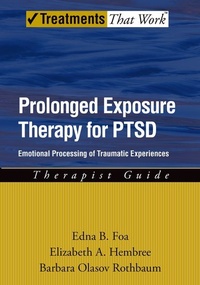
Prolonged Exposure Therapy for PTSD
Emotional Processing of Traumatic Experiences, Therapist Guide
Published on 5. April 2007
Book
Paperback/Softback
160 pages
978-0-19-530850-1 (ISBN)
Description
This guide gives clinicians the information they need to treat clients who exhibit the symptoms of PTSD. It is based on the principles of Prolonged Exposure Therapy, the most scientifically-tested and proven treatment that has been used to effectively treat victims of all types of trauma. Whether your client is a veteran of combat, a victim of a physical or sexual assault, or a casualty of a motor vehicle accident, the techniques and strategies outlined in this book
will help.
In this treatment clients are exposed to imagery of their traumatic memories, as well as real-life situations related to the traumatic event in a step-by-step, controllable way. Through these exposures, your client will learn to confront the trauma and begin to think differently about it, leading to a marked decrease in levels of anxiety and other PTSD symptoms. Clients are provided education about PTSD and other common reactions to traumatic events. Breathing retraining is taught as a method
for helping the client manage anxiety in daily life.
Designed to be used in conjunction with the corresponding client workbook, this therapist guide includes all the tools necessary to effectively implement the prolonged exposure program including assessment measures, session outlines, case studies, sample dialogues, and homework assignments. This comprehensive resource is an exceptional treatment manual that is sure to help you help your clients reclaim their lives from PTSD.
will help.
In this treatment clients are exposed to imagery of their traumatic memories, as well as real-life situations related to the traumatic event in a step-by-step, controllable way. Through these exposures, your client will learn to confront the trauma and begin to think differently about it, leading to a marked decrease in levels of anxiety and other PTSD symptoms. Clients are provided education about PTSD and other common reactions to traumatic events. Breathing retraining is taught as a method
for helping the client manage anxiety in daily life.
Designed to be used in conjunction with the corresponding client workbook, this therapist guide includes all the tools necessary to effectively implement the prolonged exposure program including assessment measures, session outlines, case studies, sample dialogues, and homework assignments. This comprehensive resource is an exceptional treatment manual that is sure to help you help your clients reclaim their lives from PTSD.
Reviews / Votes
This book has enhanced my confidence in my ability to administer the treatment. As a clinician familiar with both the empirical and applied aspects of PTSD treatment, I strongly recommend this book to any therapist interested in administering an effective, empirically based treatment for PTSD. * PsycCRITIQUES *More details
Series
Language
English
Place of publication
New York
United States
Target group
Professional and scholarly
Dimensions
Height: 255 mm
Width: 178 mm
Thickness: 11 mm
Weight
297 gr
ISBN-13
978-0-19-530850-1 (9780195308501)
Copyright in bibliographic data and cover images is held by Nielsen Book Services Limited or by the publishers or by their respective licensors: all rights reserved.
Schweitzer Classification
Other editions
Additional editions
Edna Foa | Elizabeth Hembree | Barbara Olaslov Rothbaum
Prolonged Exposure Therapy for PTSD
Emotional Processing of Traumatic Experiences
E-Book
03/2007
1st Edition
OUP eBook
€39.99
Available for download
Edna Foa | Elizabeth Hembree | Barbara Olaslov Rothbaum
Prolonged Exposure Therapy for PTSD
Emotional Processing of Traumatic Experiences
E-Book
03/2007
1st Edition
OUP eBook
€39.99
Available for download
Persons
Edna B. Foa is affiliated with the Center for the Treatment and Study of Anxiety at the University of Pennsylvania.
Elizabeth Hembree is affiliated with the University of Pennsylvania.
Elizabeth Hembree is affiliated with the University of Pennsylvania.
Author
Center for the Treatment and Study of AnxietyCenter for the Treatment and Study of Anxiety, University of Pennsylvania
Assistant Professor of PsychologyAssistant Professor of Psychology, University of Pennsylvania
Professor of PsychiatryProfessor of Psychiatry, Emory University School of Medicine
Content
1. Introductory information for therapists ; 2. Assessment and special considerations in treating trauma survivors ; 3. Session 1 ; 4. Session 2 ; 5. Session 3 ; 6. Intermediate sessions ; 7. Final session ; 8. Anticipating problems and tailoring treatment to the individual: promoting effective engagement