

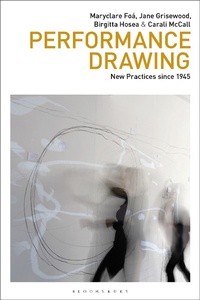
Performance Drawing
New Practices since 1945
Published on 13. January 2022
Book
Paperback/Softback
264 pages
978-1-350-28735-8 (ISBN)
Description
What is 'performance drawing'? When does a drawing turn into a performance? Is the act of drawing in itself a performative process, whether a viewer is present or not? Through conversation, interviews and essays, the authors illuminate these questions, and what it might mean to perform, and what it might mean to draw, in a diverse and expressive contemporary practice since 1945.
The term 'performance drawing' first appeared in the subtitle of Catherine de Zegher's Drawing Papers 20: Performance Drawings, in particular with reference to Alison Knowles and Elena del Rivero. In this book, it is used as a trope, and a thread of thinking, to describe a process dedicated to broadening the field of drawing through resourceful practices and cross-disciplinary influence.
Featuring a wide range of international artists, this book presents pioneering practitioners, alongside current and emerging artists. The combination of experiences and disciplines in the expanded field has established a vibrant art movement that has been progressively burgeoning in the last few years. The Introduction contextualises the background and identifies contemporary approaches to performance drawing. As a way to embrace the different voices and various lenses in producing this book, the authors combine individual perspectives and critical methodology in the five chapters.
While embedded in ephemerality and immediacy, the themes encompass body and energy, time and motion, light and space, imagined and observed, demonstrating how drawing can act as a performative tool. The dynamic interaction leads to a collective understanding of the term, performance drawing, and addresses the key developments and future directions of this applied drawing process.
The term 'performance drawing' first appeared in the subtitle of Catherine de Zegher's Drawing Papers 20: Performance Drawings, in particular with reference to Alison Knowles and Elena del Rivero. In this book, it is used as a trope, and a thread of thinking, to describe a process dedicated to broadening the field of drawing through resourceful practices and cross-disciplinary influence.
Featuring a wide range of international artists, this book presents pioneering practitioners, alongside current and emerging artists. The combination of experiences and disciplines in the expanded field has established a vibrant art movement that has been progressively burgeoning in the last few years. The Introduction contextualises the background and identifies contemporary approaches to performance drawing. As a way to embrace the different voices and various lenses in producing this book, the authors combine individual perspectives and critical methodology in the five chapters.
While embedded in ephemerality and immediacy, the themes encompass body and energy, time and motion, light and space, imagined and observed, demonstrating how drawing can act as a performative tool. The dynamic interaction leads to a collective understanding of the term, performance drawing, and addresses the key developments and future directions of this applied drawing process.
Reviews / Votes
A valuable historical primer that examines key examples of performance drawing from the last half-century and challenges established definitions and categorisations. The authors draw a picture of the changing boundaries between art forms, showing how the blurred lines between artistic disciplines are the product of an active performative process. In addition to practitioners, this should be read by anyone interested in emerging art practices. * Malcolm Cook, Associate Professor in Film, University of Southampton, UK * Performance Drawing represents a highly developed record of practice-based research, tracing the developments in contemporary drawing, building on precedents that have led to emerging trends. It analyzes the radical departure from the acceptance of drawing as a canonical medium based on mark-making on two-dimensional surfaces, into real space towards performance, light projections, film and the use of new technologies. The texts brilliantly place all these developments into a clearly articulated context. * Therese Bolliger, artist, Canada * While narrative forms of drawing have found favor through numerous exhibitions and publications world-wide, drawing as an inherently process-driven performative event is still lacking accessible comprehensive theoretical research. Bridging two centuries of contemporary practice, Performance Drawing will fill a huge gap for artists, teachers, scholars and art publics. * Francois Morelli, Concordia University, Canada *More details
Series
Language
English
Place of publication
London
United Kingdom
Publishing group
Bloomsbury Publishing PLC
Target group
College/higher education
Illustrations
32 bw illus
Dimensions
Height: 236 mm
Width: 157 mm
Thickness: 17 mm
Weight
571 gr
ISBN-13
978-1-350-28735-8 (9781350287358)
Copyright in bibliographic data and cover images is held by Nielsen Book Services Limited or by the publishers or by their respective licensors: all rights reserved.
Schweitzer Classification
Other editions
Additional editions
E-Book
09/2020
1st Edition
Bloomsbury Visual Arts
€30.99
Available for download
E-Book
09/2020
1st Edition
Bloomsbury Visual Arts
€30.99
Available for download
Persons
Maryclare Foa s a UK/Irish artist and teaches drawing at the University of the Arts London, UK. She was awarded her PhD at Camberwell, UAL, UK; her work was exhibited in A History of Drawing (2018) at UAL, UK, and can be seen in Drawing Now: Between the Lines of Contemporary Art (I.B. Tauris, 2007) and Hyperdrawing: Beyond the Lines of Contemporary Art (I.B. Tauris, 2012).
Birgitta Hosea is a time-based media artist and Professor of Moving Image at the University for the Creative Arts, UK. Previously, Head of Animation at the Royal College of Art, UK and Central Saint Martins, UAL, UK where she completed her PhD in animation as a form of performance in 2012.
Carali McCall is a Canadian London-based artist and art tutor; she was awarded her PhD at Central Saint Martins, UAL, UK, where she is active in research groups. She was a finalist in the 2017 Jerwood Drawing Prize and was recently granted funding from Arts Council England for the artwork, Run Vertical (Running up the Side of a Building).
Jane Grisewood was a New Zealand London-based artist and lecturer; she gained her PhD in 2010 at Central Saint Martins, UAL, UK, where she taught experimental drawing. She received awards from Arts Council England and had Artists' Books published that have been acquired in international collections. She exhibited at Lumen and Void London, Aether Berlin, Kaleid Oslo, Venice Biennale (2019) and in Line/Extended (2019) at the University of Hertfordshire, UK. Jane died in 2023.
Birgitta Hosea is a time-based media artist and Professor of Moving Image at the University for the Creative Arts, UK. Previously, Head of Animation at the Royal College of Art, UK and Central Saint Martins, UAL, UK where she completed her PhD in animation as a form of performance in 2012.
Carali McCall is a Canadian London-based artist and art tutor; she was awarded her PhD at Central Saint Martins, UAL, UK, where she is active in research groups. She was a finalist in the 2017 Jerwood Drawing Prize and was recently granted funding from Arts Council England for the artwork, Run Vertical (Running up the Side of a Building).
Jane Grisewood was a New Zealand London-based artist and lecturer; she gained her PhD in 2010 at Central Saint Martins, UAL, UK, where she taught experimental drawing. She received awards from Arts Council England and had Artists' Books published that have been acquired in international collections. She exhibited at Lumen and Void London, Aether Berlin, Kaleid Oslo, Venice Biennale (2019) and in Line/Extended (2019) at the University of Hertfordshire, UK. Jane died in 2023.
Content
Foreword
Preface
1. Marking: Line and Body in Time and Space
2. Physicality: Running as Drawing
3. Communicating: Directives and/or Instructions that Promote the Activity of Drawing
4. Conjuring: the Gift of a Surprise
5. Illuminating: Live Mark Making Through Projected Light
Conclusion
Bibliography
Preface
1. Marking: Line and Body in Time and Space
2. Physicality: Running as Drawing
3. Communicating: Directives and/or Instructions that Promote the Activity of Drawing
4. Conjuring: the Gift of a Surprise
5. Illuminating: Live Mark Making Through Projected Light
Conclusion
Bibliography