

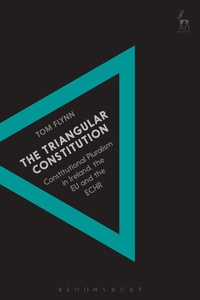
The Triangular Constitution
Constitutional Pluralism in Ireland, the EU and the ECHR
Published on 17. December 2020
Book
Paperback/Softback
288 pages
978-1-5099-4611-2 (ISBN)
Description
This book offers a new account of modern European constitutionalism. It uses the Irish constitutional order to demonstrate that, right across the European Union, the national constitution can no longer be understood on its own, in isolation from the EU legal order or from the European Convention on Human Rights. The constitution is instead triangular, with these three legal orders forming the points of a triangle, and the relationship and interactions between them forming the triangle's sides. It takes as its starting point the theory of constitutional pluralism, which suggests that overlapping constitutional orders are not necessarily arranged 'on top of' each other, but that they may be arranged heterarchically or flatly, without a hierarchy of superior and subordinate constitutions. However, it departs from conventional accounts of this theory by emphasising that we must still pay close attention to jurisdictional specificity in order to understand the norms that regulate pluralist constitutions. It shows, through application of the theory to case studies, that any attempt to extract universal principles from the jurisdictionally contingent interactions between specific legal orders is fraught with difficulty. The book is an important contribution to constitutional theory in general, and constitutional pluralism in particular, and will be of great interest to scholars in the field.
Reviews / Votes
This well-structured and exceptionally well-written text is an investigation into the relationship between the Irish constitutional system and the broader European legal space ... The Triangular Constitution is a welcome addition to the literature on both the Irish Constitution and constitutional pluralism, giving a new perspective on Irish constitutional law, contextualising it and acknowledging its European dimensions while enriching our understanding of the practical workings of constitutional pluralism and of some of its theoretical underpinnings. -- Stephen Coutts, University College Cork * The Irish Jurist * Tom Flynn's excellent book, The Triangular Constitution, is an insightful contribution to constitutional theory. It focuses on transnational constitutionalism, and the intermingling of national and international law, and explores these topics by means of a detailed case study of Ireland. -- David Kenny, Trinity College Dublin * Common Law World Review * This book will be of great value to constitutional scholars and students of constitutional law in Ireland, for its dexterous and comprehensive sweep of the thicket of constitutional law that binds the Irish, EU and ECHR legal orders. ... But Flynn's book will invite interest far beyond the Irish academic sphere. It should be recognised primarily for its contribution to constitutional pluralism as a discipline. An all-encompassing, exhaustively developed and original theoretical approach, capable of application to the tripartite relationship of any EU Member State with the EU and ECHR legal orders, will be of enormous benefit to scholars grappling with constitutional conflict in Europe. -- Ciaran Donohue * Hibernian Law Journal *More details
Language
English
Place of publication
Oxford
United Kingdom
Publishing group
Bloomsbury Publishing PLC
Target group
College/higher education
Dimensions
Height: 234 mm
Width: 156 mm
Weight
408 gr
ISBN-13
978-1-5099-4611-2 (9781509946112)
Copyright in bibliographic data and cover images is held by Nielsen Book Services Limited or by the publishers or by their respective licensors: all rights reserved.
Schweitzer Classification
Other editions
Additional editions
E-Book
05/2019
1st Edition
Hart Publishing
€43.99
Available for download
E-Book
05/2019
1st Edition
Hart Publishing
€43.99
Available for download
Person
Content
1. European Constitutional Pluralism and the Triangular Constitution
I. Constitutional Pluralism's Origins in the EU
II. The Constitutional Pluralists and the Critics
III. Metaconstitutional Pluralisms
IV. Two Problems of Metaconstitutional Pluralism
V. Triangular Constitutionalism
2. The Vertical Frame
I. The Terms of Engagement Between Irish Law and EU Law
II. The Irish Legal Order and the European Convention on Human Rights
3. The Horizontal Frame
I. The Pre-Accession Terms of Engagement Between the EU and the ECHR
II. The Draft Accession Agreement and Opinion 2/13
III. Labour Rights and Constitutional Conflict
4. The Triangular Frame
I. Avoidance, Engagement and Conditional Recognition
II. Polyarchic Deliberation
III. The Nature of the Relationships and the Universality of Interface Norms
5. Towards Triangular Constitutionalism: Universalising the Triangular Constitution
I. The Triangular Constitution Assessed
II. From the Particular to the Universal
I. Constitutional Pluralism's Origins in the EU
II. The Constitutional Pluralists and the Critics
III. Metaconstitutional Pluralisms
IV. Two Problems of Metaconstitutional Pluralism
V. Triangular Constitutionalism
2. The Vertical Frame
I. The Terms of Engagement Between Irish Law and EU Law
II. The Irish Legal Order and the European Convention on Human Rights
3. The Horizontal Frame
I. The Pre-Accession Terms of Engagement Between the EU and the ECHR
II. The Draft Accession Agreement and Opinion 2/13
III. Labour Rights and Constitutional Conflict
4. The Triangular Frame
I. Avoidance, Engagement and Conditional Recognition
II. Polyarchic Deliberation
III. The Nature of the Relationships and the Universality of Interface Norms
5. Towards Triangular Constitutionalism: Universalising the Triangular Constitution
I. The Triangular Constitution Assessed
II. From the Particular to the Universal