

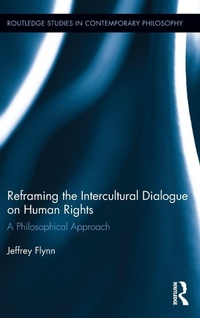
Reframing the Intercultural Dialogue on Human Rights
A Philosophical Approach
1st Edition
Published on 7. December 2013
Book
Hardback
224 pages
978-0-415-70602-5 (ISBN)
Description
In this book, Flynn stresses the vital role of intercultural dialogue in developing a non-ethnocentric conception of human rights. He argues that Juergen Habermas's discourse theory provides both the best framework for such dialogue and a much-needed middle path between philosophical approaches that derive human rights from a single foundational source and those that support multiple foundations for human rights (Charles Taylor, John Rawls, and various Rawlsians).
By analyzing the historical and political context for debates over the compatibility of human rights with Christianity, Islam, and "Asian Values," Flynn develops a philosophical approach that is continuous with and a critical reflection on the intercultural dialogue on human rights. He reframes the dialogue by situating it in relation to the globalization of modern institutions and by arguing that such dialogue must address issues like the legacy of colonialism and global inequality while also being attuned to actual political struggles for human rights.
By analyzing the historical and political context for debates over the compatibility of human rights with Christianity, Islam, and "Asian Values," Flynn develops a philosophical approach that is continuous with and a critical reflection on the intercultural dialogue on human rights. He reframes the dialogue by situating it in relation to the globalization of modern institutions and by arguing that such dialogue must address issues like the legacy of colonialism and global inequality while also being attuned to actual political struggles for human rights.
Reviews / Votes
"An exciting new contribution to the literature on human rights. Flynn systematically reconstructs Habermas's discourse-theoretical approach to human rights and compellingly argues for its superiority over rival approaches." -- Amy Allen, Dartmouth College, USA"Jeffrey Flynn's important new book is aimed at the central issues raised as actors around the globe grapple with the apparent tension between the universal aspirations of human rights and our manifest differences...[It] is a model work of political philosophy: careful and clear in its argument, rich in detail, and ambitious in scope...Flynn is very thorough and charitable toward his interlocutors. Certainly, one cannot find a better critical exposition of Habermas on human rights and global dialogue." -- Stephen C. Angle, Wesleyan University, USA, Notre Dame Philosophical Reviews
More details
Series
Language
English
Place of publication
London
United Kingdom
Publishing group
Taylor & Francis Ltd
Target group
College/higher education
Dimensions
Height: 235 mm
Width: 157 mm
Thickness: 17 mm
Weight
496 gr
ISBN-13
978-0-415-70602-5 (9780415706025)
Copyright in bibliographic data and cover images is held by Nielsen Book Services Limited or by the publishers or by their respective licensors: all rights reserved.
Schweitzer Classification
Other editions
Additional editions
Book
11/2016
1st Edition
Routledge
€69.70
Shipment within 10-20 days
E-Book
11/2013
1st Edition
Routledge
€63.49
Available for download
E-Book
11/2013
1st Edition
Routledge
€63.49
Available for download
Person
Jeffrey Flynn is Associate Professor of Philosophy at Fordham University, USA. In 2013-14 he is a Member at the Institute for Advanced Study in Princeton, NJ, USA.
Content
Introduction Part I. Multiple Foundations for Human Rights 1. Compatibility Debates, Colonial Subtexts, and Global Inequality 2. Human Rights as Political, not Metaphysical 3. Unforced Consensus and Multiple Modernities Part II. A Dialogical Framework 4. Reconstructing the Western Model 5. How to Frame a Real Dialogue 6. The Shifting Horizons of Secular Modernity 7. A Realistic Utopia of Human Rights. Conclusion