

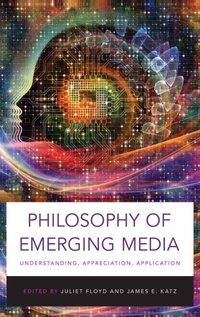
Philosophy of Emerging Media
Understanding, Appreciation, Application
Published on 14. January 2016
Book
Hardback
466 pages
978-0-19-026074-3 (ISBN)
Description
The term "emerging media " responds to the "big data " now available as a result of the larger role digital media play in everyday life, as well as the notion of "emergence " that has grown across the architecture of science and technology over the last two decades with increasing imbrication. The permeation of everyday life by emerging media is evident, ubiquitous, and destined to accelerate. No longer are images, institutions, social networks, thoughts, acts of communication, emotions and speech-the "media " by means of which we express ourselves in daily life-linked to clearly demarcated, stable entities and contexts. Instead, the loci of meaning within which these occur shift and evolve quickly, emerging in far-reaching ways we are only beginning to learn and bring about.
This volume's purpose is to develop, broaden and spark future philosophical discussion of emerging media and their ways of shaping and reshaping the habitus within which everyday lives are to be understood. Drawing from the history of philosophy ideas of influential thinkers in the past, intellectual path makers on the contemporary scene offer new philosophical perspectives, laying the groundwork for future work in philosophy and in media studies. On diverse topics such as identity, agency, reality, mentality, time, aesthetics, representation, consciousness, materiality, emergence, and human nature, the questions addressed here consider the extent to which philosophy should or should not take us to be facing a fundamental transformation.
This volume's purpose is to develop, broaden and spark future philosophical discussion of emerging media and their ways of shaping and reshaping the habitus within which everyday lives are to be understood. Drawing from the history of philosophy ideas of influential thinkers in the past, intellectual path makers on the contemporary scene offer new philosophical perspectives, laying the groundwork for future work in philosophy and in media studies. On diverse topics such as identity, agency, reality, mentality, time, aesthetics, representation, consciousness, materiality, emergence, and human nature, the questions addressed here consider the extent to which philosophy should or should not take us to be facing a fundamental transformation.
Reviews / Votes
"[T]his book is an excellent introduction to the philosophical issues concerning the emergent media. The breadth of philosophical scope and the variety of philosophical positions applied to the issues make it particularly valuable. It opens numerous paths to further development of genuinely philosophical approaches to the media from a varied menu of approaches that utilize most contemporary philosophical schools...the work is excellent in offering ideas forfurther development and application."
-- Notre Dame Philosophical Reviews
More details
Other editions
Additional editions
Book
01/2016
Oxford University Press Inc
€76.50
Shipment within 15-20 days
E-Book
11/2015
1st Edition
OUP eBook
€27.49
Available for download
E-Book
10/2015
1st Edition
OUP eBook
€33.99
Available for download
Persons
Juliet Floyd is Professor of Philosophy, Boston University. She is the author of many articles on the history of eighteenth and twentieth century philosophy of mathematics, logic, and aesthetics and co-editor of Future Pasts: The Analytic Tradition in Twentieth Century Philosophy (Oxford, 2001) and Philosophical Explorations of the Legacy of Alan Turing: Turing 100 (Springer, forthcoming).
James E. Katz is the Feld Professor of Emerging Media Studies at Boston University. Co-author of numerous books, including The Social Media President: Barack Obama and The Politics of Citizen Engagement, he also holds two patents. Prior to coming to Boston University in 2012, he was the Board of Governors Professor of Communication at Rutgers University.
James E. Katz is the Feld Professor of Emerging Media Studies at Boston University. Co-author of numerous books, including The Social Media President: Barack Obama and The Politics of Citizen Engagement, he also holds two patents. Prior to coming to Boston University in 2012, he was the Board of Governors Professor of Communication at Rutgers University.
Content
Introduction (Juliet Floyd and James E. Katz, Boston University) ; I. Ontology ; 1 Towards a Science of Emerging Media (Barry Smith, Buffalo) ; 2 Media and Their Emergence: The Ontology (Peter Simons, Trinity College Dublin) ; 3 New Realism and Media: From Documentality to Normativity (Maurizio Ferraris, Turin) ; 4 The Pygmalionic Gene: Neo-Romanticism for Emerging Media (Victor J. Krebs, Pontifical Catholic University of Peru) ; II. Perceptions, Perspectives, Transformations ; 5 Changing Philosophical Concerns about Emergence and Media as Emerging: The Long View ; (J.E. Katz, E. Robinson, Boston University) ; 6 Human Nature and Social Transformation (Gordon Graham, Princeton) ; 7 New Media, Old Concerns: Heidegger Revisited (Zsuzsanna Kondor, Hungarian Academy of Sciences) ; 8 From Traditional Documentation to Network Media (Neal Thomas, Univ. North Carolina Chapel Hill) ; III. Time, Fiction, Narrative ; 9 Emerging Media and the Philosophy of Time (Kristof Nyiri, Hungarian Academy of Sciences) ; 10 Bingewatching Television with Walt and Omar (Harvey Cormier, SUNY Stonybrook) ; 11 Media, Emergence and the Analogy of Art (John Haldane, Edinburgh/Notre Dame) ; 12 Sadness and Photography: Barthes and Benjamin (Ilit Ferber, Tel Aviv) ; IV. Emergence, Agency, Mind ; 13 Turing, Wittgenstein and Emergence (Juliet Floyd, Boston University) ; 14 Where is My Mind? Anscombe on Agency (Valerierie Aucouturier, Paris) ; 15 Agential Properties in Computer Games (John Richard Sageng, Oslo) ; 16 Will Emerging Media Create a Collective Mind? (David Ramsay Steele, Chicago) ; V. Symbols, Speech Acts ; 17 Plato and Aristotle on Writing (David Roochnik, Boston University) ; 18 Leibniz on Symbolism as a Cognitive Instrument (Sybille Kramer, Freie Universitat, Berlin) ; 19 Semantic and Pragmatic Stances toward Emerging Media (John Grey, Boston University) ; 20 Speech Acts and the Internet: Austin to Bourdieu and Fraenkel (Bruno Ambroise, CNRS) ; VI. Social Media, Big Data ; 21 Explorations in the Grammar of <"Being in touch>": From Locke to Winch, from SMS to Skype (Richard H.R. Harper, Microsoft Research) ; 22 Emerging Categories of Media Institutions (Lars Lundsten, Helsinki) ; 23 Philosophy of Critique: the New Media (Ronald E. Day, Indiana) ; 24 Big Data and The Big <"Conversation>" (Gary King, Harvard (interview)) ; CODA: Conclusion and a Perspective on Future Directions (Juliet Floyd, James Katz, and Elizabeth Robinson, Boston University)