

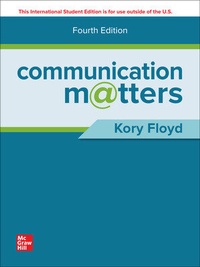
ISE Communication Matters
4th Edition
Will be published approx. on 9. March 2021
Book
Paperback/Softback
512 pages
978-1-260-59781-3 (ISBN)
Description
With a research-based, skills-focused approach to the Introduction to Communication course, Communication Matters debunks the often-held belief that good communication is based on personal instincts. Taking research and relevance a step further, Communication Matters helps students think critically about the communication they take part in every day.
More details
Edition
4th edition
Language
English
Place of publication
OH
United States
Target group
College/higher education
US School Grade: From College Freshman to College Graduate Student
Illustrations
55 Illustrations
Weight
916 gr
ISBN-13
978-1-260-59781-3 (9781260597813)
Copyright in bibliographic data and cover images is held by Nielsen Book Services Limited or by the publishers or by their respective licensors: all rights reserved.
Schweitzer Classification
Person
Kory Floyd is a professor of communication and professor of psychology at the University of Arizona. His research focuses on interpersonal communication in a variety of contexts, with particular focus on how positive communication contributes to well-being. He has written 16 books and more than 100 scientific papers and book chapters on the topics of interpersonal behavior, emotion, nonverbal behavior, and health. He is a former editor of Communication Monographs and Journal of Family Communication, and he is an elected fellow of the International Communication Association. His work has been recognized with the Charles H. Woolbert Award, the Bernard J. Brommel Award, and the Mark L. Knapp Award from the National Communication Association, as well as the Distinguished Scholar Award from the Western States Communication Association and the Early Career Achievement Award from the International Association for Relationship Research. As an educator, he teaches courses on interpersonal communication, communication theory, nonverbal communication, and quantitative research methods. Professor Floyd received his undergraduate degree from Western Washington University, his master's degree from the University of Washington, and his PhD from the University of Arizona.
Content
Part One: Communication in Principle
Chapter 1 Communication: A First Look
Chapter 2 Communication and Culture
Chapter 3 Perceiving Ourselves and Others
Chapter 4 How We Use Language
Chapter 5 Communicating Nonverbally
Chapter 6 Listening Effectively
Part Two: Communication in Context
Chapter 7 Communicating in Social and Professional Relationships
Chapter 8 Communicating in Intimate Relationships
Chapter 9 Communicating in Small Groups
Chapter 10 Decision Making and Leadership in Groups
Part Three: Communication in the Public Sphere
Chapter 11 Choosing, Developing, and Researching a Topic
Chapter 12 Organizing and Finding Support for Your Speech
Chapter 13 Presenting a Speech Confidently and Competently
Chapter 14 Speaking Informatively
Chapter 15 Speaking Persuasively
Appendix: Workplace Communication and Interviewing
Create-Only Chapters
Chapter 16 Communicating in Organizations
Chapter 17 Communication and Media
Chapter 18 Communication and Health
Chapter 1 Communication: A First Look
Chapter 2 Communication and Culture
Chapter 3 Perceiving Ourselves and Others
Chapter 4 How We Use Language
Chapter 5 Communicating Nonverbally
Chapter 6 Listening Effectively
Part Two: Communication in Context
Chapter 7 Communicating in Social and Professional Relationships
Chapter 8 Communicating in Intimate Relationships
Chapter 9 Communicating in Small Groups
Chapter 10 Decision Making and Leadership in Groups
Part Three: Communication in the Public Sphere
Chapter 11 Choosing, Developing, and Researching a Topic
Chapter 12 Organizing and Finding Support for Your Speech
Chapter 13 Presenting a Speech Confidently and Competently
Chapter 14 Speaking Informatively
Chapter 15 Speaking Persuasively
Appendix: Workplace Communication and Interviewing
Create-Only Chapters
Chapter 16 Communicating in Organizations
Chapter 17 Communication and Media
Chapter 18 Communication and Health