

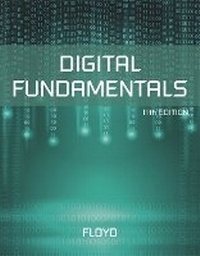
Digital Fundamentals
11th Edition
Published on 13. January 2015
Book
Hardback
912 pages
978-0-13-273796-8 (ISBN)
Description
Digital Fundamentals, Eleventh Edition, continues its long and respected tradition of offering students a strong foundation in the core fundamentals of digital technology, providing basic concepts reinforced by plentiful illustrations, examples, exercises, and applications. The text's teaching and learning resources include an Instructor's Manual, PowerPoint lecture slides, and Test Bank, as well as study resources for students.
Teaching and Learning Experience:
Provides a strong foundation in the core fundamentals of digital technology.
Covers basic concepts reinforced by plentiful illustrations, examples, exercises, and applications.
Offers a full-color design, effective chapter organization, and clear writing that help students grasp complex concepts.
Teaching and Learning Experience:
Provides a strong foundation in the core fundamentals of digital technology.
Covers basic concepts reinforced by plentiful illustrations, examples, exercises, and applications.
Offers a full-color design, effective chapter organization, and clear writing that help students grasp complex concepts.
More details
Other editions
Previous edition
Thomas L. Floyd
Digital Fundamentals
Book
05/2008
10th Edition
Pearson
€167.12
Article exhausted; check for reprint
Content
1. Digital Concepts.
2. Number Systems, Operations, and Codes.
3. Logic Gates.
4. Boolean Algebra and Logic Simplification.
5. Combinational Logic Analysis.
6. Functions of Combinational Logic.
7. Latches, Flip-Flops, and Timers.
8. Shift Registers.
9. Counters.
10. Programmable Logic.
11. Data Storage
12. Signal Conversion and Processing.
13. Data Transmission.
14. Data Processing.
15. Integrated Circuit Technologies.
2. Number Systems, Operations, and Codes.
3. Logic Gates.
4. Boolean Algebra and Logic Simplification.
5. Combinational Logic Analysis.
6. Functions of Combinational Logic.
7. Latches, Flip-Flops, and Timers.
8. Shift Registers.
9. Counters.
10. Programmable Logic.
11. Data Storage
12. Signal Conversion and Processing.
13. Data Transmission.
14. Data Processing.
15. Integrated Circuit Technologies.