

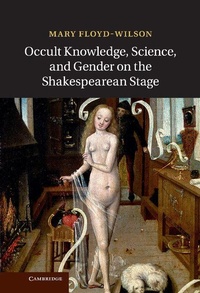
Occult Knowledge, Science, and Gender on the Shakespearean Stage
Published on 11. July 2013
Book
Hardback
250 pages
978-1-107-03632-1 (ISBN)
Description
Belief in spirits, demons and the occult was commonplace in the early modern period, as was the view that these forces could be used to manipulate nature and produce new knowledge. In this groundbreaking study, Mary Floyd-Wilson explores these beliefs in relation to women and scientific knowledge, arguing that the early modern English understood their emotions and behavior to be influenced by hidden sympathies and antipathies in the natural world. Focusing on Twelfth Night, Arden of Faversham, A Warning for Fair Women, All's Well That Ends Well, The Changeling and The Duchess of Malfi, she demonstrates how these plays stage questions about whether women have privileged access to nature's secrets and whether their bodies possess hidden occult qualities. Discussing the relationship between scientific discourse and the occult, she goes on to argue that as experiential evidence gained scientific ground, women's presumed intimacy with nature's secrets was either diminished or demonized.
Reviews / Votes
'... [a] rich, well-researched volume ... This valuable book illuminates underexplored aspects of early modern thought, with important consequences for understanding the period's plays. Highly recommended. Upper-division undergraduates through faculty.' T. Pollard, Choice '... [it] sheds new light on the development of science from early modern to modern ... The sheer breadth of knowledge in this book will make it an appealing read for students of Shakespearian performance, gender studies, the history of science, and the history of the book.' Benjamin C. Miele, The Shakespeare Newsletter '[Floyd-Wilson's] clarity and simplicity of style and wealth of documentation increase her reader's pleasure. This book reminds us that the original, though now rare, meaning of occult is 'secret or hidden'. [The book] focuses on an area between God's Providence and the Devil's interference, where an animate, mysterious natural world challenged early modern men and women to discover its occult secrets.' Barbara H. Traister, Renaissance QuarterlyMore details
Language
English
Place of publication
Cambridge
United Kingdom
Target group
Professional and scholarly
Illustrations
3 Halftones, unspecified
Dimensions
Height: 235 mm
Width: 157 mm
Thickness: 18 mm
Weight
518 gr
ISBN-13
978-1-107-03632-1 (9781107036321)
Copyright in bibliographic data and cover images is held by Nielsen Book Services Limited or by the publishers or by their respective licensors: all rights reserved.
Schweitzer Classification
Other editions
Additional editions
Mary Floyd-Wilson
Occult Knowledge, Science, and Gender on the Shakespearean Stage
Book
10/2015
Cambridge University Press
€48.90
Shipment within 15-20 days
Mary Floyd-Wilson
Occult Knowledge, Science, and Gender on the Shakespearean Stage
E-Book
07/2013
1st Edition
Cambridge University Press
€26.49
Available for download
Mary Floyd-Wilson
Occult Knowledge, Science, and Gender on the Shakespearean Stage
E-Book
07/2013
Cambridge University Press
€23.49
Available for download
Person
Mary Floyd-Wilson is Associate Professor of English and Comparative Literature at the University of North Carolina, Chapel Hill. A recipient of a National Humanities Center Fellowship, she is the author of English Ethnicity and Race in Early Modern Drama (2006) and the co-editor of Reading the Early Modern Passions: A Cultural History of Emotions (with Gail Kern Paster and Katherine Rowe, 2004) and Embodiment and Environment in Early Modern England (with Garrett A. Sullivan, Jr, 2007). She has published articles in Shakespeare Quarterly, English Literary Renaissance, Early Modern Literary Studies and Shakespeare Studies, and has co-edited a special issue of Renaissance Drama.
Content
Introduction: secret sympathies; 1. Women's secrets and the status of evidence in All's Well That Ends Well; 2. Sympathetic contagion in Arden of Faversham and A Warning for Fair Women; 3. 'As secret as maidenhead': magnetic wombs and the nature of attraction in Shakespeare's Twelfth Night; 4. Tragic antipathies in The Changeling; 5. 'To think there's power in potions': experiment, sympathy, and the devil in The Duchess of Malfi; Coda.