

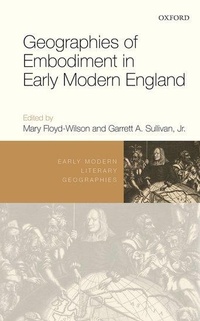
Geographies of Embodiment in Early Modern England
Published on 15. April 2020
Book
Hardback
296 pages
978-0-19-885274-2 (ISBN)
Description
Geographies of Embodiment in Early Modern England gathers essays from prominent scholars of English Renaissance literature and history who have made substantial contributions to the study of early modern embodiment, historical phenomenology, affect, cognition, memory, and natural philosophy. It provides new interpretations of the geographic dimensions of early modern embodiment, emphasizing the transactional and dynamic aspects of the relationship between body and world.
The geographies of embodiment encompass both cognitive processes and cosmic environments, and inner emotional states as well as affective landscapes. Rather than always being territorialized onto individual bodies, ideas about early modern embodiment are varied both in their scope and in terms of their representation. Reflecting this variety, this volume offers up a range of inquiries into how early modern writers accounted for the exchanges between the microcosm and macrocosm. It engages with Gail Kern Paster's groundbreaking scholarship on embodiment, humoralism, the passions, and historical phenomenology throughout, and offers new readings of Edmund Spenser, William Shakespeare, Thomas Nashe, John Milton, and others. Contributions consider the epistemiologies of navigation and cartography, the significance of geohumoralism, the ethics of self-mastery, theories of early modern cosmology, the construction of place memory, and perceptions of an animate spirit world.
The geographies of embodiment encompass both cognitive processes and cosmic environments, and inner emotional states as well as affective landscapes. Rather than always being territorialized onto individual bodies, ideas about early modern embodiment are varied both in their scope and in terms of their representation. Reflecting this variety, this volume offers up a range of inquiries into how early modern writers accounted for the exchanges between the microcosm and macrocosm. It engages with Gail Kern Paster's groundbreaking scholarship on embodiment, humoralism, the passions, and historical phenomenology throughout, and offers new readings of Edmund Spenser, William Shakespeare, Thomas Nashe, John Milton, and others. Contributions consider the epistemiologies of navigation and cartography, the significance of geohumoralism, the ethics of self-mastery, theories of early modern cosmology, the construction of place memory, and perceptions of an animate spirit world.
More details
Series
Language
English
Place of publication
Oxford
United Kingdom
Target group
Professional and scholarly
Product notice
sewn/stitched
Cloth over boards
Dimensions
Height: 217 mm
Width: 142 mm
Thickness: 26 mm
Weight
512 gr
ISBN-13
978-0-19-885274-2 (9780198852742)
Copyright in bibliographic data and cover images is held by Nielsen Book Services Limited or by the publishers or by their respective licensors: all rights reserved.
Schweitzer Classification
Other editions
Additional editions
Mary Floyd-Wilson | Garrett A. Sullivan
Geographies of Embodiment in Early Modern England
E-Book
04/2020
1st Edition
OUP eBook
€56.49
Available for download
Mary Floyd-Wilson | Garrett A. Sullivan
Geographies of Embodiment in Early Modern England
E-Book
04/2020
1st Edition
OUP eBook
€47.99
Available for download
Persons
Professor Mary Floyd-Wilson teaches in the Department of English and Comparative Literature at the University of North Carolina at Chapel Hill. She is the author of English Ethnicity and Race in Early Modern Drama and Occult Knowledge, Science, and Gender on the Shakespearean Stage. She has co-edited with Garrett A. Sullivan, Jr. the essay collection Environment and Embodiment in Early Modern England and Reading the Early Modern Passions: Essays in the Cultural History of Emotion with Gail Kern Paster and Katherine Rowe. She and Darryl Chalk have co-edited the forthcoming volume Contagion and the Shakespearean Stage, and she is currently writing a book about the early modern English devil.
Professor Garrett A. Sullivan, Jr. teaches in the Department of English at Pennsylvania State University. He is the author of The Drama of Landscape: Land, Property and Social Relations on the Early Modern Stage; Memory and Forgetting in English Renaissance Drama: Shakespeare, Marlowe, Webster; and Sleep, Romance and Human Embodiment: Vitality from Spenser to Milton. With Mary Floyd-Wilson, he has co-edited Environment and Embodiment in Early Modern England. He co-edits with Julie Sanders the Oxford University Press book series Early Modern Literary Geographies.
Professor Garrett A. Sullivan, Jr. teaches in the Department of English at Pennsylvania State University. He is the author of The Drama of Landscape: Land, Property and Social Relations on the Early Modern Stage; Memory and Forgetting in English Renaissance Drama: Shakespeare, Marlowe, Webster; and Sleep, Romance and Human Embodiment: Vitality from Spenser to Milton. With Mary Floyd-Wilson, he has co-edited Environment and Embodiment in Early Modern England. He co-edits with Julie Sanders the Oxford University Press book series Early Modern Literary Geographies.
Content
1: Mary Floyd-Wilson and Garrett A. Sullivan Jr.: Introduction
2: Michael Schoenfeldt: How gardens feel: The natural history of sensation in Spenser and Milton
3: Jonathan Gil Harris: Hi mho ji kudd: The transformation of Thomas Stephens in Goa
4: Valerie Traub: Anatomy, cartography, and the new world body
5: John Sutton: Place and memory: History, cognition, phenomenology
6: Mary Thomas Crane: Meteorology, embodiment, and environment in Shakespeare's A Midsummer Night's Dream
7: Kristen Poole: "My hand would dissolve, or seem to melt": Poetic dissolution and Stoic cosmology
8: Julian Yates: Passions of the flock
9: Elizabeth D. Harvey: Speaking (of) faces: The gestural body in Measure for Measure
10: Garrett A. Sullivan Jr.: Sleeping in error in Spenser's Faerie Queene, book 1
11: Mary Floyd-Wilson: The habitation of airy nothings in A Midsummer Night's Dream
12: Gail Kern Paster: Afterword
2: Michael Schoenfeldt: How gardens feel: The natural history of sensation in Spenser and Milton
3: Jonathan Gil Harris: Hi mho ji kudd: The transformation of Thomas Stephens in Goa
4: Valerie Traub: Anatomy, cartography, and the new world body
5: John Sutton: Place and memory: History, cognition, phenomenology
6: Mary Thomas Crane: Meteorology, embodiment, and environment in Shakespeare's A Midsummer Night's Dream
7: Kristen Poole: "My hand would dissolve, or seem to melt": Poetic dissolution and Stoic cosmology
8: Julian Yates: Passions of the flock
9: Elizabeth D. Harvey: Speaking (of) faces: The gestural body in Measure for Measure
10: Garrett A. Sullivan Jr.: Sleeping in error in Spenser's Faerie Queene, book 1
11: Mary Floyd-Wilson: The habitation of airy nothings in A Midsummer Night's Dream
12: Gail Kern Paster: Afterword